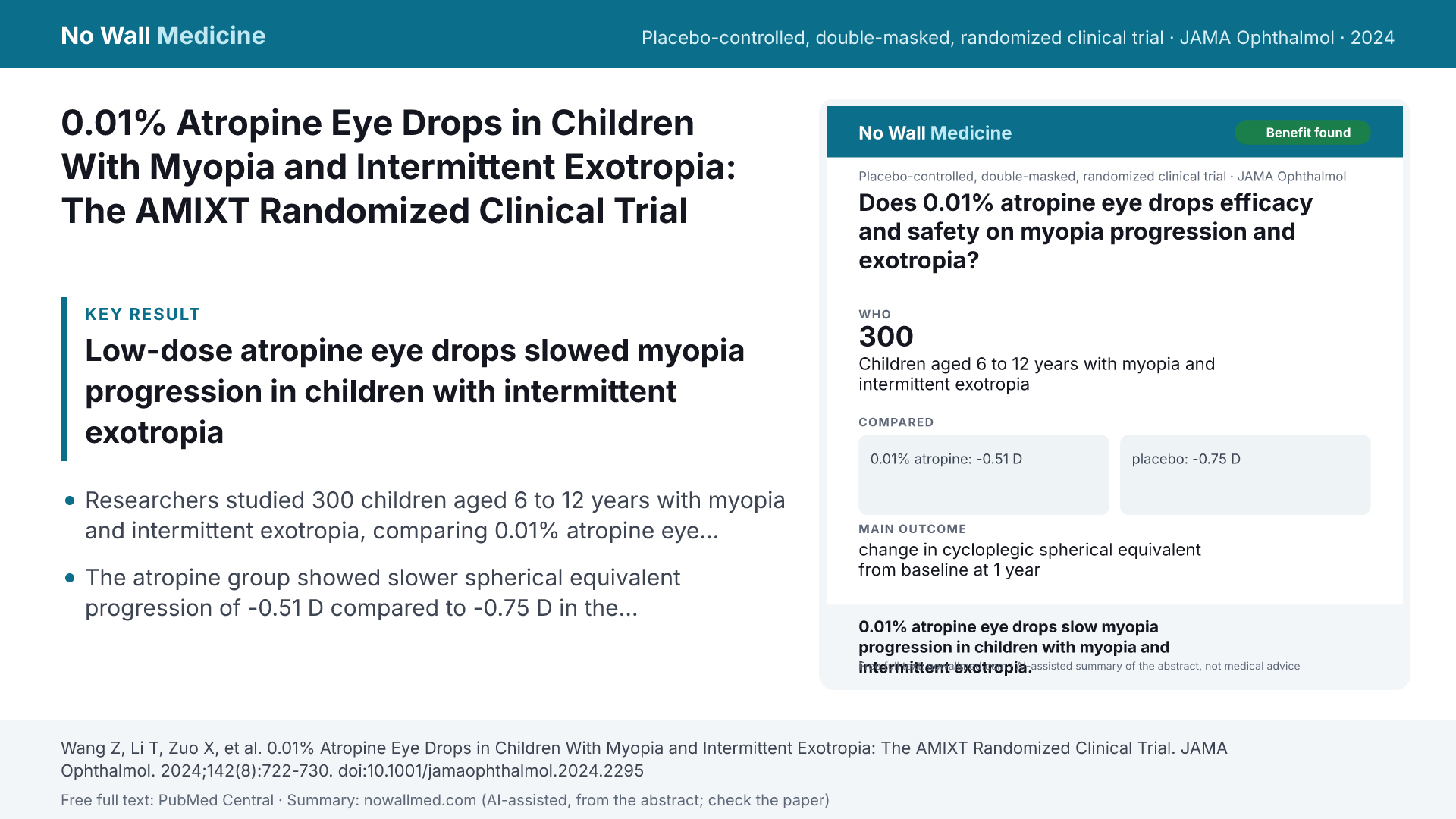
Low-dose atropine eye drops slowed myopia progression in children with intermittent exotropia
0.01% Atropine Eye Drops in Children With Myopia and Intermittent Exotropia: The AMIXT Randomized Clinical Trial
Placebo-controlled, double-masked, randomized clinical trialBenefit found
Does 0.01% atropine eye drops efficacy and safety on myopia progression and exotropia?
Who
300
Children aged 6 to 12 years with myopia and intermittent exotropia
Compared
0.01% atropine: -0.51 D
placebo: -0.75 D
Main outcome
change in cycloplegic spherical equivalent from baseline at 1 year
Result: difference = 0.24 D; 95% CI, 0.11-0.37 D
Bottom line: 0.01% atropine eye drops slow myopia progression in children with myopia and intermittent exotropia.
JAMA Ophthalmol · 2024-07-03 · Save PNG
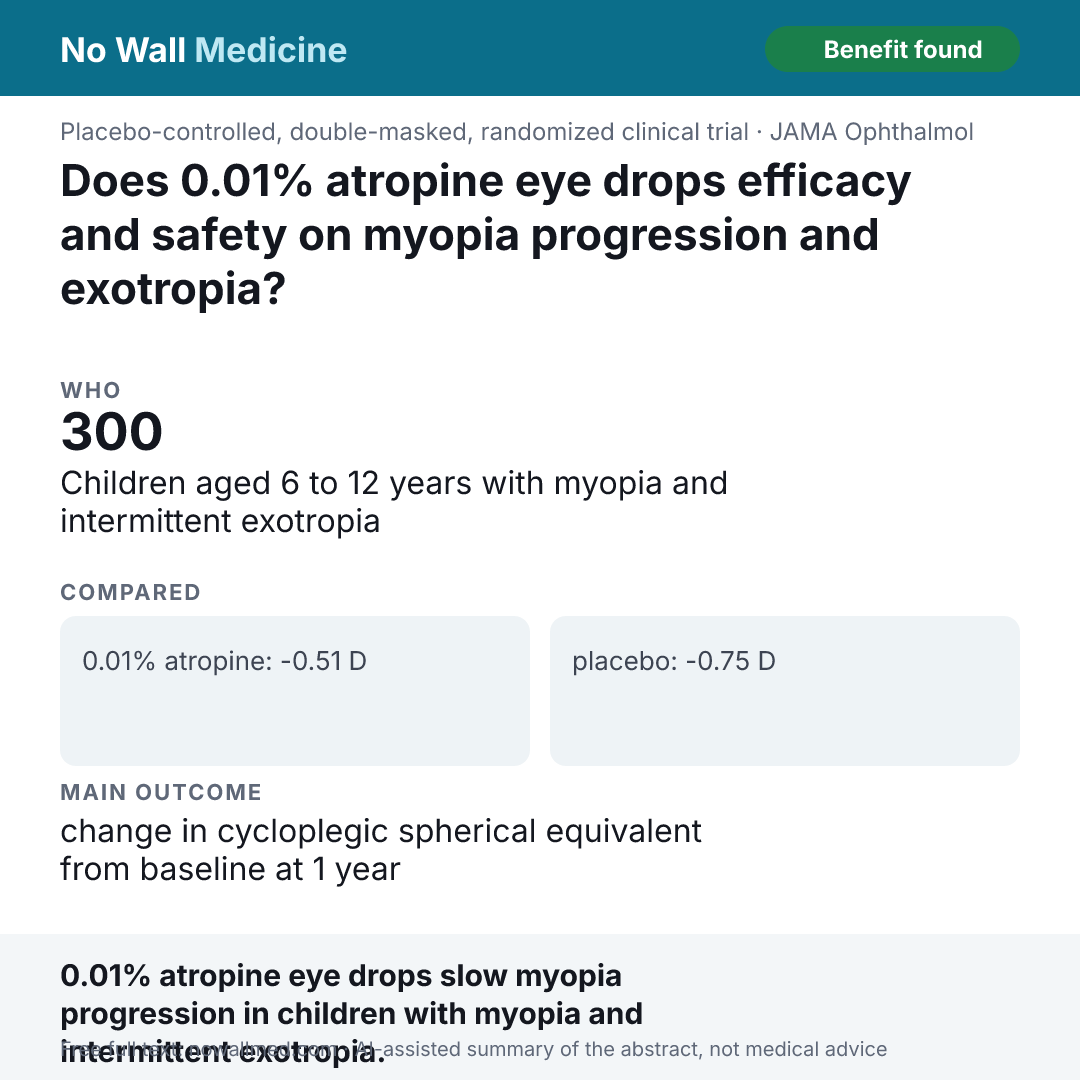
Clinical question: Does 0.01% atropine eye drops efficacy and safety on myopia progression and exotropia?
Key points
- Researchers studied 300 children aged 6 to 12 years with myopia and intermittent exotropia, comparing 0.01% atropine eye drops to a placebo over 12 months.
- The atropine group showed slower spherical equivalent progression of -0.51 D compared to -0.75 D in the placebo group, and slower eye axial length elongation of 0.31 mm versus 0.42 mm.
- The atropine group experienced a mean accommodative amplitude change of -3.06 D compared to 0.12 D in the placebo group, and photophobia occurred in 6.0% of the atropine group.
Headline and key points written with AI from the paper’s abstract, with every number checked against it. Read the paper before relying on them.
Was this summary helpful?
Subject terms
Headline, design, result, key points, caveat and citation as plain text.
Cite this article
Wang Z, Li T, Zuo X, et al. 0.01% Atropine Eye Drops in Children With Myopia and Intermittent Exotropia: The AMIXT Randomized Clinical Trial. JAMA Ophthalmol. 2024;142(8):722-730. doi:10.1001/jamaophthalmol.2024.2295
Spotted a mistake? Suggest a correction