10-Year Follow-Up After Revascularization in Elderly Patients With Complex Coronary Artery Disease
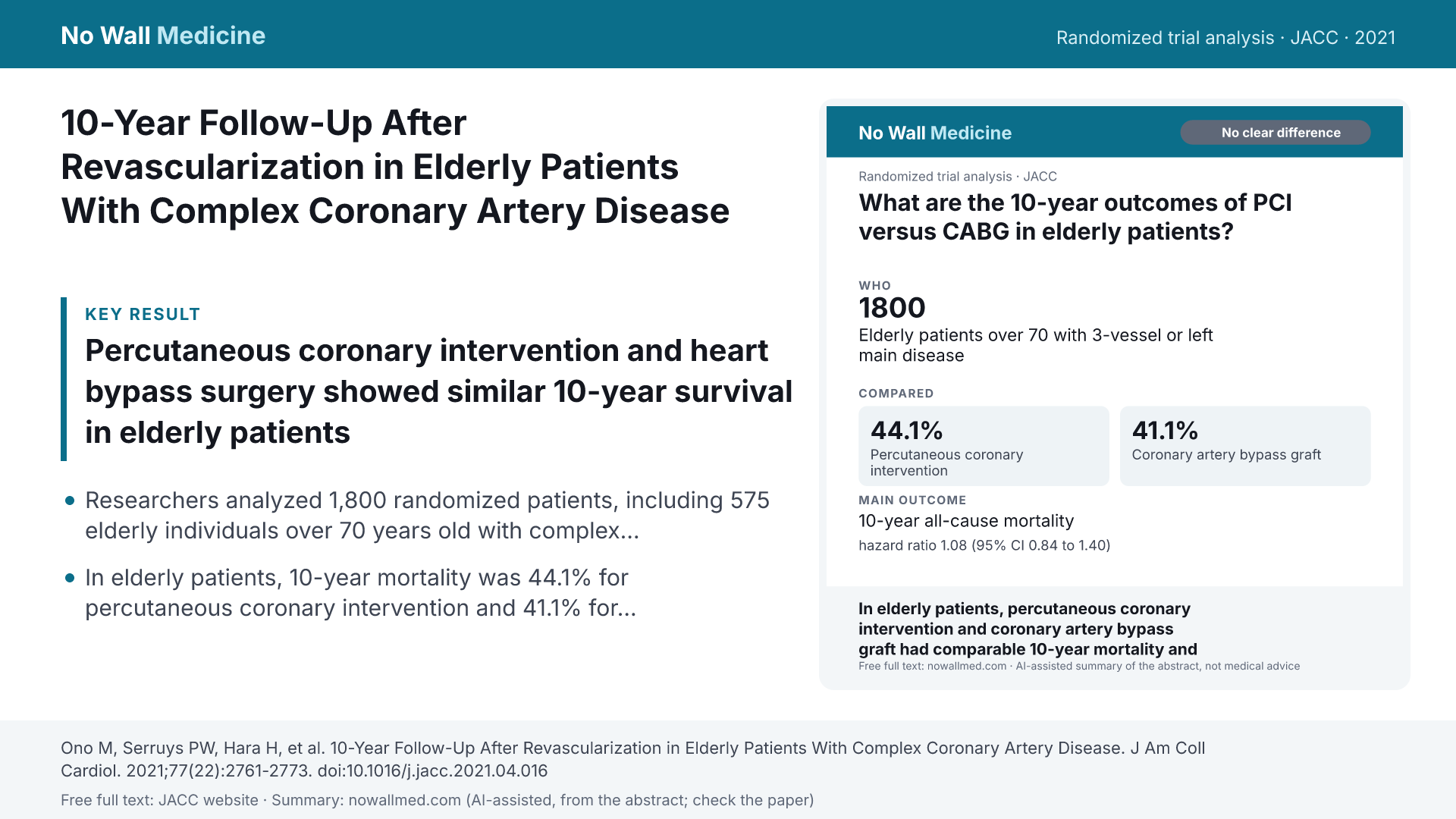
Key result: Percutaneous coronary intervention and heart bypass surgery showed similar 10-year survival in elderly patients
Randomized trial analysisNo clear difference
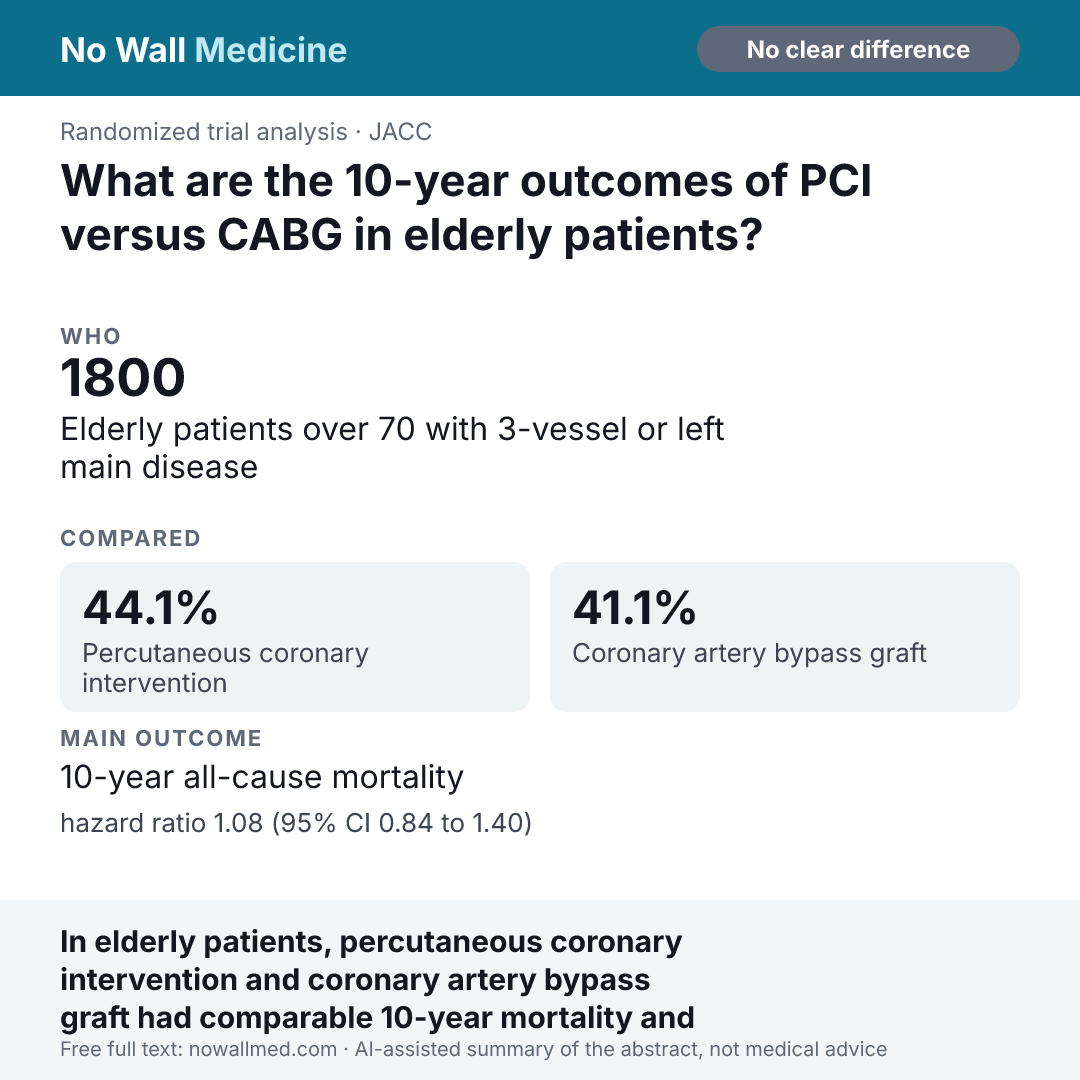
What are the 10-year outcomes of PCI versus CABG in elderly patients?
Who
1800
Elderly patients over 70 with 3-vessel or left main disease
Compared
44.1%Percutaneous coronary intervention
41.1%Coronary artery bypass graft
Main outcome
10-year all-cause mortality
Result: hazard ratio 1.08 (95% CI 0.84 to 1.40)
Bottom line: In elderly patients, percutaneous coronary intervention and coronary artery bypass graft had comparable 10-year mortality and 5-year outcomes.
JACC · 2021-06-04 · Save PNG
Key points
- Researchers analyzed 1,800 randomized patients, including 575 elderly individuals over 70 years old with complex coronary artery disease.
- In elderly patients, 10-year mortality was 44.1% for percutaneous coronary intervention and 41.1% for coronary artery bypass surgery.
- Among elderly patients, 5-year major adverse cardiac or cerebrovascular events were 39.4% for percutaneous coronary intervention and 35.1% for coronary artery bypass surgery.
Discussion prompts
- Would these patients look like yours? Who was left out?
- Is the main outcome one that matters to patients?
- Is the difference large enough to change what you do?
Cite: Ono M, Serruys PW, Hara H, et al. 10-Year Follow-Up After Revascularization in Elderly Patients With Complex Coronary Artery Disease. J Am Coll Cardiol. 2021;77(22):2761-2773. doi:10.1016/j.jacc.2021.04.016
Free full text: JACC website · Summary and visual abstract: nowallmed.com/a/10-year-follow-up-after-revascularization-in-elderly-patients-with-1mfojii/ (AI-assisted from the abstract; check the paper before relying on it).