Nirsevimab showed 82.7% efficacy against RSV-associated lower respiratory tract infection hospitalisations in infants
180-day efficacy of nirsevimab against hospitalisation for respiratory syncytial virus lower respiratory tract infections in infants (HARMONIE): a randomised, controlled, phase 3b trial
Randomised, open-label, parallel arm, phase 3b trialBenefit found
Does nirsevimab efficacy against RSV-associated lower respiratory tract infection hospitalisation last 180 days?
Who
8057
Infants aged 12 months or younger born at 29 weeks gestation · France, Germany, and the UK
Compared
0.3%nirsevimab
1.7%standard care
Main outcome
Hospitalisations due to respiratory syncytial virus-associated lower respiratory tract infection
Result: 82.7% (95% CI 67.8-91.5)
Bottom line: Nirsevimab provides consistent and sustained protection against RSV-associated lower respiratory tract infection hospitalisation for at least 6 months.
Funded by: Sanofi and AstraZeneca
Lancet Child Adolesc Health · 2025-05-17Download image
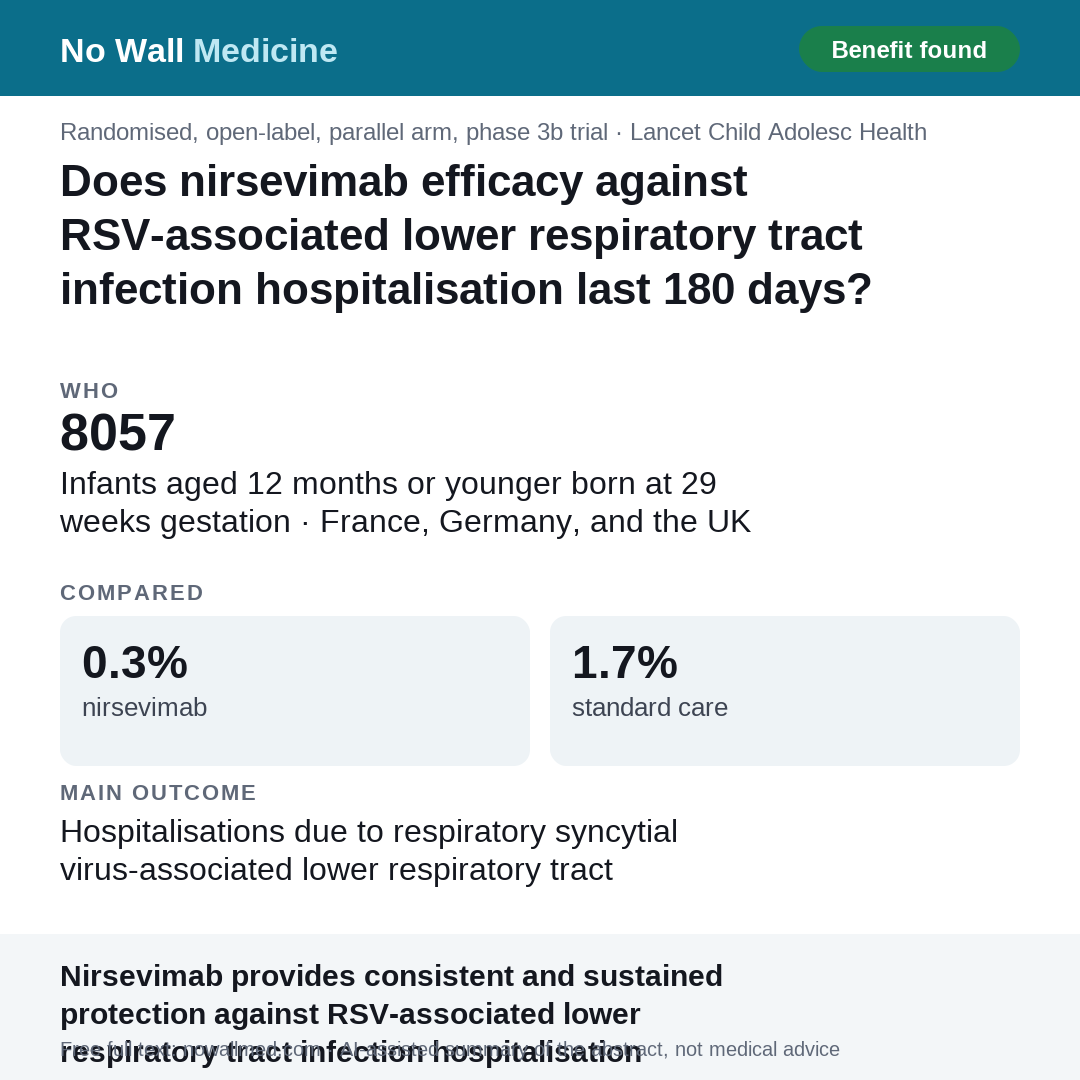
Clinical question: Does nirsevimab efficacy against RSV-associated lower respiratory tract infection hospitalisation last 180 days?
Why it matters: Researchers wanted to evaluate if nirsevimab provides protection against RSV-associated lower respiratory tract infection hospitalisations for at least 180 days after dosing.
In absolute numbers
nirsevimab: 0.3% · standard care: 1.7% → a difference of 1.4 percentage points, so about 72 people would need the treatment for 1 more to benefit (number needed to treat) over the trial’s follow-up.
Worked out by us from the two group results above, not reported by the authors. Check the paper for the exact outcome and timing.
Key points
- The study randomized 8057 infants aged 12 months or younger to receive either a single dose of nirsevimab or standard care.
- Up to 180 days, 12 (0.3%) infants in the nirsevimab group and 68 (1.7%) in the standard care group were hospitalized for RSV-associated lower respiratory tract infection.
- Most participants experienced grade 1 or grade 2 treatment-emergent adverse events, and no apparent safety concerns were raised up to 365 days after dosing.
Headline and key points written with AI from the paper’s abstract, with every number checked against it. Read the paper before relying on them.
Was this summary helpful?
Abstract
Background
Respiratory syncytial virus (RSV) is a leading cause of lower respiratory tract infection and hospitalisations in infants worldwide. The primary analyses of HARMONIE showed that nirsevimab reduced infant hospitalisations due to RSV-associated lower respiratory tract infection through the RSV season. This analysis aims to evaluate nirsevimab's efficacy at 180 days after dosing, a period exceeding the typical 5-month RSV season. Methods
HARMONIE is an ongoing, open-label, parallel arm, randomised, controlled, phase 3b study conducted in France, Germany, and the UK. Infants aged 12 months or younger, born at a gestational age of at least 29 weeks, were randomly assigned (1:1) to receive either a single intramuscular dose of nirsevimab (50 mg for children <5 kg or 100 mg for children ≥5 kg) or standard care (without RSV prophylaxis) before or during their first RSV season. Randomisation was electronically done, stratified by country and age-group. The primary efficacy endpoint for this analysis was the incidence of hospitalisations due to RSV-associated lower respiratory tract infection up to 180 days after nirsevimab administration or randomisation in all randomised participants. Safety up to 365 days following nirsevimab administration was also assessed. This trial is ongoing and registered with ClinicalTrials.gov, number NCT05437510. Findings
Between Aug 8, 2022, and Feb 28, 2023, 8057 infants were randomly assigned to either the nirsevimab group (n=4038) or the standard care group (n=4019). The median age at randomisation was 4·00 months (IQR 1·0-7·0; range 0·0-12·0, and 4195 (52·1%) were male and 3862 (47·9%) were female. Up to 180 days, 12 (0·3%) of 4038 infants in the nirsevimab group and 68 (1·7%) of 4019 infants in the standard care group had been hospitalised for RSV-associated lower respiratory tract infection, corresponding to a nirsevimab efficacy of 82·7% (95% CI 67·8-91·5; p<0·0001). Most participants experienced grade 1 (2759 [68·7%] of 4016 in the nirsevimab group; 2696 [67·1%] of 4018 in the standard care group) or grade 2 (1447 [36·0%] of 4016 in the nirsevimab group; 1436 [35·7%] of 4018 in the standard care group) treatment-emergent adverse events, and no apparent safety concerns were raised up to 365 days after dosing. Interpretation
Nirsevimab offers consistent and sustained protection against hospitalisation due to RSV-associated lower respiratory tract infection for at least 6 months. This finding provides global health systems greater flexibility when implementing nirsevimab, providing substantial benefit in the ongoing effort to reduce the burden of infant RSV and the potential wider public health value. Funding
Sanofi and AstraZeneca.
Abstract reproduced under the article’s CC BY licence.
Subject terms
Cite this article
Munro APS, Drysdale SB, Cathie K, Flamein F, Knuf M, Collins AM. 180-day efficacy of nirsevimab against hospitalisation for respiratory syncytial virus lower respiratory tract infections in infants (HARMONIE): a randomised, controlled, phase 3b trial. Lancet Child Adolesc Health. 2025. doi:10.1016/S2352-4642(25)00102-6
Spotted a mistake? Suggest a correction
Top studies every Monday
The week’s key trials and guidelines in your specialties, plus any topics you follow. By email, free.
Get the weekly digest