Tetrasodium EDTA locking fluid reduced complications for central venous access devices in intensive care patients
4% Tetrasodium EDTA to Prevent Central Venous Access Device-Associated Complications: A Randomized Clinical Trial
Pragmatic, triple-blind, multicenter, cluster-randomized crossover trialBenefit found
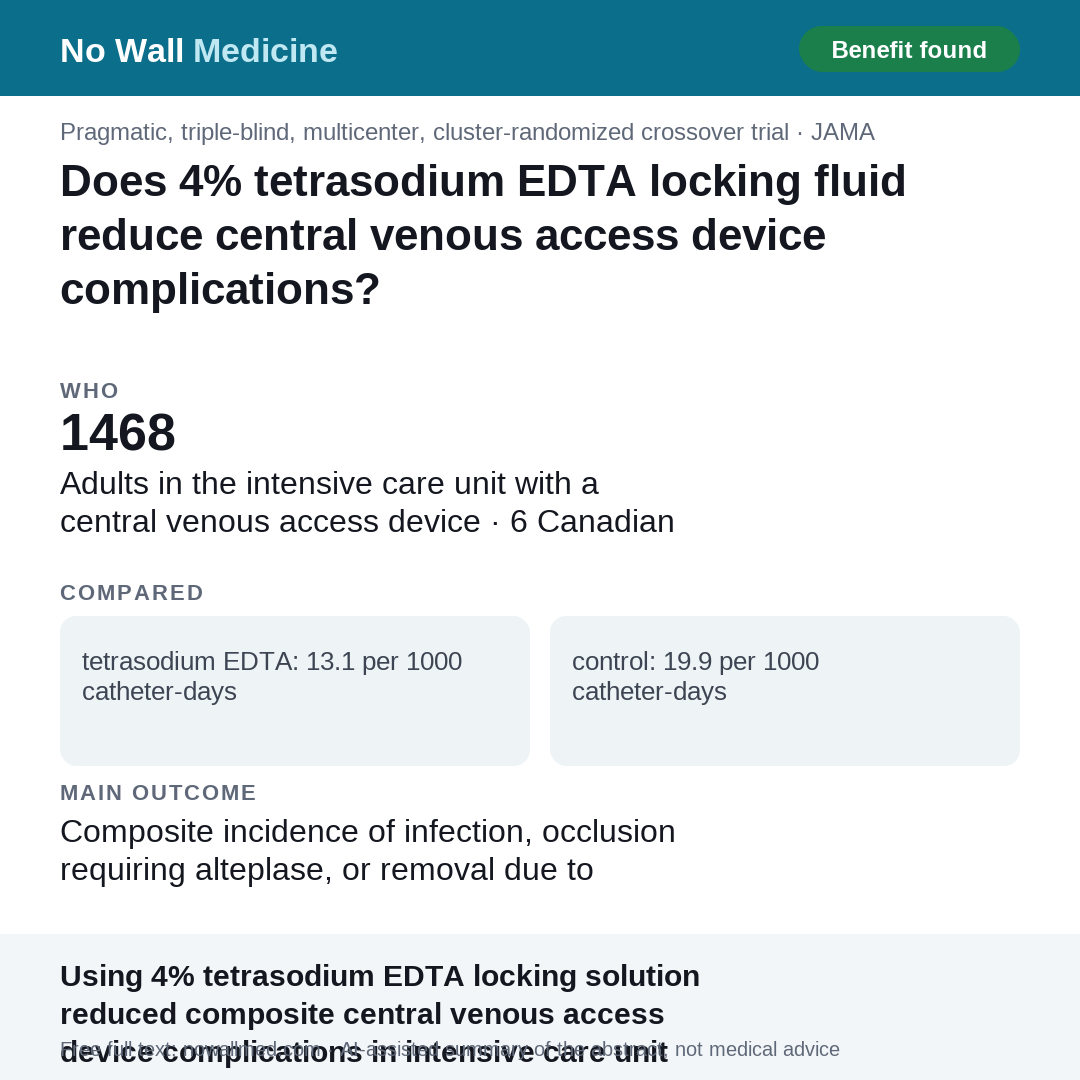
Does 4% tetrasodium EDTA locking fluid reduce central venous access device complications?
Who
1468
Adults in the intensive care unit with a central venous access device · 6 Canadian hospitals
Compared
tetrasodium EDTA: 13.1 per 1000 catheter-days
control: 19.9 per 1000 catheter-days
Main outcome
Composite incidence of infection, occlusion requiring alteplase, or removal due to occlusion
Result: rate ratio 0.68 (95% CI 0.47-0.96)
Bottom line: Using 4% tetrasodium EDTA locking solution reduced composite central venous access device complications in intensive care unit patients.
JAMA · 2026-05-18Download image
Clinical question: Does 4% tetrasodium EDTA locking fluid reduce central venous access device complications?
Why it matters: Central venous access devices can lead to bloodstream infections, catheter blockages, or blood clots in the vein.
Key points
- Researchers studied 1468 adult intensive care patients across six Canadian hospitals to compare 4% tetrasodium EDTA with control locking fluids.
- The tetrasodium EDTA group had a lower composite incidence rate of infections, blockages, or catheter removals at 13.1 per 1000 catheter-days versus 19.9 per 1000 catheter-days.
- Only the rate of catheter blockages requiring the use of alteplase, a clot-dissolving medication, showed a significant difference between the two groups.
Headline and key points written with AI from the paper’s abstract, with every number checked against it. Read the paper before relying on them.
Topics
Spotted a mistake? Suggest a correction