Forty hertz brain stimulation improved cognition and memory in patients with mild Alzheimer's disease
40 Hz biparietal transcranial alternating current stimulation for Alzheimer's disease: a prospective study
Randomized prospective studyBenefit found
Is biparietal 40 Hz transcranial alternating current stimulation effective for Alzheimer's disease?
Who
Patients with mild Alzheimer's disease · First Hospital of Hebei Medical University
Compared
tACS group: improvements in global cognition, memory, language, attention, and executive functions
Sham group: clinical efficacies were not obvious
Main outcome
global cognition, memory, language, attention, executive functions, and neuropsychiatric inventory scores
Bottom line: Biparietal 40 Hz transcranial alternating current stimulation is a potentially safe and effective treatment for mild Alzheimer's disease.
BMC Med · 2026-06-26Download image
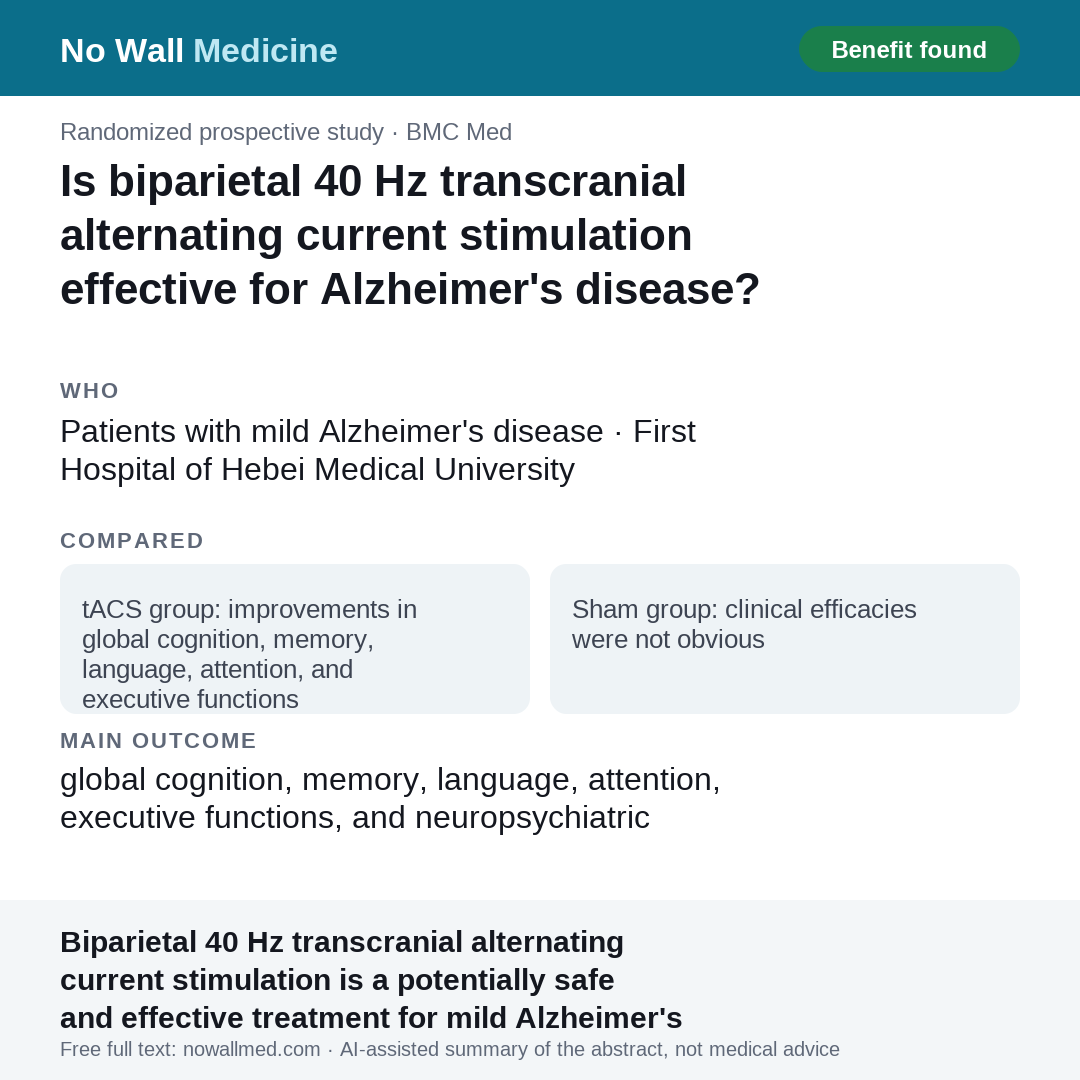
Clinical question: Is biparietal 40 Hz transcranial alternating current stimulation effective for Alzheimer's disease?
Why it matters: Alzheimer's disease is characterized by dysfunction in multiple cognitive domains and dysregulation of brain oscillations in the temporal and parietal lobes.
Key points
- Researchers studied patients with mild Alzheimer's disease who received either 40 Hz transcranial alternating current stimulation or a sham stimulation for 15 consecutive days.
- The stimulation group showed improvements in global cognition, memory, language, attention, and executive functions compared to their scores before treatment.
- Patients receiving the active stimulation also showed decreased neuropsychiatric inventory scores and enhanced connectivity within the default mode network.
Headline and key points written with AI from the paper’s abstract, with every number checked against it. Read the paper before relying on them.
Topics
Spotted a mistake? Suggest a correction
More in Neurology
Automated model correctly identified 68 out of 90 seizure events as epileptic or nonepileptic
Video-Based Automated Seizure Classification Using Multimodal Large Language Models
Neuroimmune interactions contribute to migraine headache generation
Cortical and meningeal neuroimmune interactions contribute to the generation of migraine headaches
Pain and depressive symptoms linked to lower cognitive performance in older adults
Joint trajectories of pain and depressive symptoms in relation to repeated cognitive performance: a harmonized longitudinal analysis of four aging cohorts
AD biomarker-positive participants with DLB had faster cognitive decline than biomarker-negative ones
Biomarker-informed differences in treatment-associated cognitive decline in dementia with Lewy bodies