Long-term follow-up shows similar reintervention risks for two heavy menstrual bleeding treatments
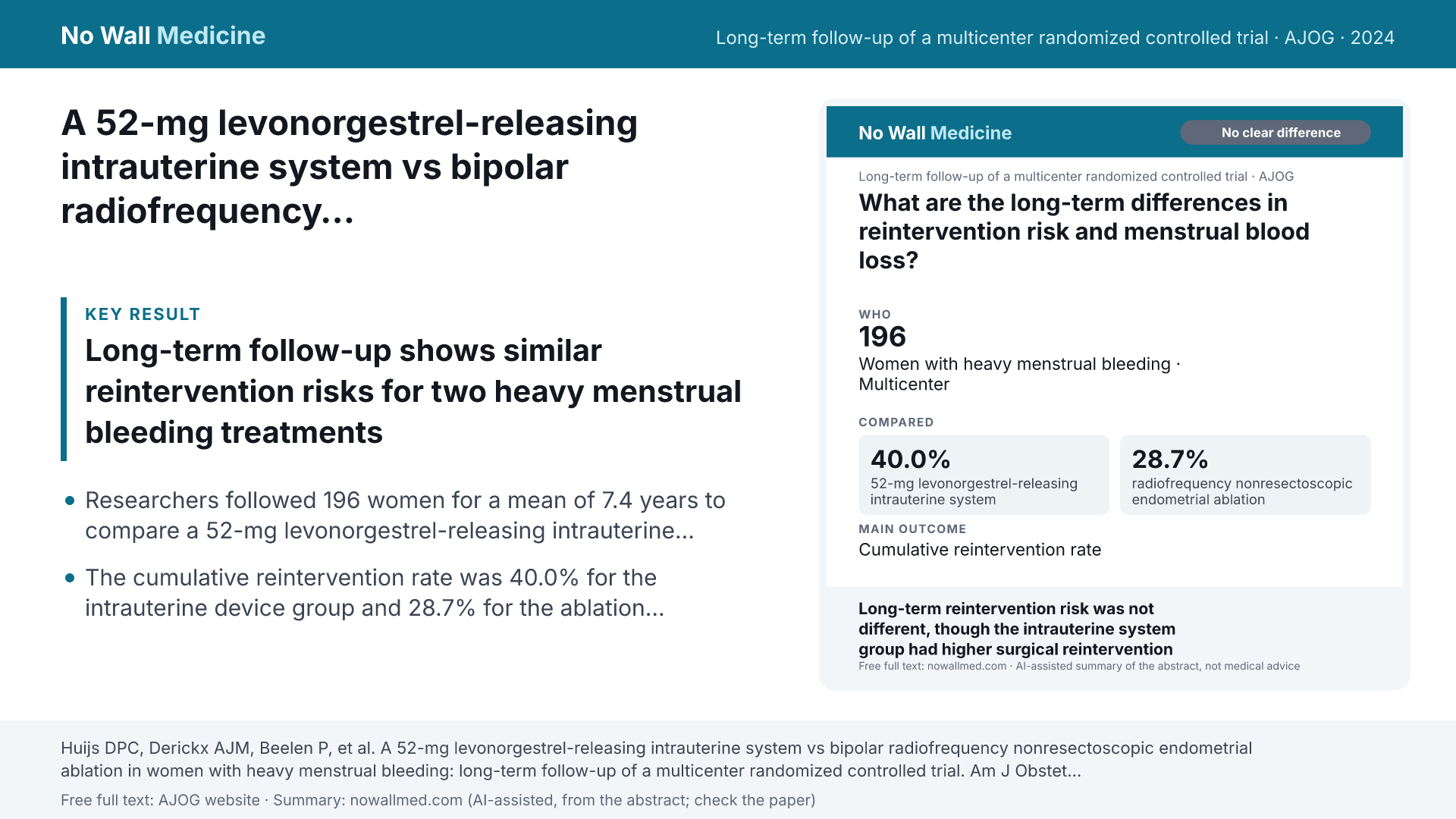
A 52-mg levonorgestrel-releasing intrauterine system vs bipolar radiofrequency nonresectoscopic endometrial ablation in women with heavy menstrual bleeding: long-term follow-up of a multicenter randomized controlled trial
Long-term follow-up of a multicenter randomized controlled trialNo clear difference
What are the long-term differences in reintervention risk and menstrual blood loss?
Who
196
Women with heavy menstrual bleeding · Multicenter
Compared
40.0%52-mg levonorgestrel-releasing intrauterine system (34/85)
28.7%radiofrequency nonresectoscopic endometrial ablation (27/94)
Main outcome
Cumulative reintervention rate
Result: relative risk 1.39 (95% confidence interval 0.92-2.10)
Bottom line: Long-term reintervention risk was not different, though the intrauterine system group had higher surgical reintervention rates.
AJOG · 2024-01-26 · Save PNG
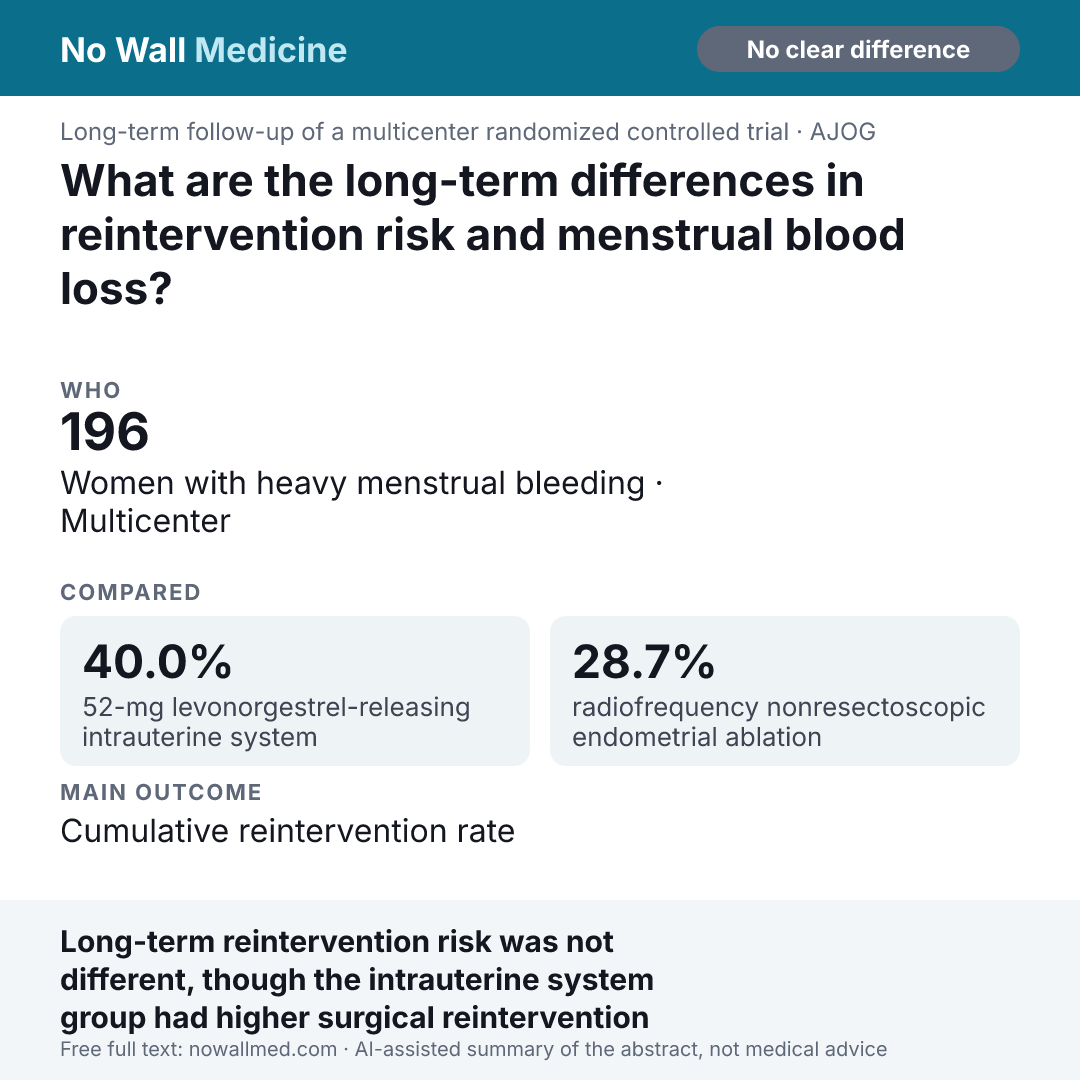
Clinical question: What are the long-term differences in reintervention risk and menstrual blood loss?
Why it matters: Long-term results regarding reintervention risk and menstrual blood loss are unknown for these two treatment strategies for heavy menstrual bleeding.
Key points
- Researchers followed 196 women for a mean of 7.4 years to compare a 52-mg levonorgestrel-releasing intrauterine device and radiofrequency nonresectoscopic endometrial ablation.
- The cumulative reintervention rate was 40.0% for the intrauterine device group and 28.7% for the ablation group, which was not a statistically significant difference.
- The rate of surgical reinterventions was significantly higher in the intrauterine device group at 35.3% compared to 19.1% in the ablation group.
Headline and key points written with AI from the paper’s abstract, with every number checked against it. Read the paper before relying on them.
Was this summary helpful?
Subject terms
Headline, design, result, key points, caveat and citation as plain text.
Cite this article
Huijs DPC, Derickx AJM, Beelen P, et al. A 52-mg levonorgestrel-releasing intrauterine system vs bipolar radiofrequency nonresectoscopic endometrial ablation in women with heavy menstrual bleeding: long-term follow-up of a multicenter randomized controlled trial. Am J Obstet Gynecol. 2024;230(5):542.e1-542.e10. doi:10.1016/j.ajog.2024.01.016
Spotted a mistake? Suggest a correction