A better understanding of the association between maternal perception of foetal movements and late stillbirth-findings from an individual participant data meta-analysis
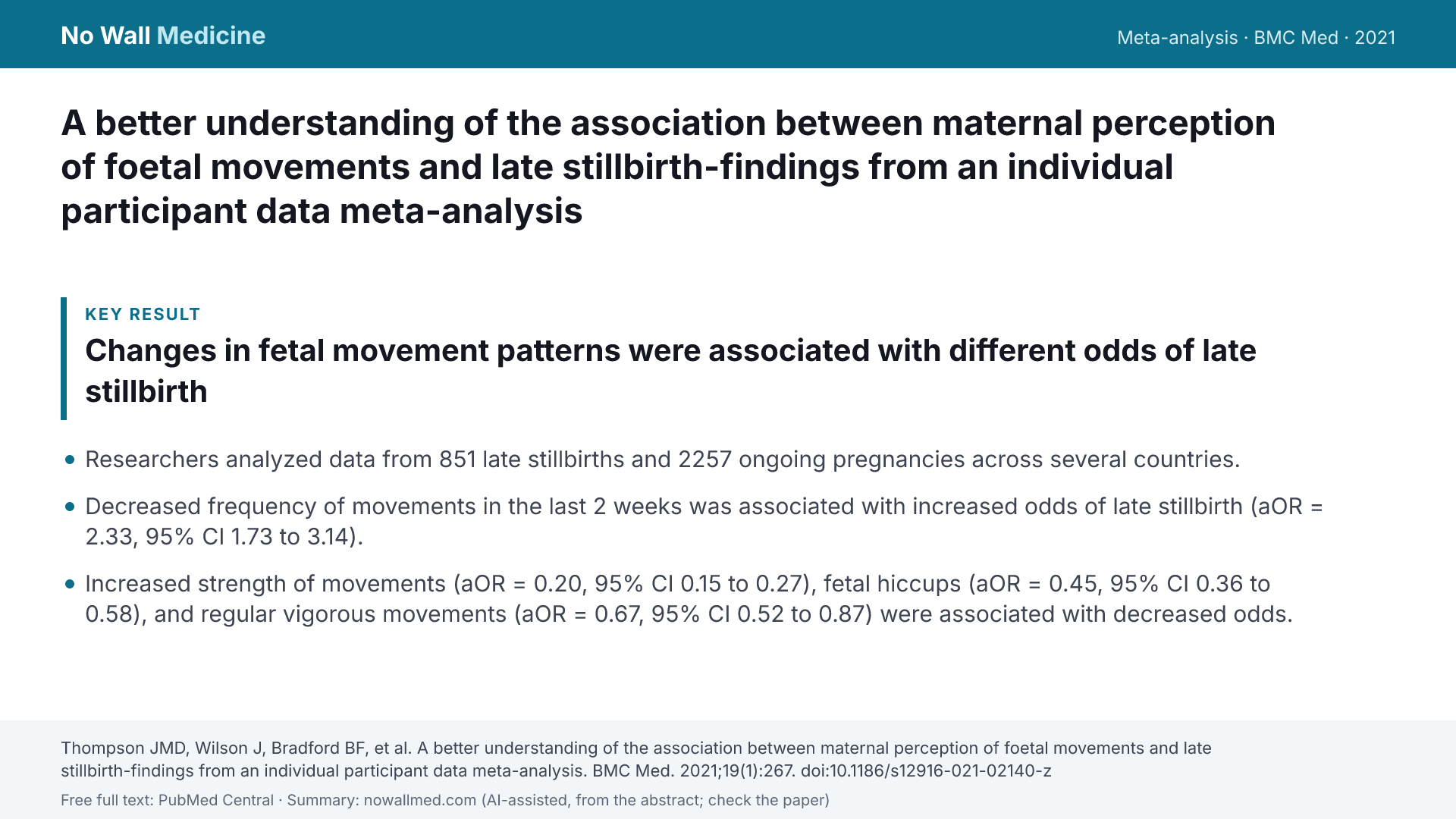
Key result: Changes in fetal movement patterns were associated with different odds of late stillbirth
Key points
- Researchers analyzed data from 851 late stillbirths and 2257 ongoing pregnancies across several countries.
- Decreased frequency of movements in the last 2 weeks was associated with increased odds of late stillbirth (aOR = 2.33, 95% CI 1.73 to 3.14).
- Increased strength of movements (aOR = 0.20, 95% CI 0.15 to 0.27), fetal hiccups (aOR = 0.45, 95% CI 0.36 to 0.58), and regular vigorous movements (aOR = 0.67, 95% CI 0.52 to 0.87) were associated with decreased odds.
Discussion prompts
- Would these patients look like yours? Who was left out?
- Is the main outcome one that matters to patients?
- Is the difference large enough to change what you do?
Cite: Thompson JMD, Wilson J, Bradford BF, et al. A better understanding of the association between maternal perception of foetal movements and late stillbirth-findings from an individual participant data meta-analysis. BMC Med. 2021;19(1):267. doi:10.1186/s12916-021-02140-z
Free full text: PubMed Central · Summary and visual abstract: nowallmed.com/a/a-better-understanding-of-the-association-between-maternal-perception-i10brq/ (AI-assisted from the abstract; check the paper before relying on it).