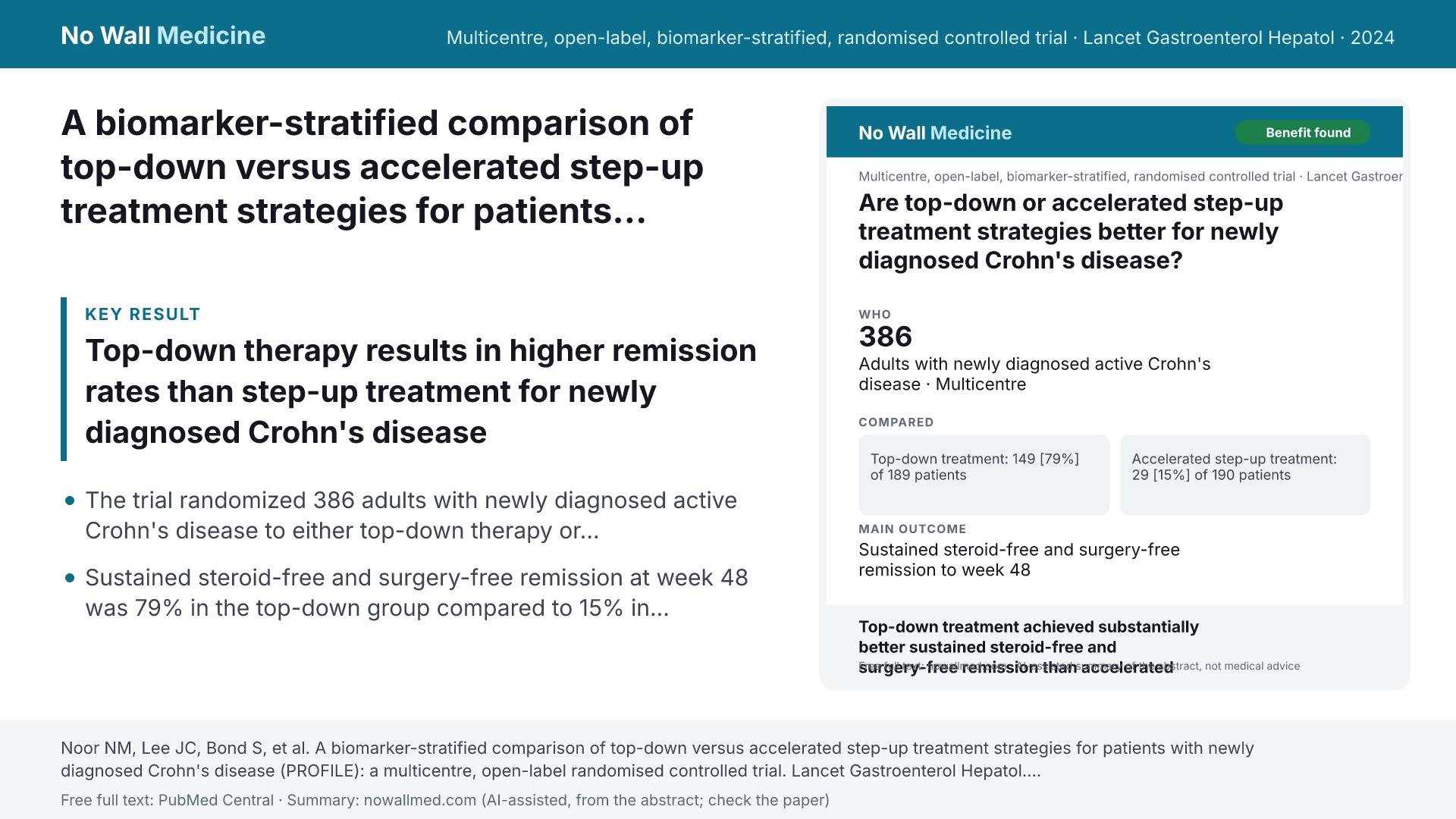
Top-down therapy results in higher remission rates than step-up treatment for newly diagnosed Crohn's disease
A biomarker-stratified comparison of top-down versus accelerated step-up treatment strategies for patients with newly diagnosed Crohn's disease (PROFILE): a multicentre, open-label randomised controlled trial
Multicentre, open-label, biomarker-stratified, randomised controlled trialBenefit found
Are top-down or accelerated step-up treatment strategies better for newly diagnosed Crohn's disease?
Who
386
Adults with newly diagnosed active Crohn's disease · Multicentre
Compared
Top-down treatment: 149 [79%] of 189 patients
Accelerated step-up treatment: 29 [15%] of 190 patients
Main outcome
Sustained steroid-free and surgery-free remission to week 48
Result: absolute difference 64 percentage points, 95% CI 57 to 72
Bottom line: Top-down treatment achieved substantially better sustained steroid-free and surgery-free remission than accelerated step-up treatment at one year.
Funded by: Wellcome and PredictImmune Ltd.
Lancet Gastroenterol Hepatol · 2024-02-22Download image
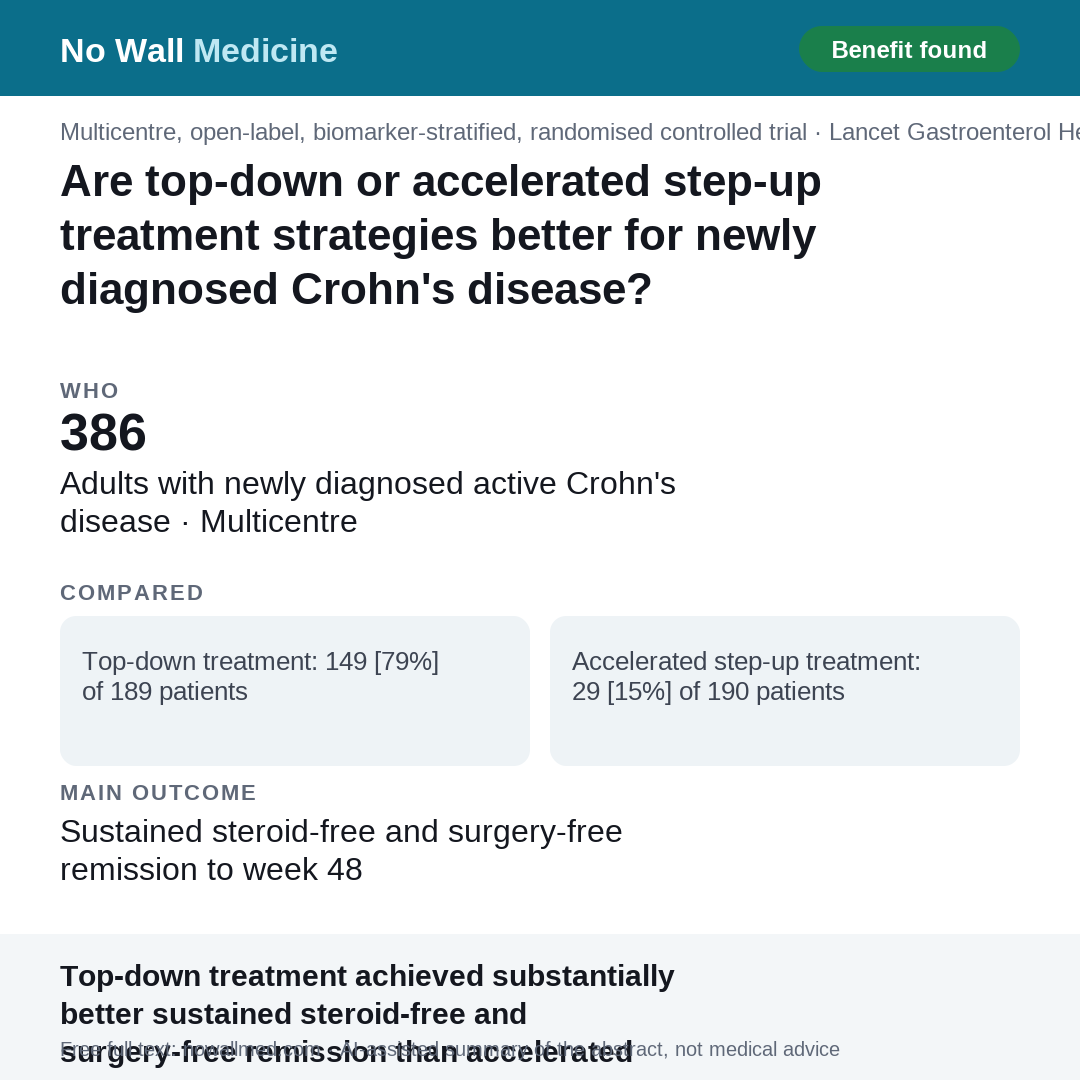
Clinical question: Are top-down or accelerated step-up treatment strategies better for newly diagnosed Crohn's disease?
Why it matters: It is unknown whether using a molecular biomarker to guide treatment strategies improves clinical outcomes for patients newly diagnosed with Crohn's disease.
Key points
- The trial randomized 386 adults with newly diagnosed active Crohn's disease to either top-down therapy or accelerated step-up therapy.
- Sustained steroid-free and surgery-free remission at week 48 was 79% in the top-down group compared to 15% in the accelerated step-up group.
- The top-down group had fewer adverse events (168 vs 315) and fewer serious adverse events (15 vs 42) than the step-up group.
Headline and key points written with AI from the paper’s abstract, with every number checked against it. Read the paper before relying on them.
Was this summary helpful?
Abstract
Background
Management strategies and clinical outcomes vary substantially in patients newly diagnosed with Crohn's disease. We evaluated the use of a putative prognostic biomarker to guide therapy by assessing outcomes in patients randomised to either top-down (ie, early combined immunosuppression with infliximab and immunomodulator) or accelerated step-up (conventional) treatment strategies. Methods
PROFILE (PRedicting Outcomes For Crohn's disease using a moLecular biomarker) was a multicentre, open-label, biomarker-stratified, randomised controlled trial that enrolled adults with newly diagnosed active Crohn's disease (Harvey-Bradshaw Index ≥7, either elevated C-reactive protein or faecal calprotectin or both, and endoscopic evidence of active inflammation). Potential participants had blood drawn to be tested for a prognostic biomarker derived from T-cell transcriptional signatures (PredictSURE-IBD assay). Following testing, patients were randomly assigned, via a secure online platform, to top-down or accelerated step-up treatment stratified by biomarker subgroup (IBDhi or IBDlo), endoscopic inflammation (mild, moderate, or severe), and extent (colonic or other). Blinding to biomarker status was maintained throughout the trial. The primary endpoint was sustained steroid-free and surgery-free remission to week 48. Remission was defined by a composite of symptoms and inflammatory markers at all visits. Flare required active symptoms (HBI ≥5) plus raised inflammatory markers (CRP >upper limit of normal or faecal calprotectin ≥200 μg/g, or both), while remission was the converse-ie, quiescent symptoms (HBI <5) or resolved inflammatory markers (both CRP ≤ the upper limit of normal and calprotectin <200 μg/g) or both. Analyses were done in the full analysis (intention-to-treat) population. The trial has completed and is registered (ISRCTN11808228). Findings
Between Dec 29, 2017, and Jan 5, 2022, 386 patients (mean age 33·6 years [SD 13·2]; 179 [46%] female, 207 [54%] male) were randomised: 193 to the top-down group and 193 to the accelerated step-up group. Median time from diagnosis to trial enrolment was 12 days (range 0-191). Primary outcome data were available for 379 participants (189 in the top-down group; 190 in the accelerated step-up group). There was no biomarker-treatment interaction effect (absolute difference 1 percentage points, 95% CI -15 to 15; p=0·944). Sustained steroid-free and surgery-free remission was significantly more frequent in the top-down group than in the accelerated step-up group (149 [79%] of 189 patients vs 29 [15%] of 190 patients, absolute difference 64 percentage points, 95% CI 57 to 72; p<0·0001). There were fewer adverse events (including disease flares) and serious adverse events in the top-down group than in the accelerated step-up group (adverse events: 168 vs 315; serious adverse events: 15 vs 42), with fewer complications requiring abdominal surgery (one vs ten) and no difference in serious infections (three vs eight). Interpretation
Top-down treatment with combination infliximab plus immunomodulator achieved substantially better outcomes at 1 year than accelerated step-up treatment. The biomarker did not show clinical utility. Top-down treatment should be considered standard of care for patients with newly diagnosed active Crohn's disease. Funding
Wellcome and PredictImmune Ltd.
Abstract reproduced under the article’s CC BY licence.
Subject terms
Cite this article
Noor NM, Lee JC, Bond S, Dowling F, Brezina B, Patel KV. A biomarker-stratified comparison of top-down versus accelerated step-up treatment strategies for patients with newly diagnosed Crohn's disease (PROFILE): a multicentre, open-label randomised controlled trial. Lancet Gastroenterol Hepatol. 2024. doi:10.1016/S2468-1253(24)00034-7
Spotted a mistake? Suggest a correction