Blended learning course outperformed traditional teaching for undergraduate psychology students learning mental disorder diagnostics
A Blended Learning Course on the Diagnostics of Mental Disorders: Multicenter Cluster Randomized Noninferiority Trial
Multicenter cluster randomized noninferiority trialBenefit found
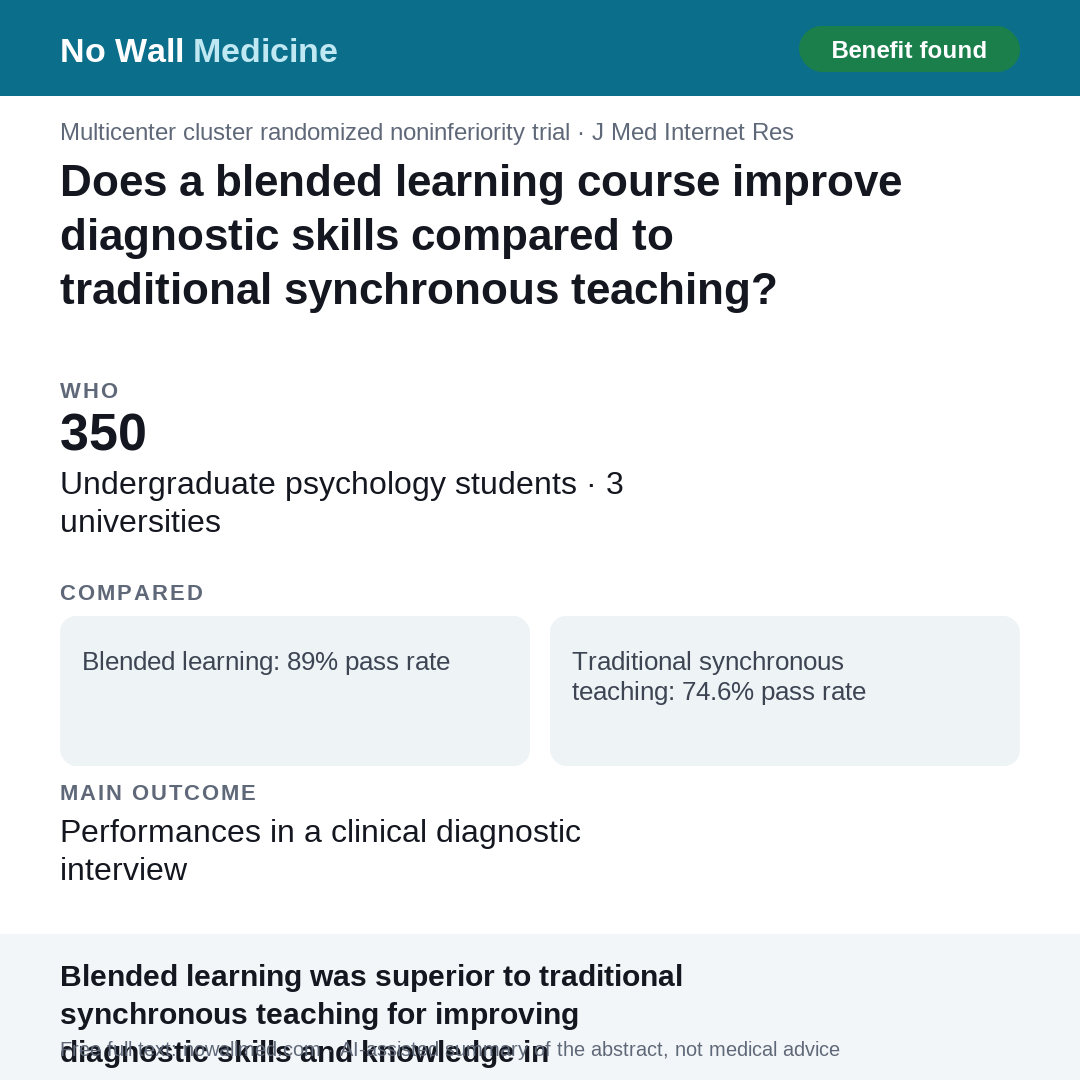
Does a blended learning course improve diagnostic skills compared to traditional synchronous teaching?
Who
350
Undergraduate psychology students · 3 universities
Compared
Blended learning: 89% pass rate
Traditional synchronous teaching: 74.6% pass rate
Main outcome
Performances in a clinical diagnostic interview
Result: odds ratio 2.77, 95% CI 1.55-5.13
Bottom line: Blended learning was superior to traditional synchronous teaching for improving diagnostic skills and knowledge in psychology students.
J Med Internet Res · 2024-11-27Download image
Clinical question: Does a blended learning course improve diagnostic skills compared to traditional synchronous teaching?
Why it matters: It is important to disseminate evidence-based diagnostic skills into clinical practice to avoid misdiagnoses that can have severe adverse effects.
Key points
- Researchers studied 350 undergraduate psychology students across 18 university courses at 3 universities, comparing blended learning to traditional synchronous teaching.
- The blended learning group had an 89% pass rate on a clinical diagnostic interview compared to a 74.6% pass rate for the synchronous group.
- Blended learning was also associated with higher scores in diagnostic knowledge, course clarity, course structure, and informativeness.
Headline and key points written with AI from the paper’s abstract, with every number checked against it. Read the paper before relying on them.
Topics
Cite this article
Bonnin G, Kröber S, Schneider S, Margraf J, Pflug V, Gerlach AL. A Blended Learning Course on the Diagnostics of Mental Disorders: Multicenter Cluster Randomized Noninferiority Trial. J Med Internet Res. 2024. doi:10.2196/54176
Spotted a mistake? Suggest a correction
Top studies every Monday
The week’s key trials and guidelines in your specialties, plus any topics you follow. By email, free.
Get the weekly digest