Brief video intervention showed small improvement in perceived recovery for childhood maltreatment survivors
A brief video intervention targeting self-stigma among childhood maltreatment survivors: an international, multicentre, single-blind, randomised controlled trial
International, multicentre, single-blind, randomised controlled trialMixed results
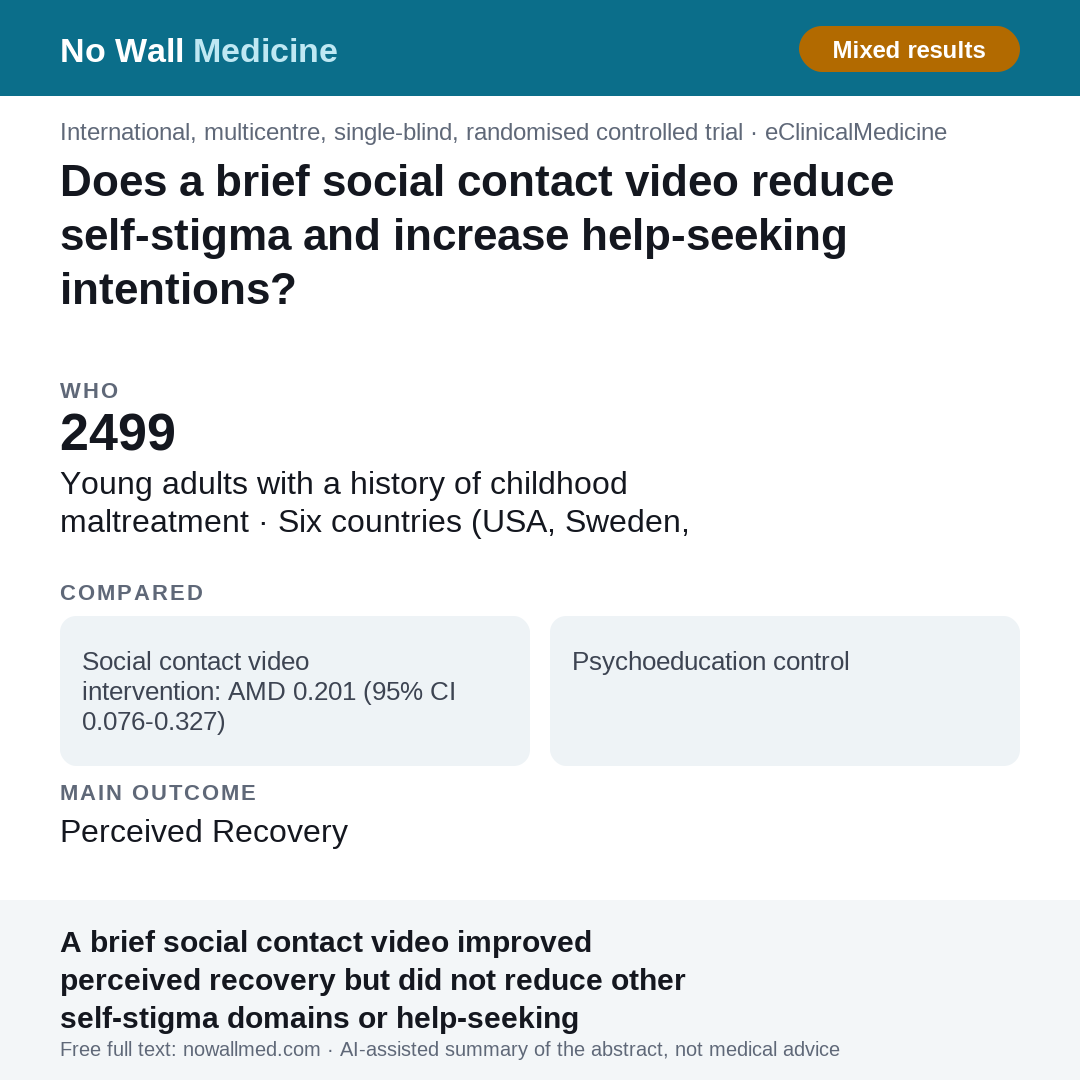
Does a brief social contact video reduce self-stigma and increase help-seeking intentions?
Who
2499
Young adults with a history of childhood maltreatment · Six countries (USA, Sweden, Switzerland, Japan, South Africa, Türkiye)
Compared
Social contact video intervention: AMD 0.201 (95% CI 0.076-0.327)
Psychoeducation control
Main outcome
Perceived Recovery
Result: adjusted mean difference 0.201 (95% CI 0.076-0.327)
Bottom line: A brief social contact video improved perceived recovery but did not reduce other self-stigma domains or help-seeking intentions.
Funded by: Azrieli Foundation, NYSPI, JSPS, KAKENHI, and South African Medical Research Council
eClinicalMedicine · 2026-09-15Download image
Clinical question: Does a brief social contact video reduce self-stigma and increase help-seeking intentions?
Why it matters: Self-stigma acts as a barrier to treatment-seeking for survivors of childhood maltreatment, but few interventions have targeted this issue across multiple countries.
Key points
- Researchers studied 2499 young adults from six countries who had experienced childhood maltreatment and compared a social-contact video to a psychoeducation control.
- The social contact video produced a small but statistically significant improvement in Perceived Recovery compared to the control group (adjusted mean difference 0.201; p = 0.0020).
- No significant differences were found for alienation, stereotype endorsement, secrecy, or help-seeking intentions, and the recovery improvement was not durable at 30-day follow-up in US participants.
Limitation the authors note: The US was the only site with sufficient follow-up data to assess the 30-day results.
Headline and key points written with AI from the paper’s abstract, with every number checked against it. Read the paper before relying on them.
Cite this article
Haim-Nachum S, Oe M, Seedat S, Ahmed F, Fisch CT, Lazarov A. A brief video intervention targeting self-stigma among childhood maltreatment survivors: an international, multicentre, single-blind, randomised controlled trial. eClinicalMedicine. 2026. doi:10.1016/j.eclinm.2026.104201
Spotted a mistake? Suggest a correction