Christmas themed physical activity emails were associated with less sedentary time in inactive adults
A Christmas themed physical activity intervention to increase participation in physical activity during Advent: pilot randomised controlled trial
Pilot randomised controlled trialNo clear difference
Does a Christmas themed physical activity intervention increase participation in physical activity?
Who
107
107 inactive adults aged 18-75 years · United Kingdom
Compared
intervention: 20.6 minutes difference at week three
comparator
Main outcome
weekly minutes of moderate-to-vigorous intensity physical activity
Result: adjusted mean difference 20.6 minutes (95% confidence interval -29.7 to 70.9)
Bottom line: The Christmas themed intervention showed potential to increase physical activity and reduce sedentary time, though results were not statistically significant.
BMJ · 2022-12-19Download image
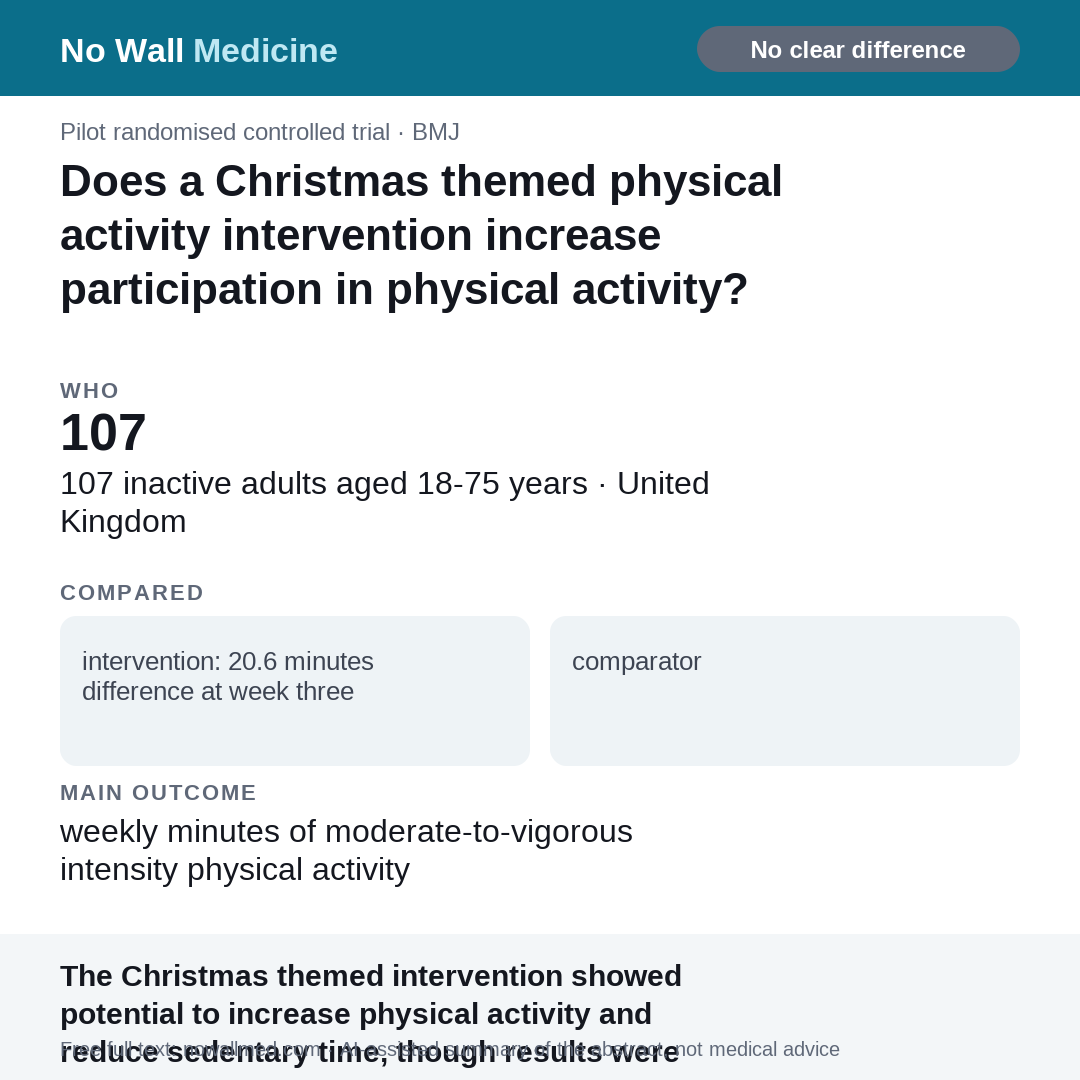
Clinical question: Does a Christmas themed physical activity intervention increase participation in physical activity?
Why it matters: Researchers investigated whether a Christmas themed physical activity intervention could increase participation in exercise and decrease sedentary behavior in inactive adults during the Advent period.
Key points
- The pilot trial studied 107 inactive adults who were assigned to either a daily Christmas themed activity email intervention or a healthy living leaflet group.
- At week three, the intervention group showed an adjusted mean difference of 20.6 minutes of moderate-to-vigorous physical activity per week compared to the control group.
- Accelerometer data showed the intervention group spent -58.6 minutes less sedentary per day than the comparator group, with a 95% confidence interval of -113.5 to -3.8.
Headline and key points written with AI from the paper’s abstract, with every number checked against it. Read the paper before relying on them.
Abstract
Objectives
To examine the recruitment, retention, and preliminary effects of a Christmas themed physical activity intervention designed to increase participation in physical activity and decrease sedentary behaviour in inactive adults. Design
Pilot randomised controlled trial. Setting
Recruitment from social medial platforms, workplaces, and community groups in the UK. Participants
107 inactive adults (who did not meet the UK guidelines for physical activity) aged 18-75 years. Interventions
The intervention consisted of an email sent to participants each day of Advent (1-24 December 2021), which contained a Christmas themed physical activity idea to be completed that day. Each physical activity idea was presented in three intensity formats, including Easy Elf (light intensity), Moderate Mrs Claus (moderate intensity), and Strenuous Santa (vigorous intensity). The comparator group received a leaflet about healthy living on the 1 December. Main outcome measures
Participants were randomly assigned (2:1) to either the intervention or control and were masked to group allocation before randomisation. Primary outcomes were recruitment rate, retention, and weekly minutes of participation in self-reported moderate-to-vigorous intensity physical activity by use of the exercise vital signs questionnaire. Primary analysis compared change in minutes of moderate-to-vigorous intensity physical activity from baseline to weeks one, two, and three during the Active Advent intervention. Secondary outcomes were participation in muscle strengthening based physical activity (days per week), accelerometer measured moderate-to-vigorous intensity physical activity, light intensity physical activity, total physical activity, and sedentary time (minutes per day), and enjoyment of and adherence to the intervention. Results
323 individuals expressed interest in participating in the trial and 107 were randomly assigned to the intervention (n=71) or the comparator (n=36) group. The recruitment target (n=105) was reached within 19 days of starting recruitment. 23 (21%) of 107 participants were lost to follow-up. On average, the groups reported participation in similar minutes of moderate-to-vigorous intensity physical activity in weeks one and two. At week three, the adjusted mean difference between groups was 20.6 minutes of participation in moderate-to-vigorous intensity physical activity per week (95% confidence interval -29.7 to 70.9) in favour of the intervention group. Accelerometer data showed that the intervention group spent fewer minutes sedentary per day than comparators (mean difference -58.6 (-113.5 to -3.8)). Overall, 42 (70%) of 60 participants in the intervention group reported that they liked the intervention and 41 (69%) of 59 reported that they completed the Active Advent intervention ideas each day. Conclusions
The public were interested to participate in a Christmas themed physical activity intervention during Advent, which might increase physical activity and reduce time sedentary. Enjoyment of, and adherence to the intervention shows the potential benefit that Christmas themed physical activity campaigns/initiatives might have for improving public health. Trial registration
ISRCTN12415556.
Abstract reproduced under the article’s CC BY NC licence.
Topics
Cite this article
Biddle GJH, Sanders JP, Gokal K, Madigan CD, Thomas JJC, Pyle A. A Christmas themed physical activity intervention to increase participation in physical activity during Advent: pilot randomised controlled trial. BMJ. 2022. doi:10.1136/bmj-2022-072807
Spotted a mistake? Suggest a correction