Workplace health interventions were associated with improved lung function and fewer respiratory symptoms in textile workers
A cluster randomised controlled trial to reduce respiratory effects of cotton dust exposure among textile workers: the MultiTex RCT study
Cluster randomised controlled trialBenefit found
Does an intervention reduce respiratory effects of cotton dust exposure among textile workers?
Who
2031
Textile workers · 38 textile mills in Karachi, Pakistan
Compared
Intervention arm: more likely to report an improvement in respiratory symptoms (OR 1.58, 95% CI 1.06-2.36)
Control arm
Main outcome
respiratory symptoms, lung function, and cotton dust levels
Result: OR 1.58 (95% CI 1.06-2.36) for respiratory symptoms; β 1.31% (95% CI 0.04-2.57%) for lung function
Bottom line: The intervention improved respiratory symptoms and lung function among textile workers in Pakistan.
Eur Respir J · 2024-01-18Download image
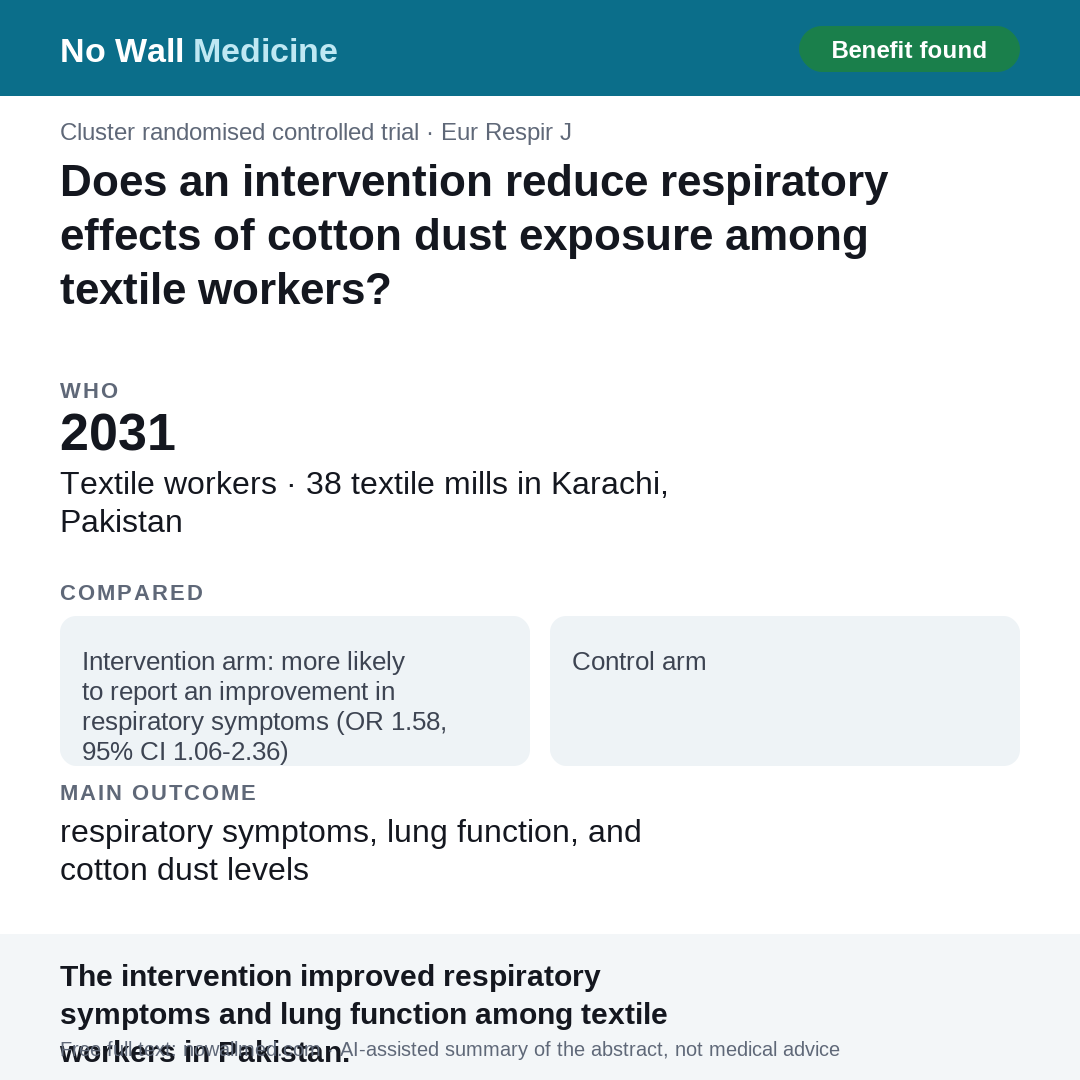
Clinical question: Does an intervention reduce respiratory effects of cotton dust exposure among textile workers?
Why it matters: It was unknown if a combination of training, workplace committees, and face masks could reduce respiratory symptoms and improve lung function in textile workers exposed to cotton dust.
Key points
- Researchers conducted a cluster randomized controlled trial involving 2031 textile workers across 38 mills in Karachi, Pakistan.
- At the 18-month follow-up, workers in the intervention group were more likely to report improved respiratory symptoms (OR 1.58, 95% CI 1.06-2.36) and lung function (FEV1 % pred: β 1.31%, 95% CI 0.04-2.57%).
- Personal dust levels decreased, though this was not observed in adjusted models due to the small number of samples.
Limitation the authors note: The study had a low follow-up rate with only 807 (40%) participants available at the third follow-up.
Headline and key points written with AI from the paper’s abstract, with every number checked against it. Read the paper before relying on them.
Topics
Cite this article
Nafees AA, Allana A, Kadir MM, Potts J, Minelli C, Semple S. A cluster randomised controlled trial to reduce respiratory effects of cotton dust exposure among textile workers: the MultiTex RCT study. Eur Respir J. 2024. doi:10.1183/13993003.01028-2023
Spotted a mistake? Suggest a correction
Top studies every Monday
The week’s key trials and guidelines in your specialties, plus any topics you follow. By email, free.
Get the weekly digest