Community-based behavioral intervention showed significant difference in body mass index change among school-aged children
A Community-Based Behavioral Intervention and Body Mass Index in School-Aged Children: A Cluster Randomized Clinical Trial
Cluster randomized clinical trialBenefit found
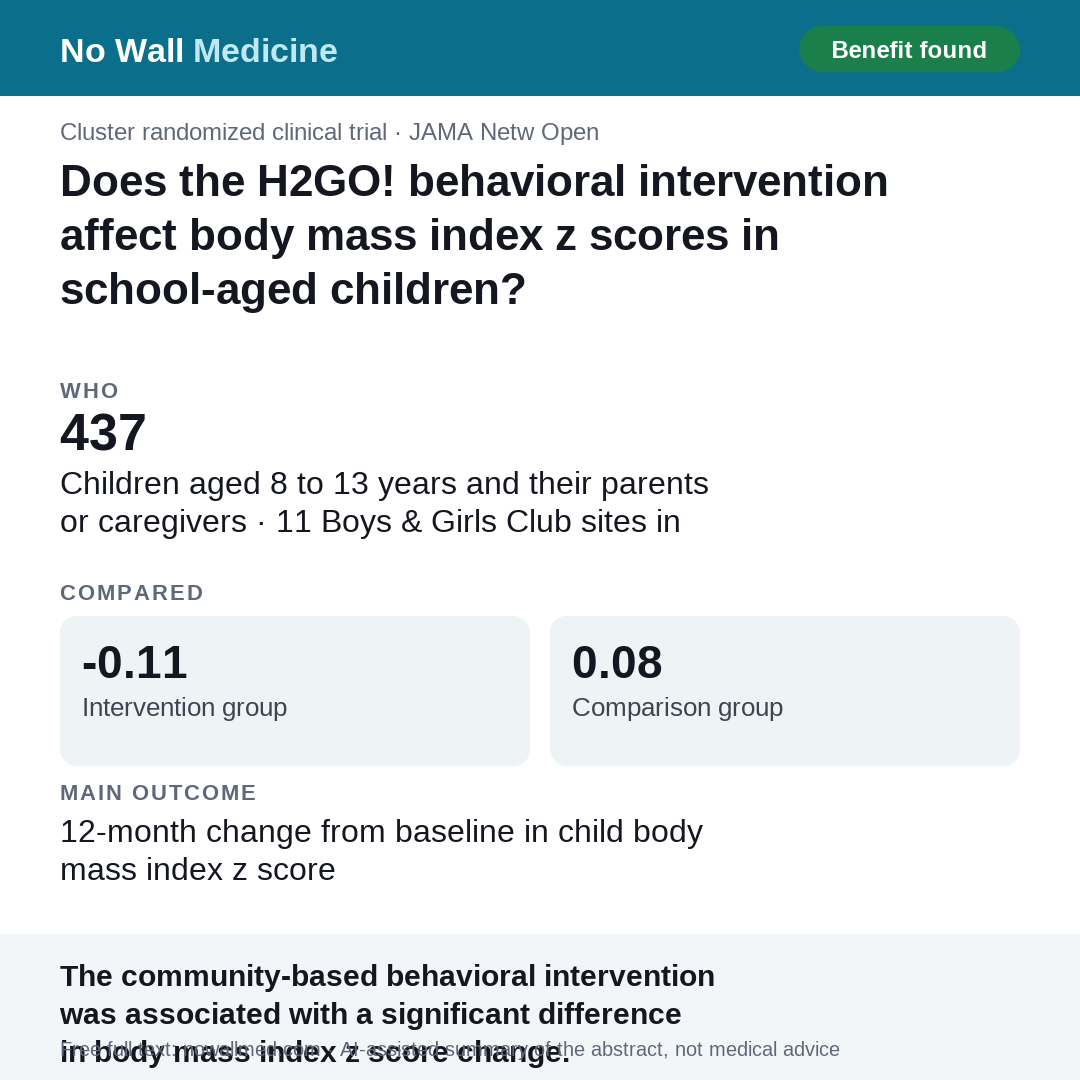
Does the H2GO! behavioral intervention affect body mass index z scores in school-aged children?
Who
437
Children aged 8 to 13 years and their parents or caregivers · 11 Boys & Girls Club sites in Massachusetts
Compared
-0.11Intervention group (95% CI, -0.25 to 0.02)
0.08Comparison group (95% CI, -0.04 to 0.20)
Main outcome
12-month change from baseline in child body mass index z score
Result: -0.19 (95% CI, -0.38 to -0.01)
Bottom line: The community-based behavioral intervention was associated with a significant difference in body mass index z score change.
JAMA Netw Open · 2026-10-01Download image
Clinical question: Does the H2GO! behavioral intervention affect body mass index z scores in school-aged children?
Why it matters: Scalable behavioral interventions are needed in community settings to support obesity prevention as body mass index increases during and after the COVID-19 pandemic.
Key points
- Researchers studied 437 children aged 8 to 13 years at 11 Boys & Girls Club sites to compare a behavioral intervention against usual care.
- The intervention group showed a statistically significant between-group difference in the adjusted mean change in body mass index z-score of -0.19 compared to the control group.
- There were no significant differences between the groups regarding water intake or the intake of sugar-sweetened beverages.
Headline and key points written with AI from the paper’s abstract, with every number checked against it. Read the paper before relying on them.
Topics
Spotted a mistake? Suggest a correction