Multi-component community intervention showed no significant difference in three-year BMI trajectory for Latinx children
A community-based, multi-level, multi-setting, multi-component intervention to reduce weight gain among low socioeconomic status Latinx children with overweight or obesity: The Stanford GOALS randomised controlled trial
Randomized, open-label, active placebo-controlled trialNo clear difference
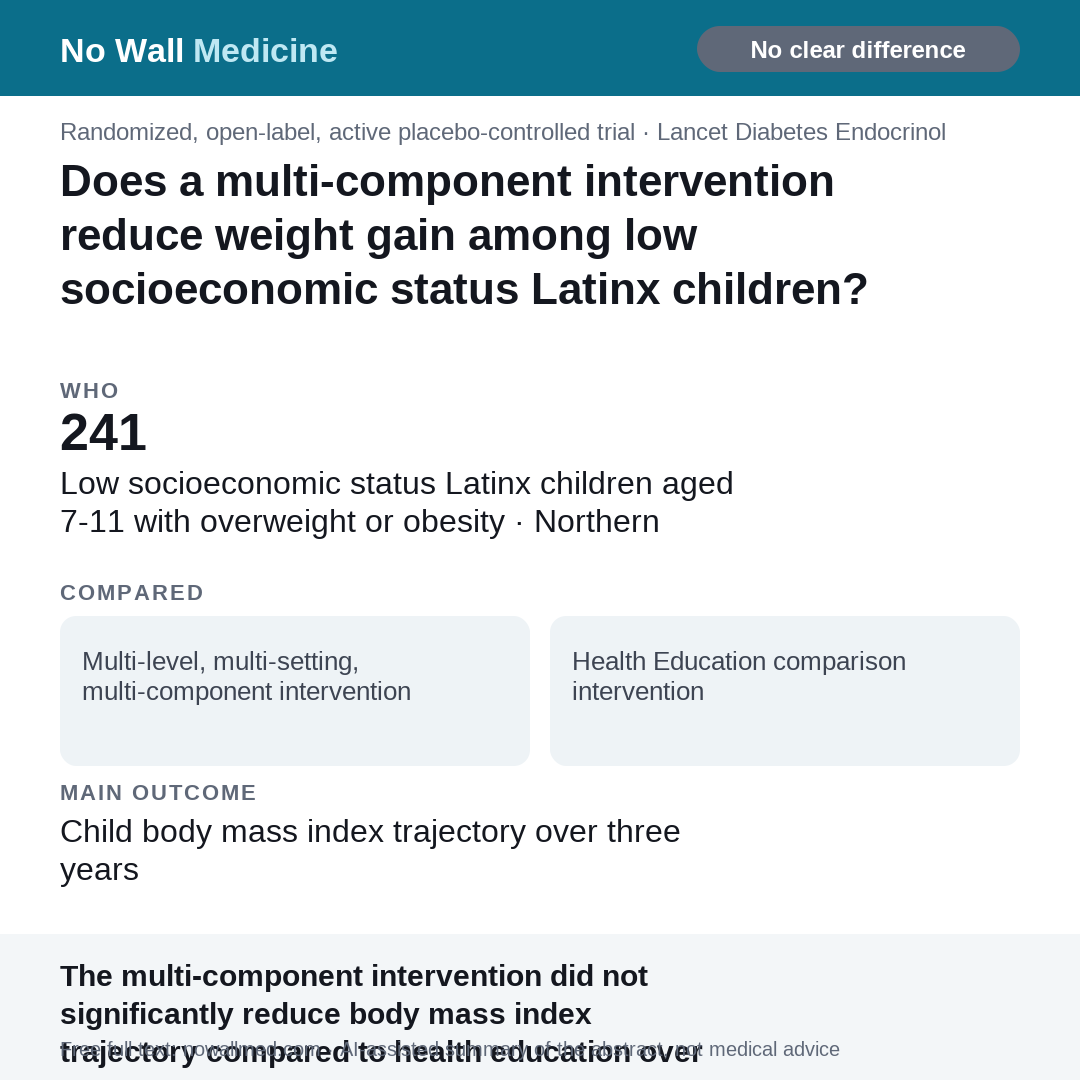
Does a multi-component intervention reduce weight gain among low socioeconomic status Latinx children?
Who
241
Low socioeconomic status Latinx children aged 7-11 with overweight or obesity · Northern California, USA
Compared
Multi-level, multi-setting, multi-component intervention
Health Education comparison intervention
Main outcome
Child body mass index trajectory over three years
Result: mean adjusted difference -0·25 (95% CI -0·90 to 0·40) kg/m2
Bottom line: The multi-component intervention did not significantly reduce body mass index trajectory compared to health education over three years.
Funded by: US National Institutes of Health
Lancet Diabetes Endocrinol · 2021-04-29Download image
Clinical question: Does a multi-component intervention reduce weight gain among low socioeconomic status Latinx children?
Why it matters: There are few long-term studies of interventions to reduce weight gain among low socioeconomic status children with overweight or obesity.
Key points
- Researchers studied 241 families with children aged 7-11 years from low-income Latinx communities, comparing a multi-level intervention to a health education program.
- The difference in body mass index trajectory over 3 years between the groups was not significant, with a mean adjusted difference of -0.25 kg/m2.
- Over 1 year, the multi-level intervention group gained -0.73 kg/m2 less body mass index than the health education group, and this continued over 2 years at -0.63 kg/m2.
Headline and key points written with AI from the paper’s abstract, with every number checked against it. Read the paper before relying on them.
Was this summary helpful?
Subject terms
Cite this article
Robinson TN, Matheson D, Wilson DM, Weintraub DL, Banda JA, McClain A. A community-based, multi-level, multi-setting, multi-component intervention to reduce weight gain among low socioeconomic status Latinx children with overweight or obesity: The Stanford GOALS randomised controlled trial. Lancet Diabetes Endocrinol. 2021. doi:10.1016/S2213-8587(21)00084-X
Spotted a mistake? Suggest a correction
Top studies every Monday
The week’s key trials and guidelines in your specialties, plus any topics you follow. By email, free.
Get the weekly digest