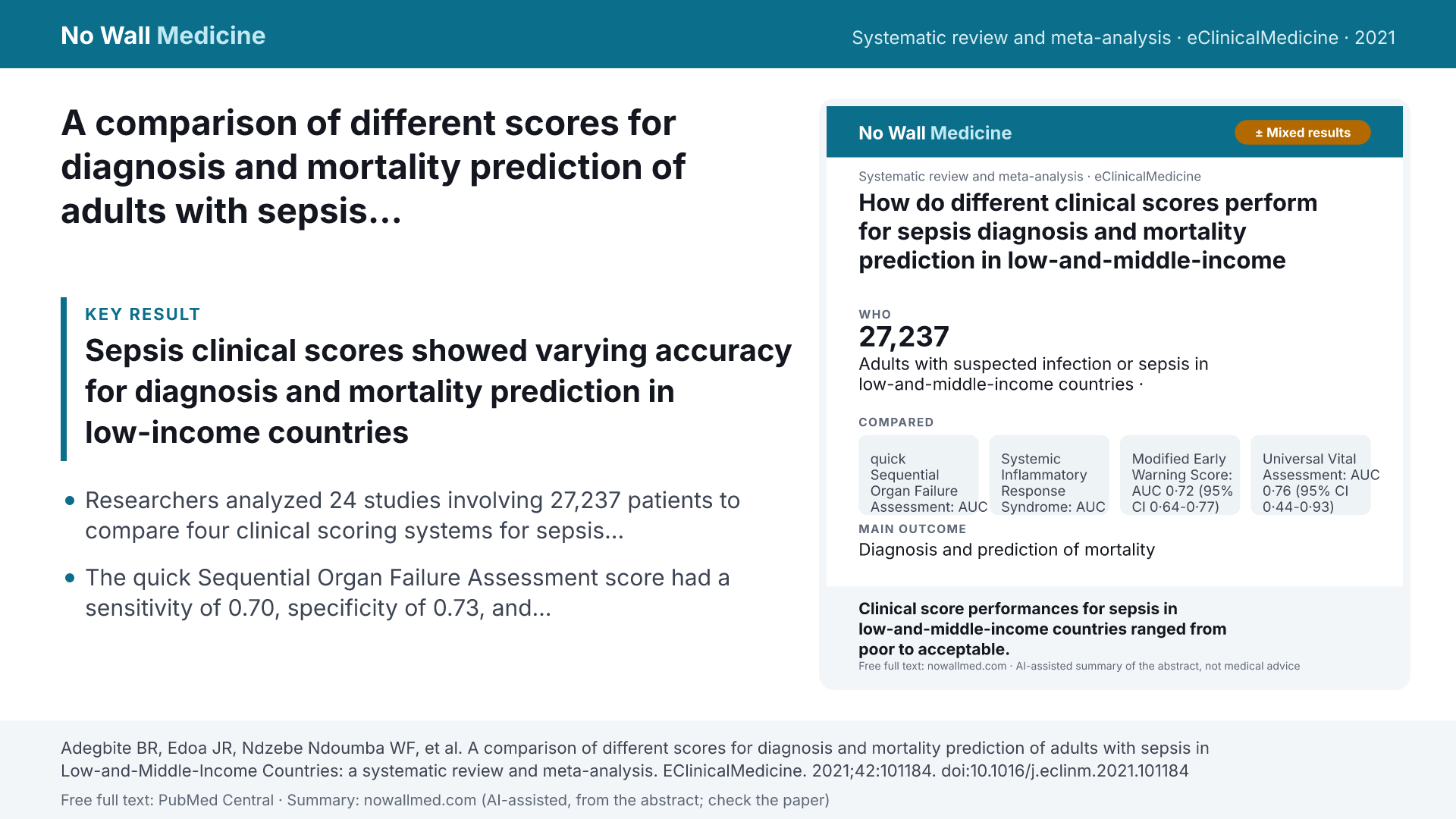
Sepsis clinical scores showed varying accuracy for diagnosis and mortality prediction in low-income countries
A comparison of different scores for diagnosis and mortality prediction of adults with sepsis in Low-and-Middle-Income Countries: a systematic review and meta-analysis
Systematic review and meta-analysisMixed results
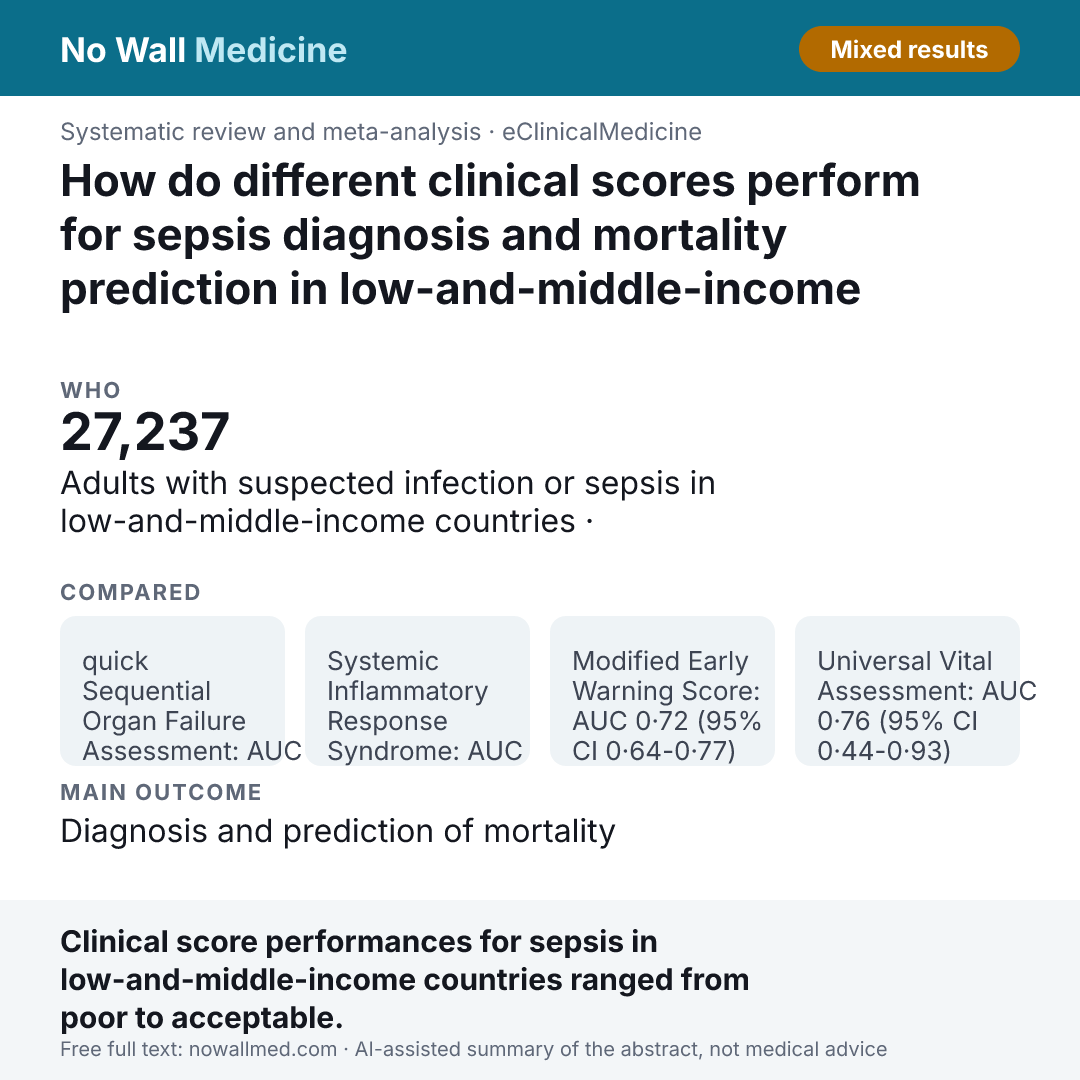
How do different clinical scores perform for sepsis diagnosis and mortality prediction in low-and-middle-income countries?
Who
27,237
Adults with suspected infection or sepsis in low-and-middle-income countries · Low-and-middle-income countries
Compared
quick Sequential Organ Failure Assessment: AUC 0·77 (95% CI 0·72-0·82)
Systemic Inflammatory Response Syndrome: AUC 0·69 (95% CI 0·50-0·83)
Modified Early Warning Score: AUC 0·72 (95% CI 0·64-0·77)
Universal Vital Assessment: AUC 0·76 (95% CI 0·44-0·93)
Main outcome
Diagnosis and prediction of mortality
Bottom line: Clinical score performances for sepsis in low-and-middle-income countries ranged from poor to acceptable.
Limitation: Significant heterogeneity was observed in the pooled analysis.
Funded by: UK National Institute for Health Research
eClinicalMedicine · 2021-10-30 · Save PNG
Clinical question: How do different clinical scores perform for sepsis diagnosis and mortality prediction in low-and-middle-income countries?
Why it matters: Most clinical scores for sepsis were developed for and applied in high-income countries rather than low-and-middle-income countries.
Key points
- Researchers analyzed 24 studies involving 27,237 patients to compare four clinical scoring systems for sepsis in low-and-middle-income countries.
- The quick Sequential Organ Failure Assessment score had a sensitivity of 0.70, specificity of 0.73, and an area-under-the-curve of 0.77.
- Systemic Inflammatory Response Syndrome had a sensitivity of 0.88 and specificity of 0.34, while Universal Vital Assessment had a sensitivity of 0.49 and specificity of 0.91.
Limitation the authors note: Significant heterogeneity was observed in the pooled analysis.
Headline and key points written with AI from the paper’s abstract, with every number checked against it. Read the paper before relying on them.
Was this summary helpful?
Headline, design, result, key points, caveat and citation as plain text.
Cite this article
Adegbite BR, Edoa JR, Ndzebe Ndoumba WF, et al. A comparison of different scores for diagnosis and mortality prediction of adults with sepsis in Low-and-Middle-Income Countries: a systematic review and meta-analysis. EClinicalMedicine. 2021;42:101184. doi:10.1016/j.eclinm.2021.101184
Spotted a mistake? Suggest a correction