Computer-aided detection increased adenoma detection during screening and surveillance colonoscopies
A computer-aided polyp detection system in screening and surveillance colonoscopy: an international, multicentre, randomised, tandem trial
Multicentre, randomised, controlled trialBenefit found
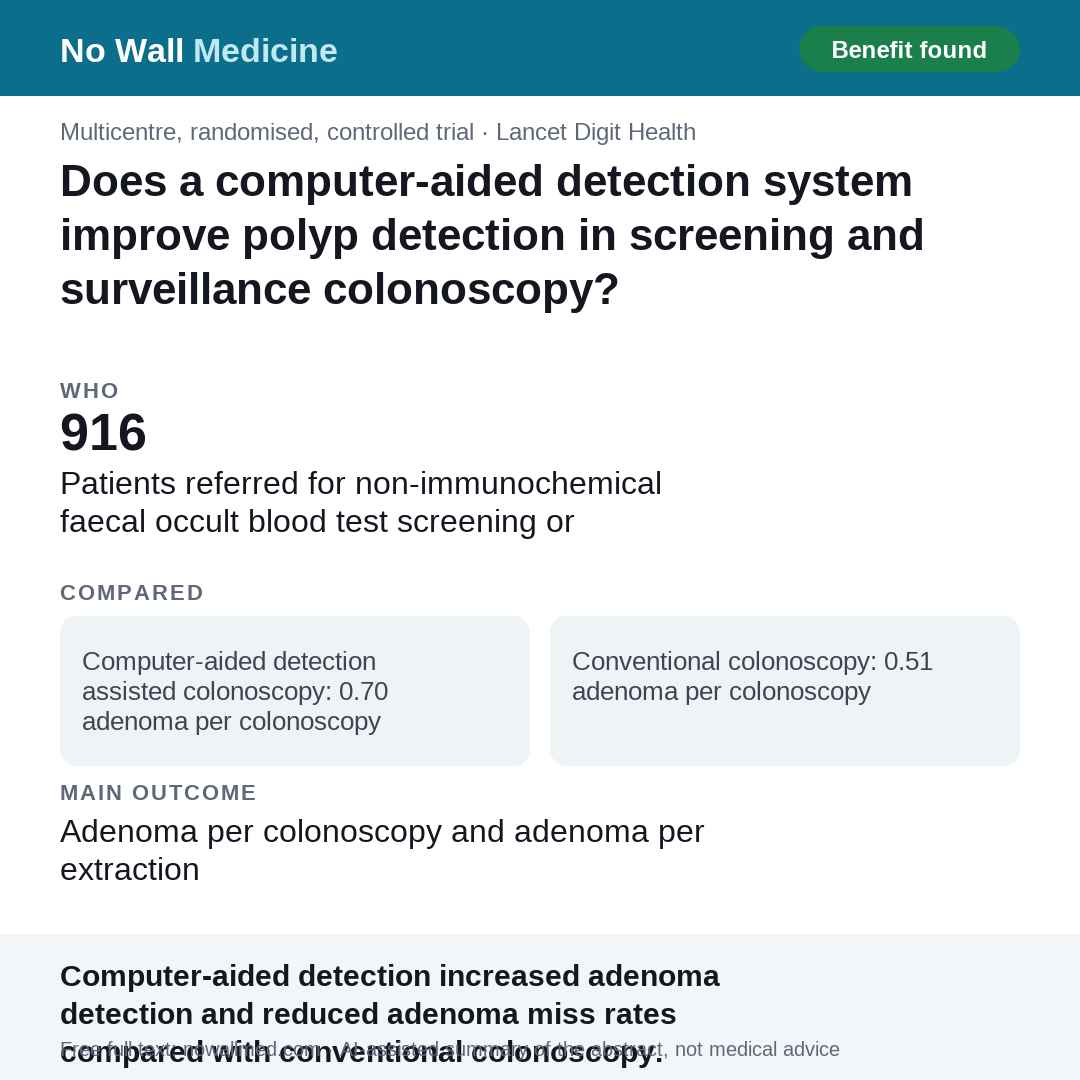
Does a computer-aided detection system improve polyp detection in screening and surveillance colonoscopy?
Who
916
Patients referred for non-immunochemical faecal occult blood test screening or surveillance colonoscopy · Ten hospitals in Europe, the USA, and Israel
Compared
Computer-aided detection assisted colonoscopy: 0.70 adenoma per colonoscopy
Conventional colonoscopy: 0.51 adenoma per colonoscopy
Main outcome
Adenoma per colonoscopy and adenoma per extraction
Result: poisson effect ratio 1.372 (95% CI 1.068-1.769)
Bottom line: Computer-aided detection increased adenoma detection and reduced adenoma miss rates compared with conventional colonoscopy.
Funded by: Magentiq Eye
Lancet Digit Health · 2024-02-24Download image
Clinical question: Does a computer-aided detection system improve polyp detection in screening and surveillance colonoscopy?
Why it matters: It was unknown how a novel computer-aided detection system affects adenoma detection in routine clinical screening and surveillance colonoscopy practice.
Key points
- Researchers conducted a multicentre randomized trial involving 916 patients to compare computer-aided detection with conventional colonoscopy.
- The computer-aided detection group had a higher adenoma per colonoscopy rate of 0.70 compared to 0.51 in the conventional group.
- In patients undergoing tandem colonoscopies, the adenoma miss rate was 19% when computer-aided detection was performed first compared to 36% when conventional colonoscopy was performed first.
Headline and key points written with AI from the paper’s abstract, with every number checked against it. Read the paper before relying on them.
Was this summary helpful?
Abstract
Background
Studies on the effect of computer-aided detection (CAD) in a daily clinical screening and surveillance colonoscopy population practice are scarce. The aim of this study was to evaluate a novel CAD system in a screening and surveillance colonoscopy population. Methods
This multicentre, randomised, controlled trial was done in ten hospitals in Europe, the USA, and Israel by 31 endoscopists. Patients referred for non-immunochemical faecal occult blood test (iFOBT) screening or surveillance colonoscopy were included. Patients were randomomly assigned to CAD-assisted colonoscopy or conventional colonoscopy; a subset was further randomly assigned to undergo tandem colonoscopy: CAD followed by conventional colonoscopy or conventional colonoscopy followed by CAD. Primary objectives included adenoma per colonoscopy (APC) and adenoma per extraction (APE). Secondary objectives included adenoma miss rate (AMR) in the tandem colonoscopies. The study was registered at ClinicalTrials.gov, NCT04640792. Findings
A total of 916 patients were included in the modified intention-to-treat analysis: 449 in the CAD group and 467 in the conventional colonoscopy group. APC was higher with CAD compared with conventional colonoscopy (0·70 vs 0·51, p=0·015; 314 adenomas per 449 colonoscopies vs 238 adenomas per 467 colonoscopies; poisson effect ratio 1·372 [95% CI 1·068-1·769]), while showing non-inferiority of APE compared with conventional colonoscopy (0·59 vs 0·66; p<0·001 for non-inferiority; 314 of 536 extractions vs 238 of 360 extractions). AMR in the 127 (61 with CAD first, 66 with conventional colonoscopy first) patients completing tandem colonoscopy was 19% (11 of 59 detected during the second pass) in the CAD first group and 36% (16 of 45 detected during the second pass) in the conventional colonoscopy first group (p=0·024). Interpretation
CAD increased adenoma detection in non-iFOBT screening and surveillance colonoscopies and reduced adenoma miss rates compared with conventional colonoscopy, without an increase in the resection of non-adenomatous lesions. Funding
Magentiq Eye.
Abstract reproduced under the article’s CC BY licence.
Subject terms
Cite this article
Maas MHJ, Neumann H, Shirin H, Katz LH, Benson AA, Kahloon A. A computer-aided polyp detection system in screening and surveillance colonoscopy: an international, multicentre, randomised, tandem trial. Lancet Digit Health. 2024. doi:10.1016/S2589-7500(23)00242-X
Spotted a mistake? Suggest a correction
Top studies every Monday
The week’s key trials and guidelines in your specialties, plus any topics you follow. By email, free.
Get the weekly digest