Cognitive distancing training was associated with clearer choices and higher sensitivity to negative feedback
A core component of psychological therapy causes adaptive changes in computational learning mechanisms
Randomized trialBenefit found
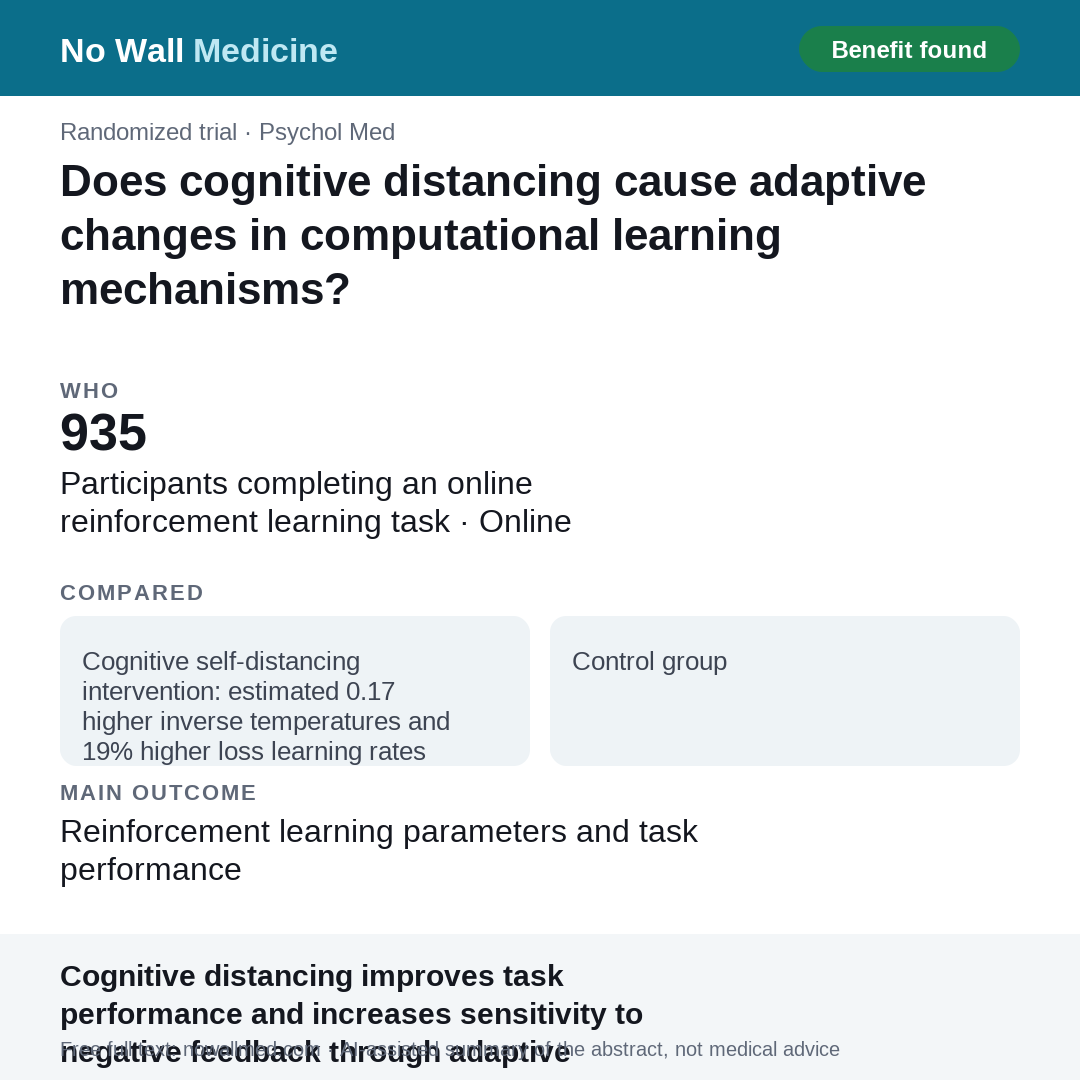
Does cognitive distancing cause adaptive changes in computational learning mechanisms?
Who
935
Participants completing an online reinforcement learning task · Online
Compared
Cognitive self-distancing intervention: estimated 0.17 higher inverse temperatures and 19% higher loss learning rates
Control group
Main outcome
Reinforcement learning parameters and task performance
Bottom line: Cognitive distancing improves task performance and increases sensitivity to negative feedback through adaptive computational learning changes.
Psychol Med · 2023-06-08Download image
Clinical question: Does cognitive distancing cause adaptive changes in computational learning mechanisms?
Why it matters: The therapeutic mechanisms behind cognitive distancing, an emotion regulation strategy used in psychological treatment, are currently unknown.
Key points
- Researchers studied 935 participants who were randomized to either a cognitive self-distancing intervention or a control group during an online reinforcement learning task.
- The cognitive distancing group showed clearer representations of option values with estimated 0.17 higher inverse temperatures and 19% higher loss learning rates.
- Participants in the cognitive distancing group showed improved task performance, including during later tests on novel symbol combinations without feedback.
Headline and key points written with AI from the paper’s abstract, with every number checked against it. Read the paper before relying on them.
Topics
Cite this article
Dercon Q, Mehrhof SZ, Sandhu TR, Hitchcock C, Lawson RP, Pizzagalli DA. A core component of psychological therapy causes adaptive changes in computational learning mechanisms. Psychol Med. 2023. doi:10.1017/S0033291723001587
Spotted a mistake? Suggest a correction
Top studies every Monday
The week’s key trials and guidelines in your specialties, plus any topics you follow. By email, free.
Get the weekly digest