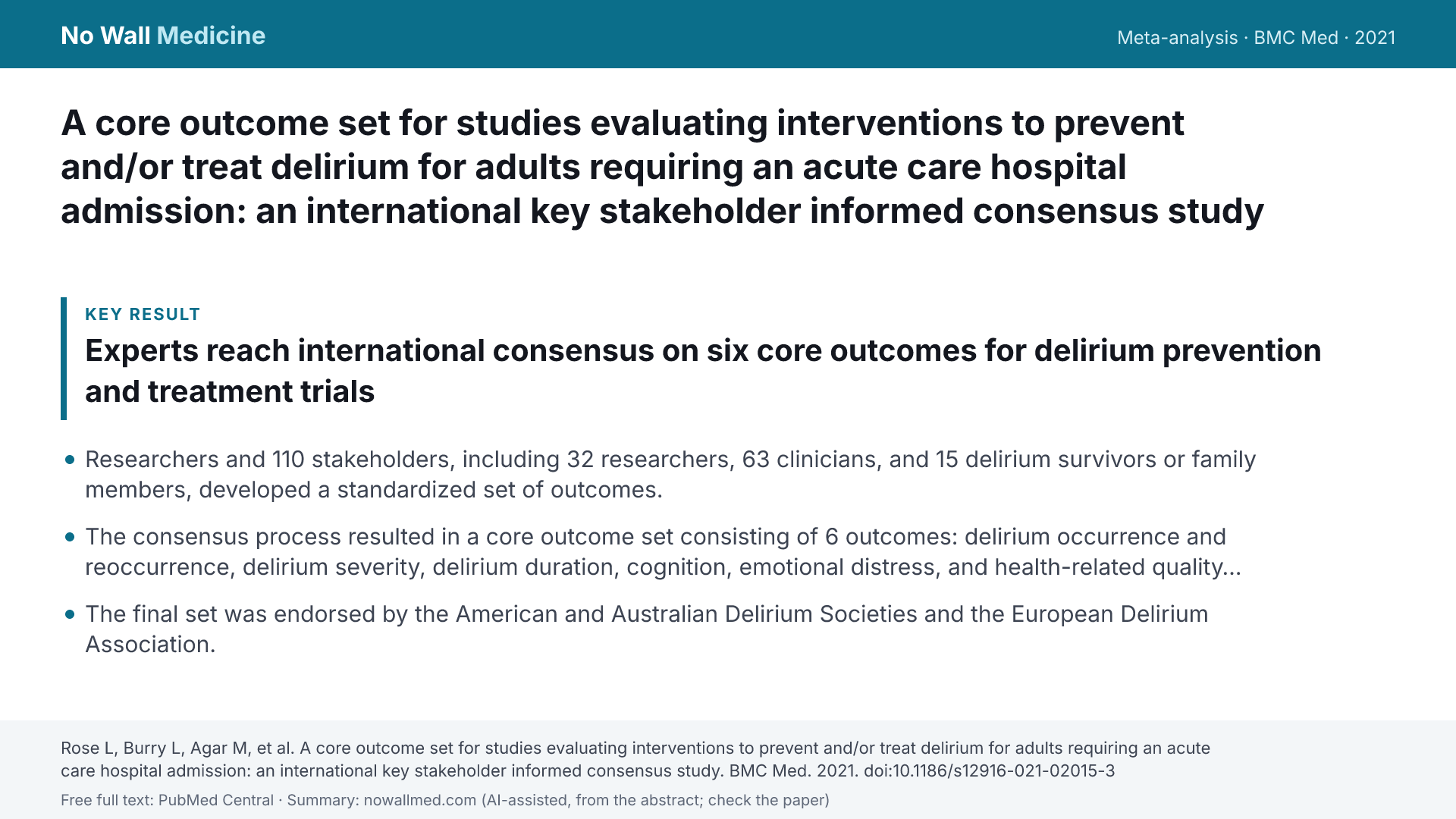
A core outcome set for studies evaluating interventions to prevent and/or treat delirium for adults requiring an acute care hospital admission: an international key stakeholder informed consensus study
Key result: Experts reach international consensus on six core outcomes for delirium prevention and treatment trials
Key points
- Researchers and 110 stakeholders, including 32 researchers, 63 clinicians, and 15 delirium survivors or family members, developed a standardized set of outcomes.
- The consensus process resulted in a core outcome set consisting of 6 outcomes: delirium occurrence and reoccurrence, delirium severity, delirium duration, cognition, emotional distress, and health-related quality of life.
- The final set was endorsed by the American and Australian Delirium Societies and the European Delirium Association.
Why it matters: Clinical trials evaluating interventions to prevent or treat delirium in acute care hospital settings currently report inconsistent and varied outcomes.
Limitation the authors note: The study excluded non-English studies and stakeholders and had small representation of delirium survivors and family members at the in-person consensus meeting.
Discussion prompts
- Would these patients look like yours? Who was left out?
- Is the main outcome one that matters to patients?
- Is the difference large enough to change what you do?
Cite: Rose L, Burry L, Agar M, et al. A core outcome set for studies evaluating interventions to prevent and/or treat delirium for adults requiring an acute care hospital admission: an international key stakeholder informed consensus study. BMC Med. 2021. doi:10.1186/s12916-021-02015-3
Free full text: PubMed Central · Summary and visual abstract: nowallmed.com/a/a-core-outcome-set-for-studies-evaluating-interventions-to-prevent-h5b7vg/ (AI-assisted from the abstract; check the paper before relying on it).