A Cross-Lagged Panel Model Testing the Impact of Physical Activity During Hospitalization on 1- and 6-Month Discharge Physical Activity and Adverse Events Among Older Adults With Dementia
Secondary data analysisBenefit found
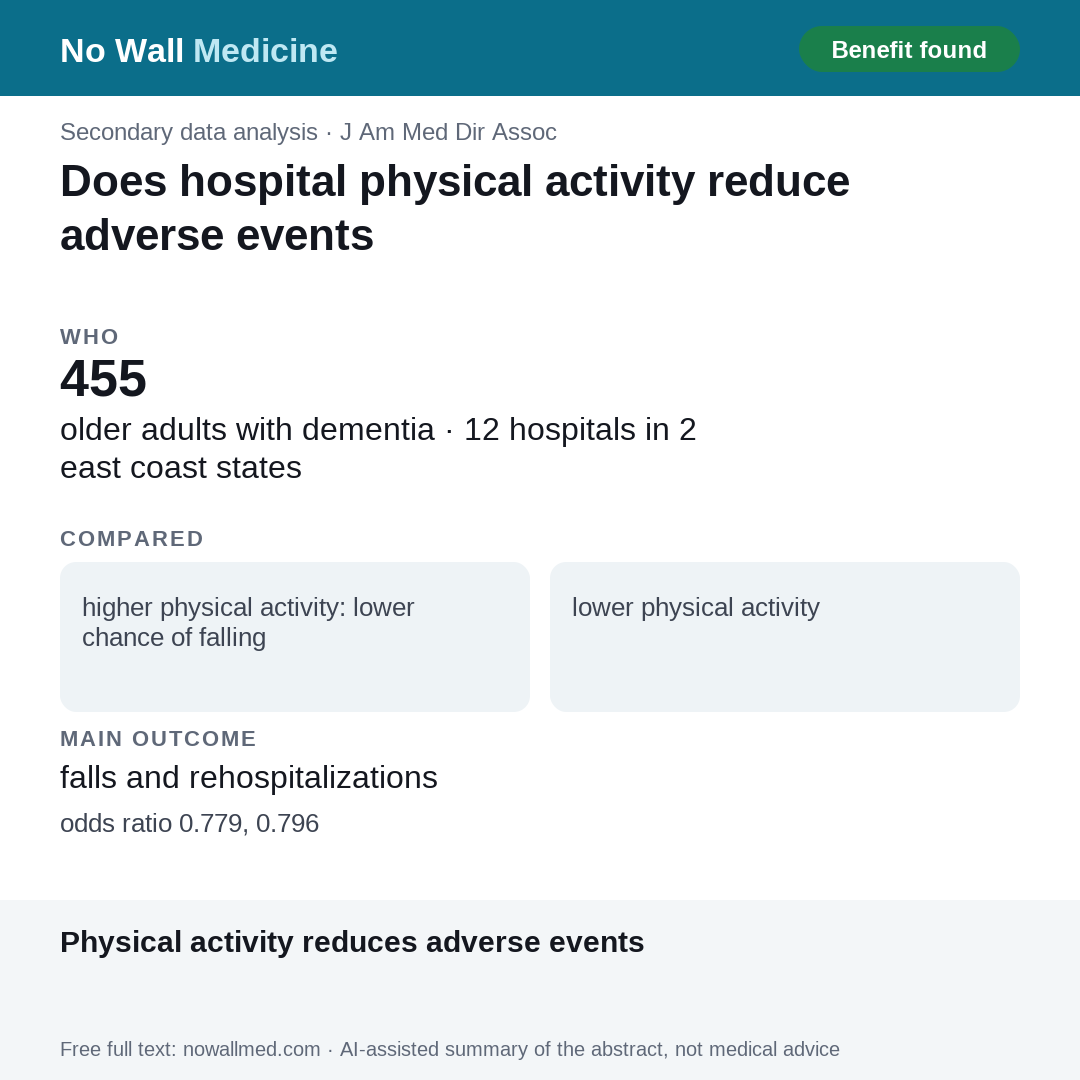
Does hospital physical activity reduce adverse events
Who
455
older adults with dementia · 12 hospitals in 2 east coast states
Compared
higher physical activity: lower chance of falling
lower physical activity
Main outcome
falls and rehospitalizations
Result: odds ratio 0.779, 0.796
Bottom line: Physical activity reduces adverse events
J Am Med Dir Assoc · 2025-07-24Download image
Abstract
Objective
The objective of this study was to examine the effects of physical activity during hospital stay on falls, emergency room visits, and rehospitalizations among older patients with dementia at 1 and 6 months post discharge. Design
This is a secondary data analysis. Bidirectional analysis using panel data from a cluster randomized clinical trial was utilized. Setting and participants
The sample comprised 455 older adults with dementia from a clustered randomized clinical trial among 12 hospitals in 2 east coast states. Methods
The bidirectional relationships between physical activity at 1 and 6 months and falls, emergency room visits, and rehospitalizations at 1 and 6 months post discharge and their relations with physical activity at discharge were assessed using cross-lagged panel models, accounting for the autoregression of physical activity and adverse events over time. Age, race, gender, cognitive status, admission location, comorbidity, and intervention groups were controlled in the modeling. Results
Physical activity at hospitalization discharge showed autoregressive associations for the 3 time points. Patients with a higher level of physical activity at discharge had a lower chance of falling (β = -0.250, SE = 0.094, OR = 0.779, P = .008) and rehospitalizations (β = -0.228, SE = 0.092, OR = 0.796, P = .013) within 1 month post discharge. Falls, emergency room visits, or rehospitalizations at 1 month were not significantly associated with physical activity, or any adverse events at 6 months. Conclusions and implications
The findings from this study highlighted the significance and value of engaging older adults, particularly those living with dementia, in physical activity when hospitalized, as this reduced the likelihood of adverse events such as falls and rehospitalization at least in the first month post discharge.
Topics
Cite this article
Zhu S, Resnick B, Boltz M, Galik E, McPherson R, Kuzmik A. A Cross-Lagged Panel Model Testing the Impact of Physical Activity During Hospitalization on 1- and 6-Month Discharge Physical Activity and Adverse Events Among Older Adults With Dementia. J Am Med Dir Assoc. 2025. doi:10.1016/j.jamda.2025.105767
Spotted a mistake? Suggest a correction
Top studies every Monday
The week’s key trials and guidelines in your specialties, plus any topics you follow. By email, free.
Get the weekly digest