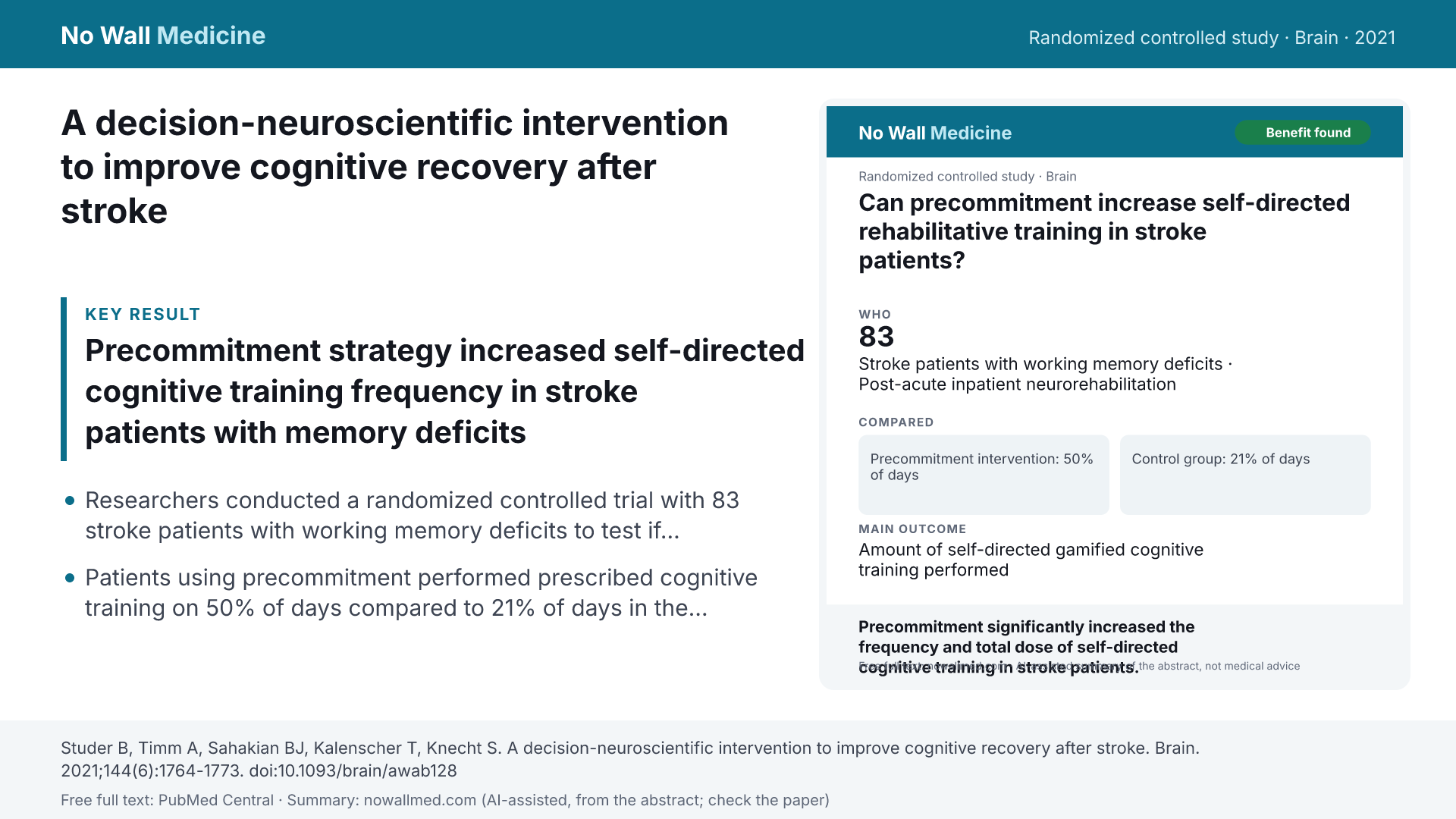
Precommitment strategy increased self-directed cognitive training frequency in stroke patients with memory deficits
A decision-neuroscientific intervention to improve cognitive recovery after stroke
Randomized controlled studyBenefit found
Can precommitment increase self-directed rehabilitative training in stroke patients?
Who
83
Stroke patients with working memory deficits · Post-acute inpatient neurorehabilitation
Compared
Precommitment intervention: 50% of days
Control group: 21% of days
Main outcome
Amount of self-directed gamified cognitive training performed
Result: d = 0.87, 95% confidence interval (CI95%) = 0.31 to 1.42
Bottom line: Precommitment significantly increased the frequency and total dose of self-directed cognitive training in stroke patients.
Limitation: Results warrant a full clinical trial to link interventions directly with clinical outcome.
Brain · 2021-03-21Download image
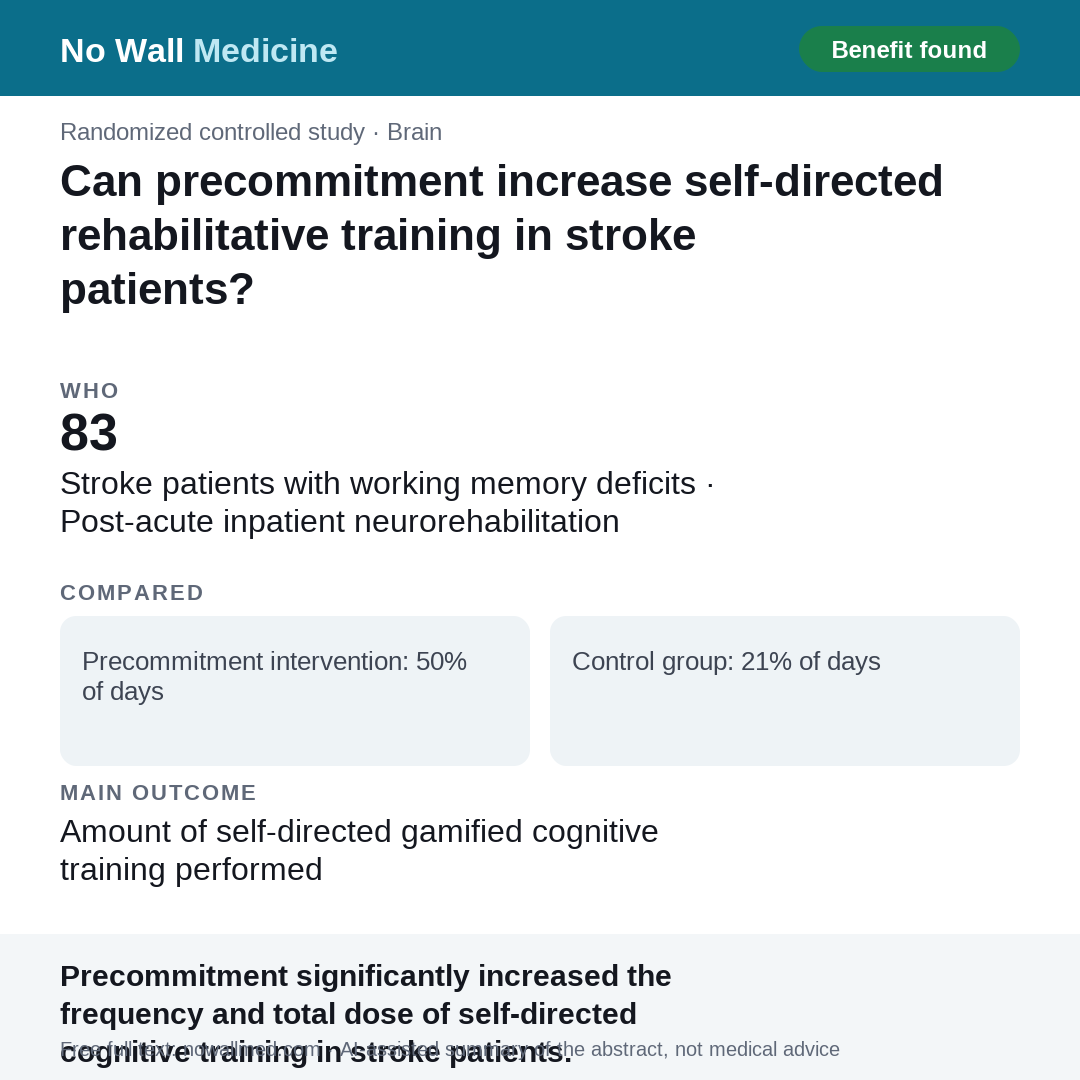
Clinical question: Can precommitment increase self-directed rehabilitative training in stroke patients?
Why it matters: Motivational hurdles can limit the amount of rehabilitative training patients complete, which is important because functional recovery after stroke is dose-dependent.
Key points
- Researchers conducted a randomized controlled trial with 83 stroke patients with working memory deficits to test if upfront voluntary choice restriction increased rehabilitative training.
- Patients using precommitment performed prescribed cognitive training on 50% of days compared to 21% of days in the control group.
- The precommitment group reached a 3-fold higher total training dose of 90.21 versus 33.60 minutes.
Headline and key points written with AI from the paper’s abstract, with every number checked against it. Read the paper before relying on them.
Was this summary helpful?
Subject terms
Headline, design, result, key points, caveat and citation as plain text.
Cite this article
Studer B, Timm A, Sahakian BJ, Kalenscher T, Knecht S. A decision-neuroscientific intervention to improve cognitive recovery after stroke. Brain. 2021. doi:10.1093/brain/awab128
Spotted a mistake? Suggest a correction