Artificial intelligence tool speeds up detection of colorectal cancer metastases in lymph node samples
A Deep Neural Network-Based Decision Support Tool for the Detection of Lymph Node Metastases in Colorectal Cancer Specimens
Randomized crossover trialBenefit found
Can a deep neural network improve detection and speed of lymph node metastases?
Who
1517
Digitized histologic sections of lymph nodes from colorectal cancer specimens
Compared
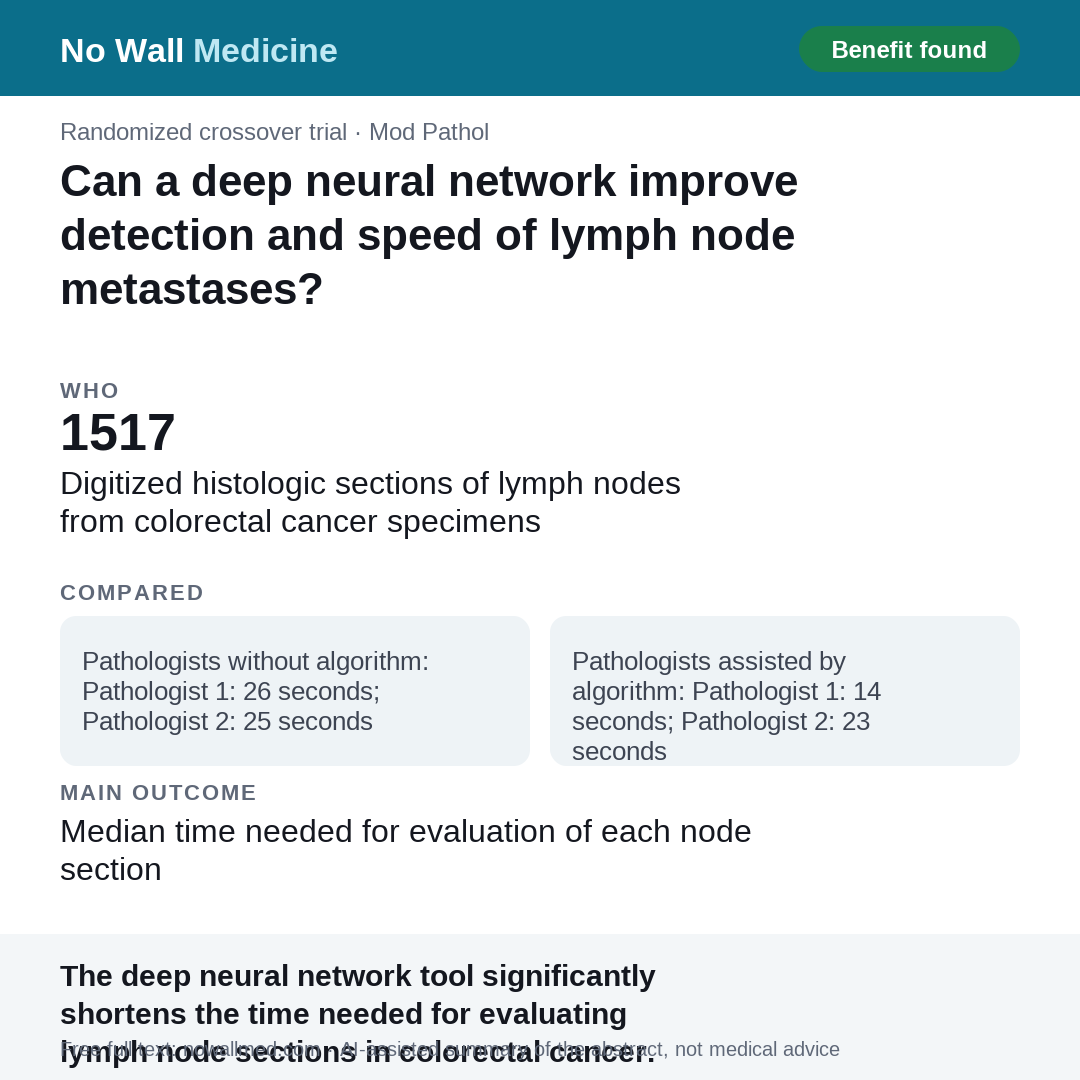
Pathologists without algorithm: Pathologist 1: 26 seconds; Pathologist 2: 25 seconds
Pathologists assisted by algorithm: Pathologist 1: 14 seconds; Pathologist 2: 23 seconds
Main outcome
Median time needed for evaluation of each node section
Bottom line: The deep neural network tool significantly shortens the time needed for evaluating lymph node sections in colorectal cancer.
Mod Pathol · 2023-01-10Download image
Clinical question: Can a deep neural network improve detection and speed of lymph node metastases?
Why it matters: Identifying cancer spread in lymph nodes is a time-consuming task for pathologists that is essential for planning postoperative treatment.
Key points
- Researchers tested a deep neural network, a type of artificial intelligence, on 288 digitized slide images containing 1517 lymph node sections.
- The tool achieved a sensitivity of 0.990 for detecting cancer metastases and a median pixel-level accuracy of 0.952 on slides with cancerous areas.
- Using the algorithm shortened the median evaluation time for the first pathologist from 26 to 14 seconds and for the second from 25 to 23 seconds.
Headline and key points written with AI from the paper’s abstract, with every number checked against it. Read the paper before relying on them.
Was this summary helpful?
Subject terms
Cite this article
Kindler C, Elfwing S, Öhrvik J, Nikberg M. A Deep Neural Network-Based Decision Support Tool for the Detection of Lymph Node Metastases in Colorectal Cancer Specimens. Mod Pathol. 2023. doi:10.1016/j.modpat.2022.100015
Spotted a mistake? Suggest a correction
Top studies every Monday
The week’s key trials and guidelines in your specialties, plus any topics you follow. By email, free.
Get the weekly digest