Digital behavioral intervention reduced sugar-sweetened beverage consumption among adults living in Appalachia
A digital behavioral intervention to reduce sugar-sweetened beverage consumption: a randomized, controlled trial
Randomized, controlled trialBenefit found
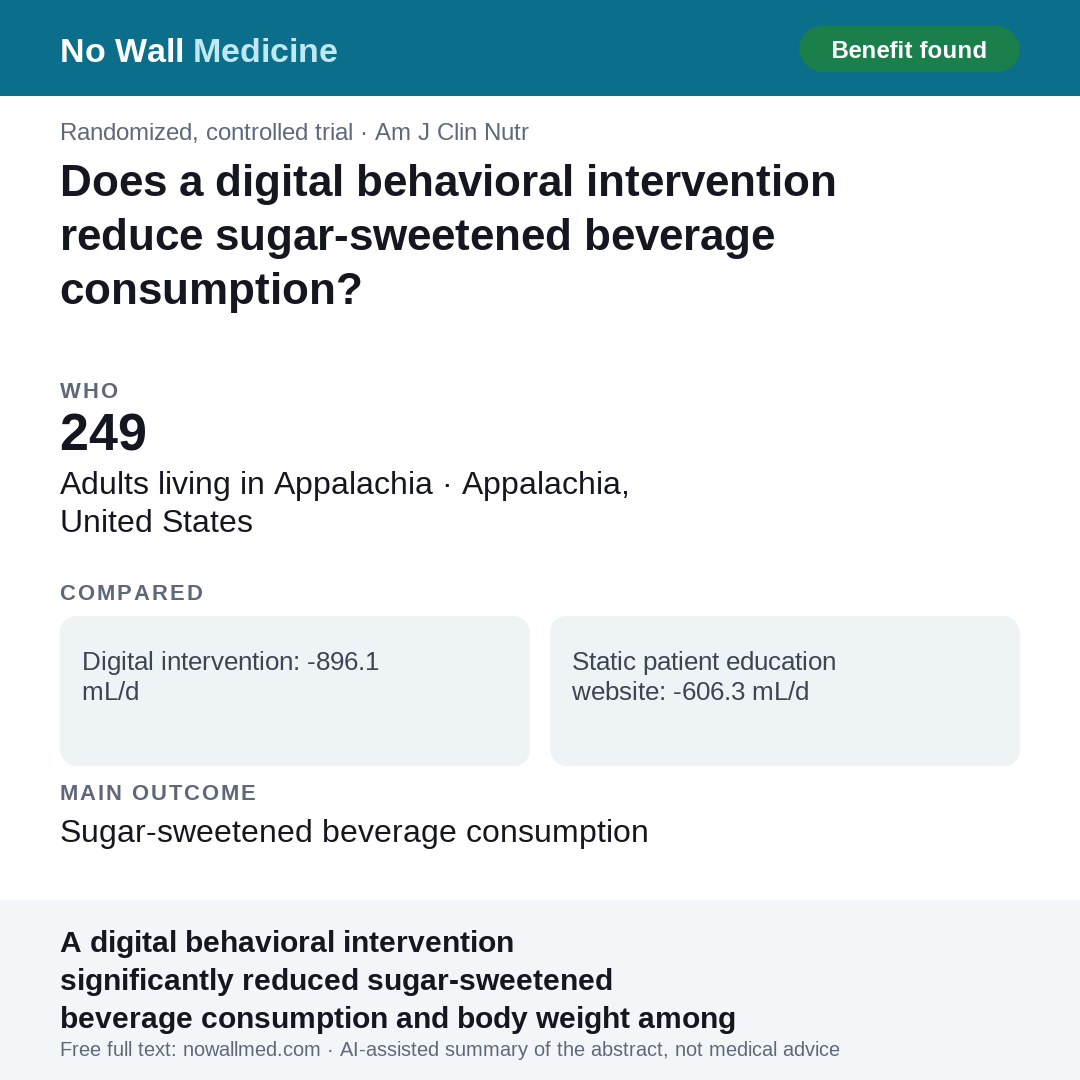
Does a digital behavioral intervention reduce sugar-sweetened beverage consumption?
Who
249
Adults living in Appalachia · Appalachia, United States
Compared
Digital intervention: -896.1 mL/d
Static patient education website: -606.3 mL/d
Main outcome
Sugar-sweetened beverage consumption
Result: -289.8 (95% CI: -493.9, -88.7) mL/d
Bottom line: A digital behavioral intervention significantly reduced sugar-sweetened beverage consumption and body weight among Appalachian adults.
Am J Clin Nutr · 2025-06-11Download image
Clinical question: Does a digital behavioral intervention reduce sugar-sweetened beverage consumption?
Why it matters: Reducing the consumption of sugar-sweetened beverages is a global public health priority, particularly in regions with notable consumption disparities like Appalachia.
Key points
- Researchers conducted a randomized controlled trial with 249 adults in Appalachia, comparing a digital behavioral intervention to a static patient education website.
- At 9 weeks, the digital intervention group consumed 289.8 mL/d less sugar-sweetened beverages than the comparison group, and this difference remained at 6 months.
- The digital intervention group also showed a significant reduction in body weight compared to the comparison group at the 6-month assessment.
Headline and key points written with AI from the paper’s abstract, with every number checked against it. Read the paper before relying on them.
Topics
Cite this article
Zoellner JM, You W, Porter K, Reid AL, Brock DP, Markwalter T. A digital behavioral intervention to reduce sugar-sweetened beverage consumption: a randomized, controlled trial. Am J Clin Nutr. 2025. doi:10.1016/j.ajcnut.2025.06.010
Spotted a mistake? Suggest a correction
Top studies every Monday
The week’s key trials and guidelines in your specialties, plus any topics you follow. By email, free.
Get the weekly digest