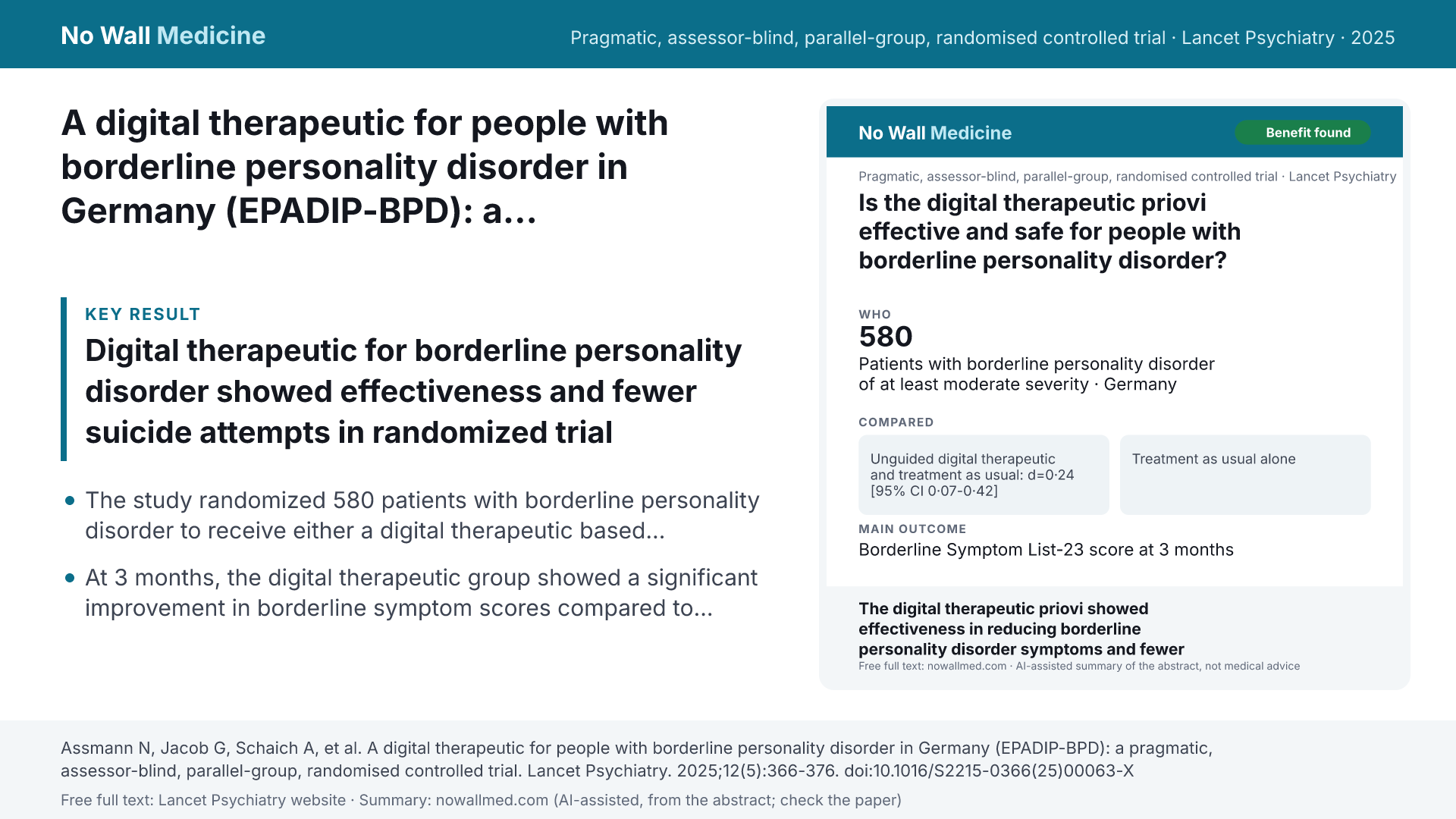
Digital therapeutic for borderline personality disorder showed effectiveness and fewer suicide attempts in randomized trial
A digital therapeutic for people with borderline personality disorder in Germany (EPADIP-BPD): a pragmatic, assessor-blind, parallel-group, randomised controlled trial
Pragmatic, assessor-blind, parallel-group, randomised controlled trialBenefit found
Is the digital therapeutic priovi effective and safe for people with borderline personality disorder?
Who
580
Patients with borderline personality disorder of at least moderate severity · Germany
Compared
Unguided digital therapeutic and treatment as usual: d=0·24 [95% CI 0·07-0·42]
Treatment as usual alone
Main outcome
Borderline Symptom List-23 score at 3 months
Result: d=0·24 (95% CI 0·07 to 0·42)
Bottom line: The digital therapeutic priovi showed effectiveness in reducing borderline personality disorder symptoms and fewer suicide attempts compared to usual care.
Funded by: GAIA
Lancet Psychiatry · 2025-04-17Download image
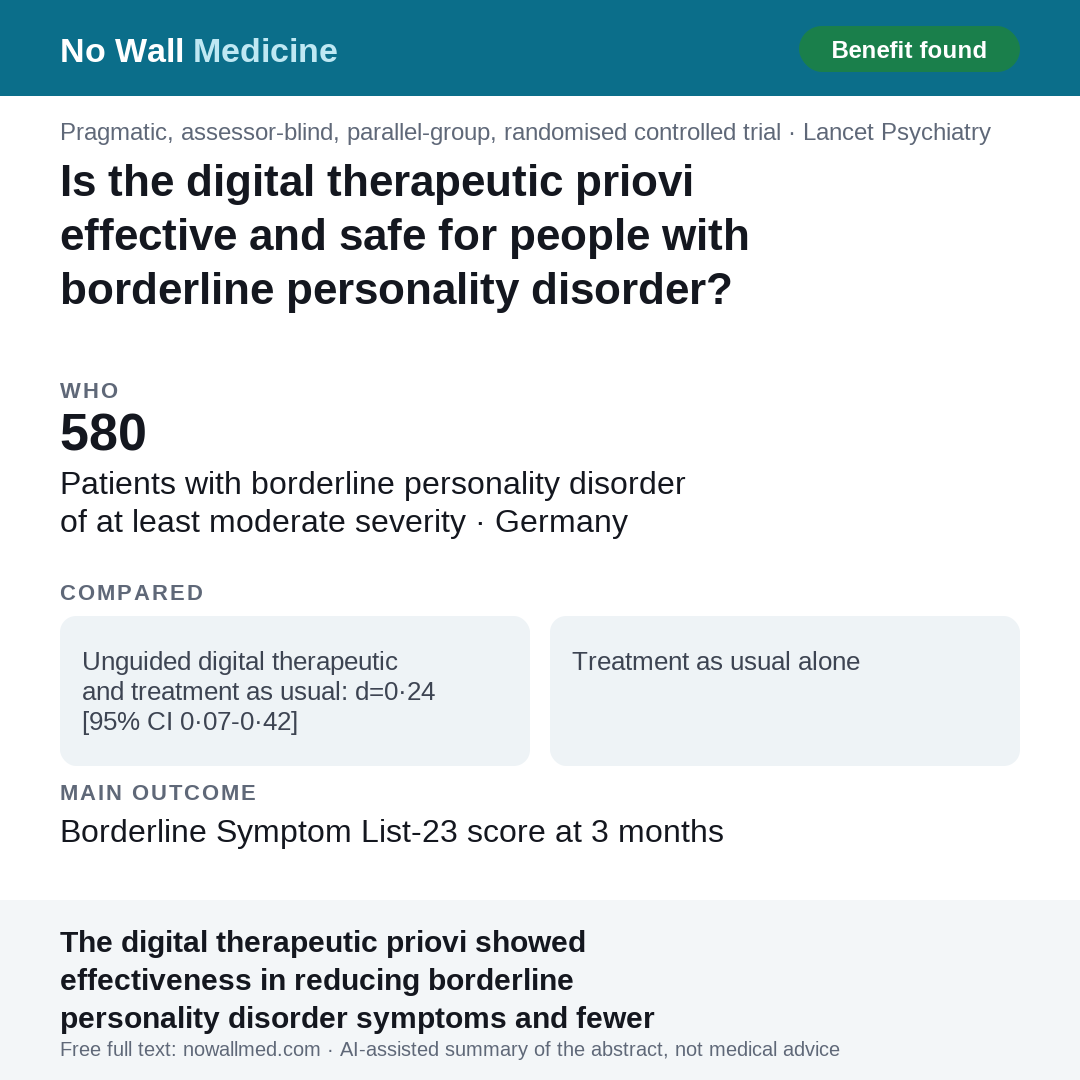
Clinical question: Is the digital therapeutic priovi effective and safe for people with borderline personality disorder?
Why it matters: Fewer than 25% of patients with borderline personality disorder receive psychotherapy that follows clinical guidelines.
Key points
- The study randomized 580 patients with borderline personality disorder to receive either a digital therapeutic based on schema therapy plus usual care or usual care plus self-help material.
- At 3 months, the digital therapeutic group showed a significant improvement in borderline symptom scores compared to the control group (p=0.0005).
- The intervention group had significantly fewer suicide attempts, with 7 cases compared to 21 in the control group (p=0.0081).
Headline and key points written with AI from the paper’s abstract, with every number checked against it. Read the paper before relying on them.
Was this summary helpful?
Abstract
Background
Fewer than 25% of patients with borderline personality disorder (BPD) receive guideline-adherent psychotherapy. Digital therapeutics can help reduce this gap. Therefore, we tested the effectiveness and safety of priovi, a digital therapeutic for BPD. Methods
We conducted a pragmatic, assessor-blind, parallel-group, randomised controlled trial, recruiting patients with BPD, according to DSM-5 classification, of at least moderate severity on the 23-item Borderline Symptom List (BSL-23) via online advertisements in Germany. Patients were aged 18 years or older, agreed on an emergency plan for suicidal crises, and gave informed consent to participate. Patients were excluded if they had a primary diagnosis of a substance use disorder or a diagnosis of a psychotic disorder. Simple computerised coin-toss randomisation (1:1) without stratification was used to assign patients to either the unguided digital therapeutic based on schema therapy together with treatment as usual (TAU; intervention group) or TAU alone (control group) and study investigators were masked to group assignment until after the analysis of the primary outcome and main safety outcome. All patients could use any form of usual care. The control group received freely available BPD-specific self-help material. The primary outcome was the time by treatment interaction in the intention-to-treat sample at 3 months measured by BSL-23 score. Safety was established via the number of serious adverse events (ie, suicide attempts, other life-threatening events, and hospitalisation), assessed via online questionnaire. Individuals with BPD were involved in the development of the digital therapeutic, but not in the design of this study. The trial was registered on German Clinical Trials Register (DRKS00028888) and is completed. Findings
Between May 3 and Oct 20, 2022, 1766 patients were screened for eligibility and 580 patients (520 [90%] women, 47 [8%] men, and 13 [2%] gender diverse) were randomly assigned to the intervention group (n=302) and control group (n=278). Ethnicity data were not recorded. At the primary timepoint of 3 months, 35 (12%) patients dropped out of the intervention group and 15 (5%) of the control group. The median age of patients was 29 years (IQR 24-37). Intention-to-treat analysis with linear mixed models showed a significant time by treatment interaction (p=0·0005) at 3 months in favour of the intervention group (d=0·24 [95% CI 0·07-0·42]). Regarding safety, there were significantly fewer suicide attempts in the intervention group (n=7) than in the control group (n=21; incidence rate ratio 0·34 [95% CI 0·14-0·79]; p=0·0081) and there were no differences regarding other serious adverse events. Interpretation
This trial provides tentative evidence of the effectiveness and absence of safety concerns of the digital therapeutic, priovi, in the treatment of individuals with BPD. Funding
GAIA.
Abstract reproduced under the article’s CC BY licence.
Subject terms
Cite this article
Assmann N, Jacob G, Schaich A, et al. A digital therapeutic for people with borderline personality disorder in Germany (EPADIP-BPD): a pragmatic, assessor-blind, parallel-group, randomised controlled trial. Lancet Psychiatry. 2025. doi:10.1016/S2215-0366(25)00063-X
Spotted a mistake? Suggest a correction