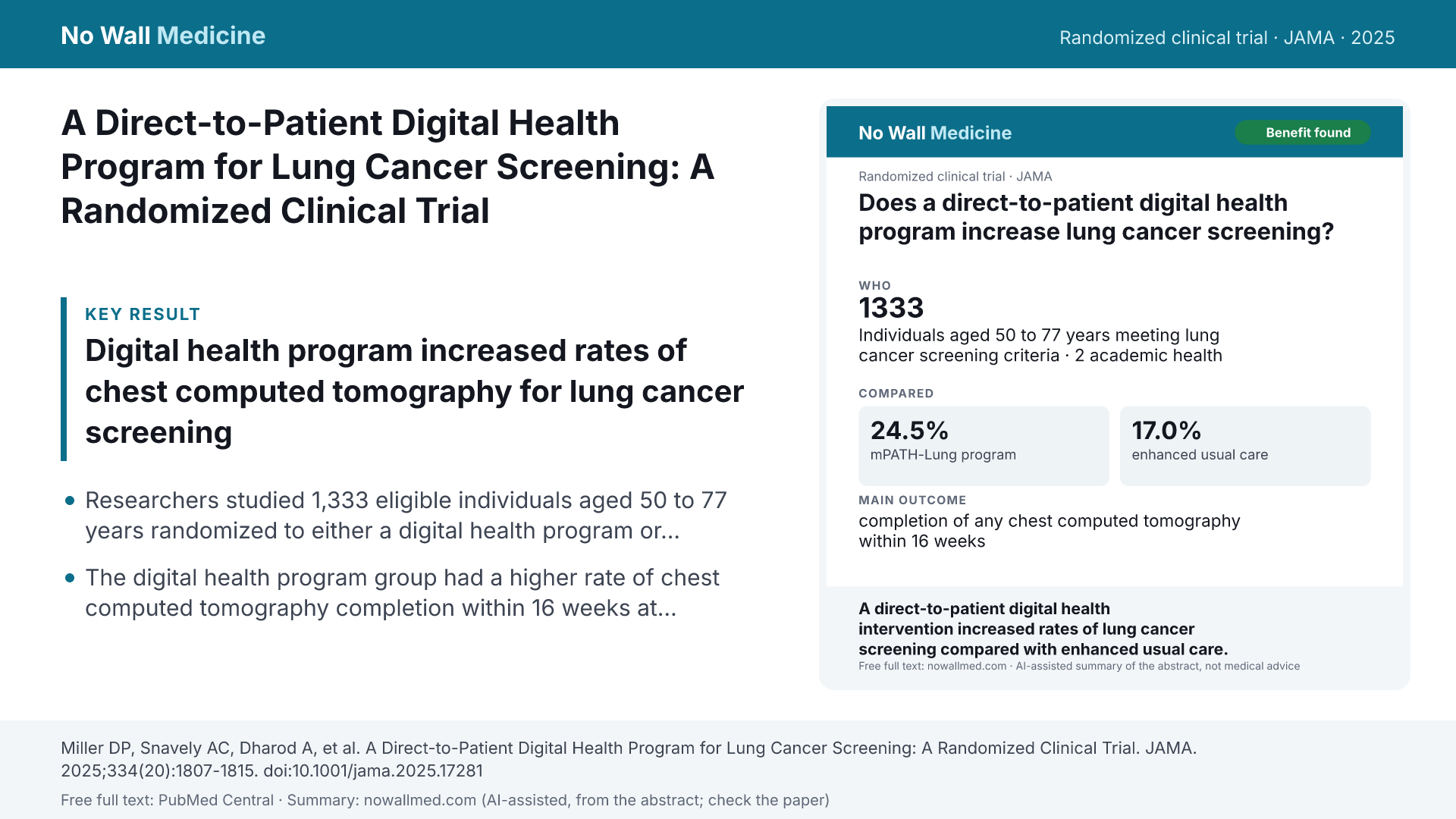
Digital health program increased rates of chest computed tomography for lung cancer screening
A Direct-to-Patient Digital Health Program for Lung Cancer Screening: A Randomized Clinical Trial
Randomized clinical trialBenefit found
Does a direct-to-patient digital health program increase lung cancer screening?
Who
1333
Individuals aged 50 to 77 years meeting lung cancer screening criteria · 2 academic health systems in the southeastern US
Compared
24.5%mPATH-Lung program (164/669)
17.0%enhanced usual care (113/664)
Main outcome
completion of any chest computed tomography within 16 weeks
Result: odds ratio, 1.6 (95% CI, 1.2-2.1)
Bottom line: A direct-to-patient digital health intervention increased rates of lung cancer screening compared with enhanced usual care.
JAMA · 2025-10-20Download image
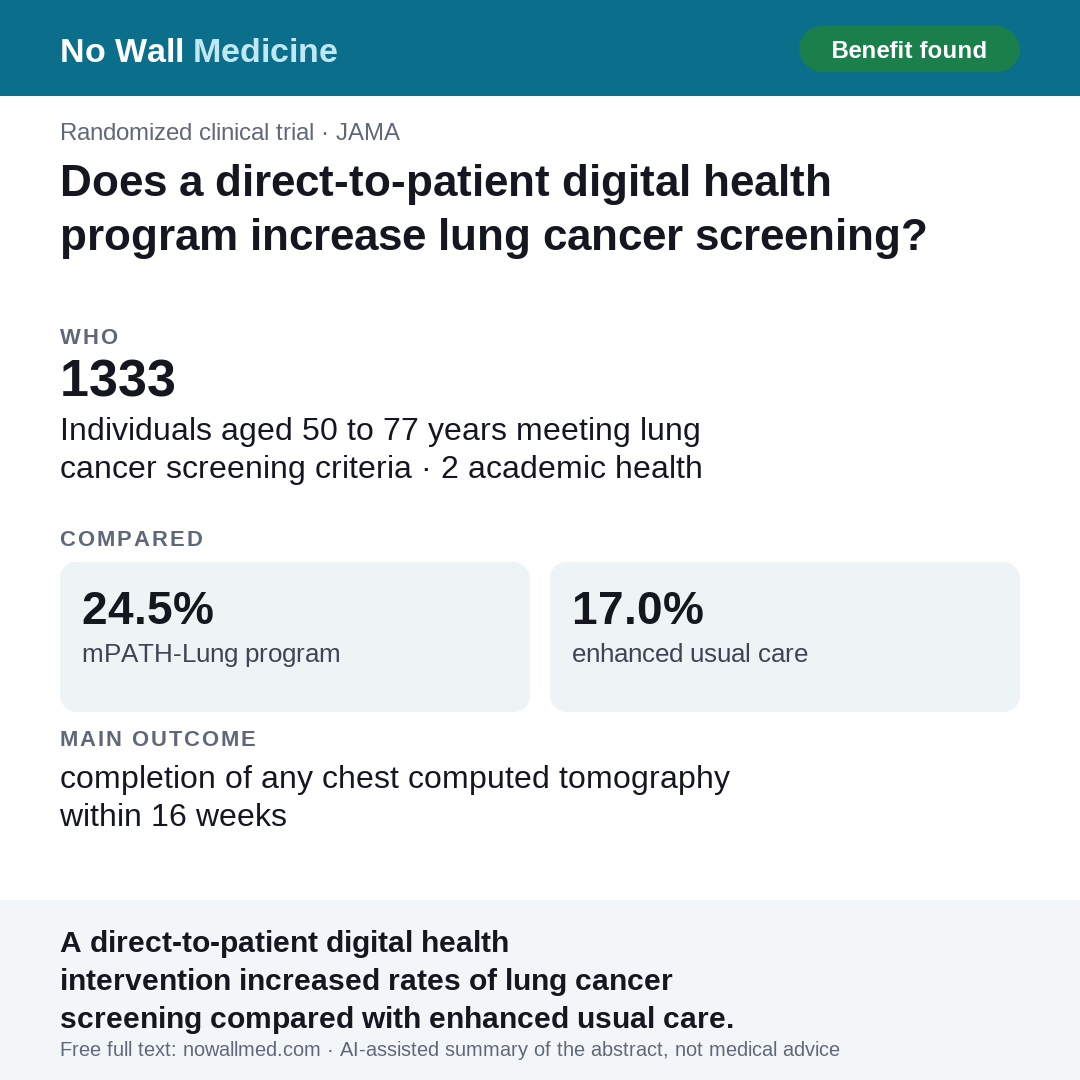
Clinical question: Does a direct-to-patient digital health program increase lung cancer screening?
Why it matters: Less than 20% of eligible individuals in the US undergo lung cancer screening using chest computed tomography scans.
In absolute numbers
mPATH-Lung program: 24.5% · enhanced usual care: 17% → a difference of 7.5 percentage points, so about 14 people would need the treatment for 1 more to benefit (number needed to treat) over the trial’s follow-up.
Worked out by us from the two group results above, not reported by the authors. Check the paper for the exact outcome and timing.
Key points
- Researchers studied 1,333 eligible individuals aged 50 to 77 years randomized to either a digital health program or enhanced usual care.
- The digital health program group had a higher rate of chest computed tomography completion within 16 weeks at 24.5% compared to 17.0% in the control group.
- Among those screened, false-positive results occurred in 12.7% of the digital program group and 8.4% of the control group.
Headline and key points written with AI from the paper’s abstract, with every number checked against it. Read the paper before relying on them.
Was this summary helpful?
Subject terms
Cite this article
Miller DP, Snavely AC, Dharod A, et al. A Direct-to-Patient Digital Health Program for Lung Cancer Screening: A Randomized Clinical Trial. JAMA. 2025. doi:10.1001/jama.2025.17281
Spotted a mistake? Suggest a correction