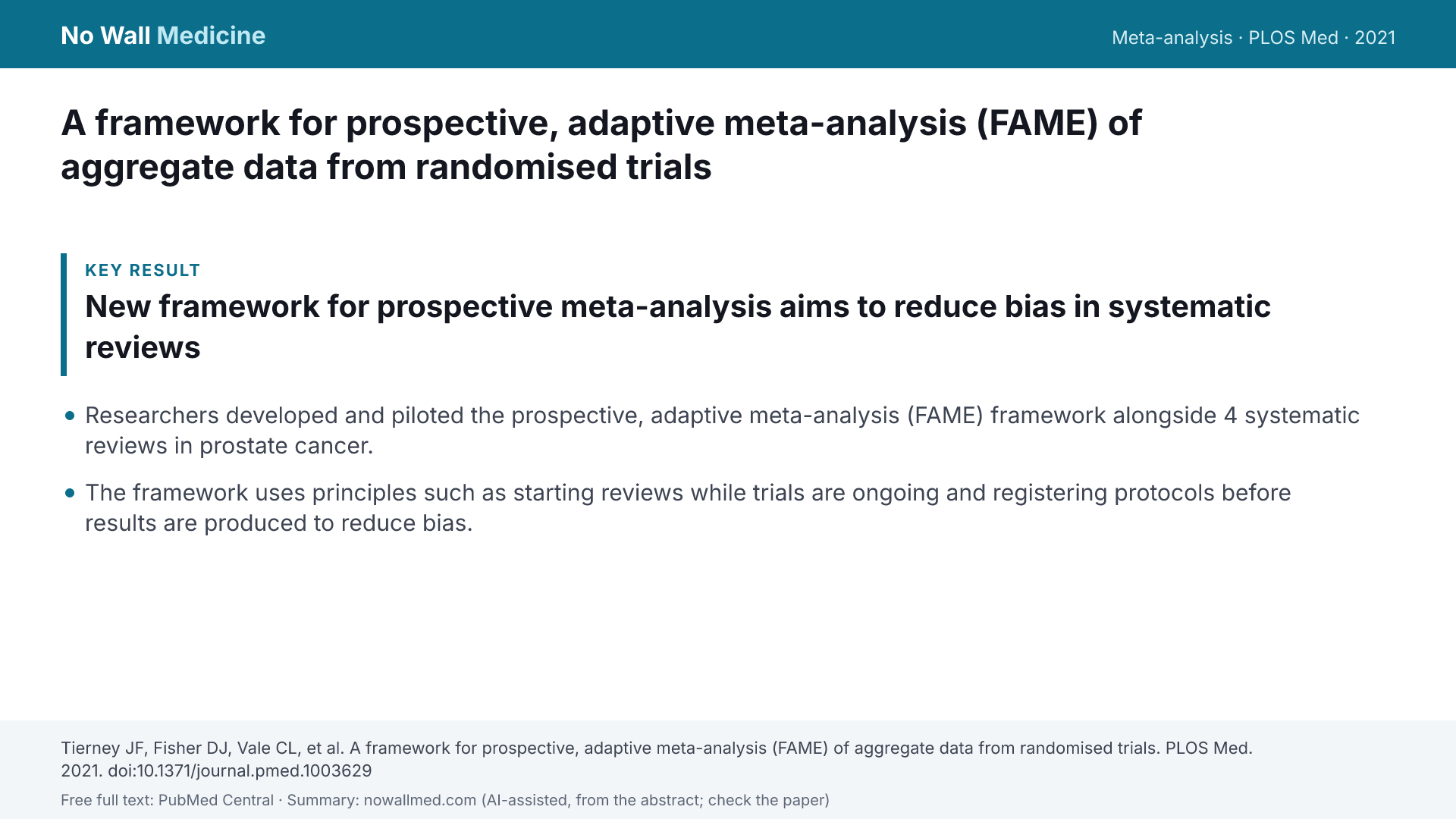
A framework for prospective, adaptive meta-analysis (FAME) of aggregate data from randomised trials
Key result: New framework for prospective meta-analysis aims to reduce bias in systematic reviews
Key points
- Researchers developed and piloted the prospective, adaptive meta-analysis (FAME) framework alongside 4 systematic reviews in prostate cancer.
- The framework uses principles such as starting reviews while trials are ongoing and registering protocols before results are produced to reduce bias.
Why it matters: Retrospective systematic reviews may be prone to bias from prior knowledge of trial results or the omission of unpublished data.
Discussion prompts
- Would these patients look like yours? Who was left out?
- Is the main outcome one that matters to patients?
- Is the difference large enough to change what you do?
Cite: Tierney JF, Fisher DJ, Vale CL, et al. A framework for prospective, adaptive meta-analysis (FAME) of aggregate data from randomised trials. PLOS Med. 2021. doi:10.1371/journal.pmed.1003629
Free full text: PubMed Central · Summary and visual abstract: nowallmed.com/a/a-framework-for-prospective-adaptive-meta-analysis-fame-of-aggregate-1tl2m7f/ (AI-assisted from the abstract; check the paper before relying on it).