Oxygenated perfusion before liver transplantation reduced early allograft dysfunction compared to static cold storage
A French multicenter randomized controlled trial of hypothermic oxygenated perfusion in extended criteria donor liver transplantation
Multicenter randomized controlled trialBenefit found
Does hypothermic oxygenated perfusion reduce early allograft dysfunction in extended criteria donor liver transplantation?
Who
262
Extended criteria donor liver grafts from donation after brain death · 8 French centers
Compared
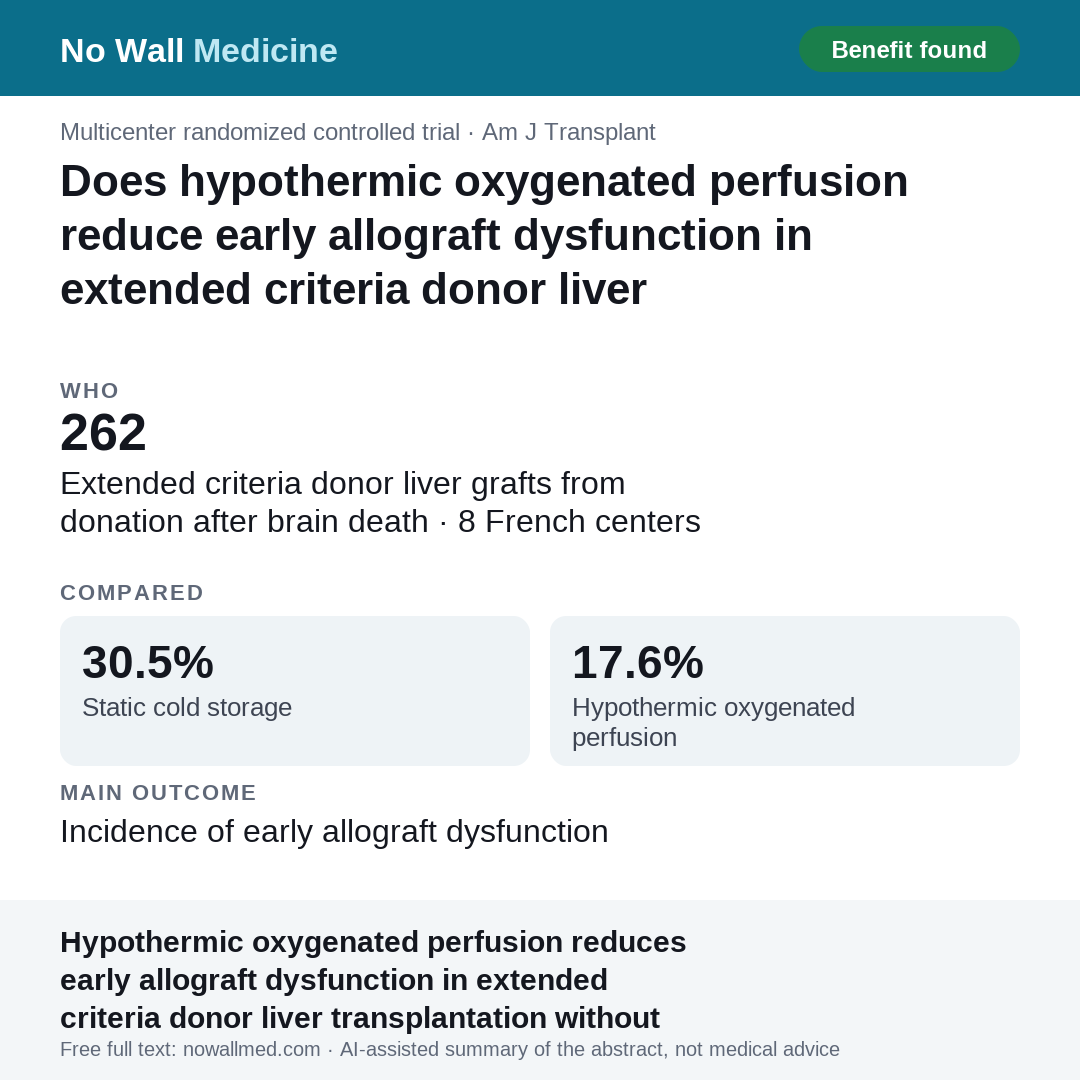
30.5%Static cold storage
17.6%Hypothermic oxygenated perfusion
Main outcome
Incidence of early allograft dysfunction
Bottom line: Hypothermic oxygenated perfusion reduces early allograft dysfunction in extended criteria donor liver transplantation without affecting mortality.
Am J Transplant · 2025-10-17Download image
Clinical question: Does hypothermic oxygenated perfusion reduce early allograft dysfunction in extended criteria donor liver transplantation?
Why it matters: It is unclear if hypothermic oxygenated perfusion, a method of preserving organs with cold oxygenated fluid, reduces early allograft dysfunction in livers from extended criteria donors.
Key points
- Researchers studied 262 liver grafts from deceased donors in 8 French centers, comparing static cold storage to one to four hours of hypothermic oxygenated perfusion.
- The use of hypothermic oxygenated perfusion resulted in a lower rate of early allograft dysfunction, which is early organ failure, at 17.6% compared to 30.5%.
- There were no significant differences between groups regarding 90-day mortality, which was 5.3% versus 2.3%, or the rate of severe complications.
Headline and key points written with AI from the paper’s abstract, with every number checked against it. Read the paper before relying on them.
Topics
Cite this article
Lesurtel M, Mohkam K, Allard MA, Adam R, Robin F, Rayar M. A French multicenter randomized controlled trial of hypothermic oxygenated perfusion in extended criteria donor liver transplantation. Am J Transplant. 2025. doi:10.1016/j.ajt.2025.10.006
Spotted a mistake? Suggest a correction
Top studies every Monday
The week’s key trials and guidelines in your specialties, plus any topics you follow. By email, free.
Get the weekly digest