Gamified mobile health intervention increased physical activity and improved mental health in college students
A Gamified Mobile Health Intervention to Promote Physical Activity, Executive Function, and Mental Health in College Students: Randomized Controlled Trial
Randomized, open-label, parallel-group controlled trialBenefit found
Does a gamified mobile health intervention improve physical activity and health in college students?
Who
160
160 college students aged 18-25 years · Yantai University
Compared
Intervention group: daily steps: mean 10,356, SD 1245
Control group: daily steps: mean 8242, SD 1087
Main outcome
physical activity and adherence
Result: daily steps: d=1.81, 95% CI 1.44-2.18
Bottom line: Gamified mobile health interventions significantly enhance physical activity, adherence, and several health outcomes in college students.
J Med Internet Res · 2026-04-07Download image
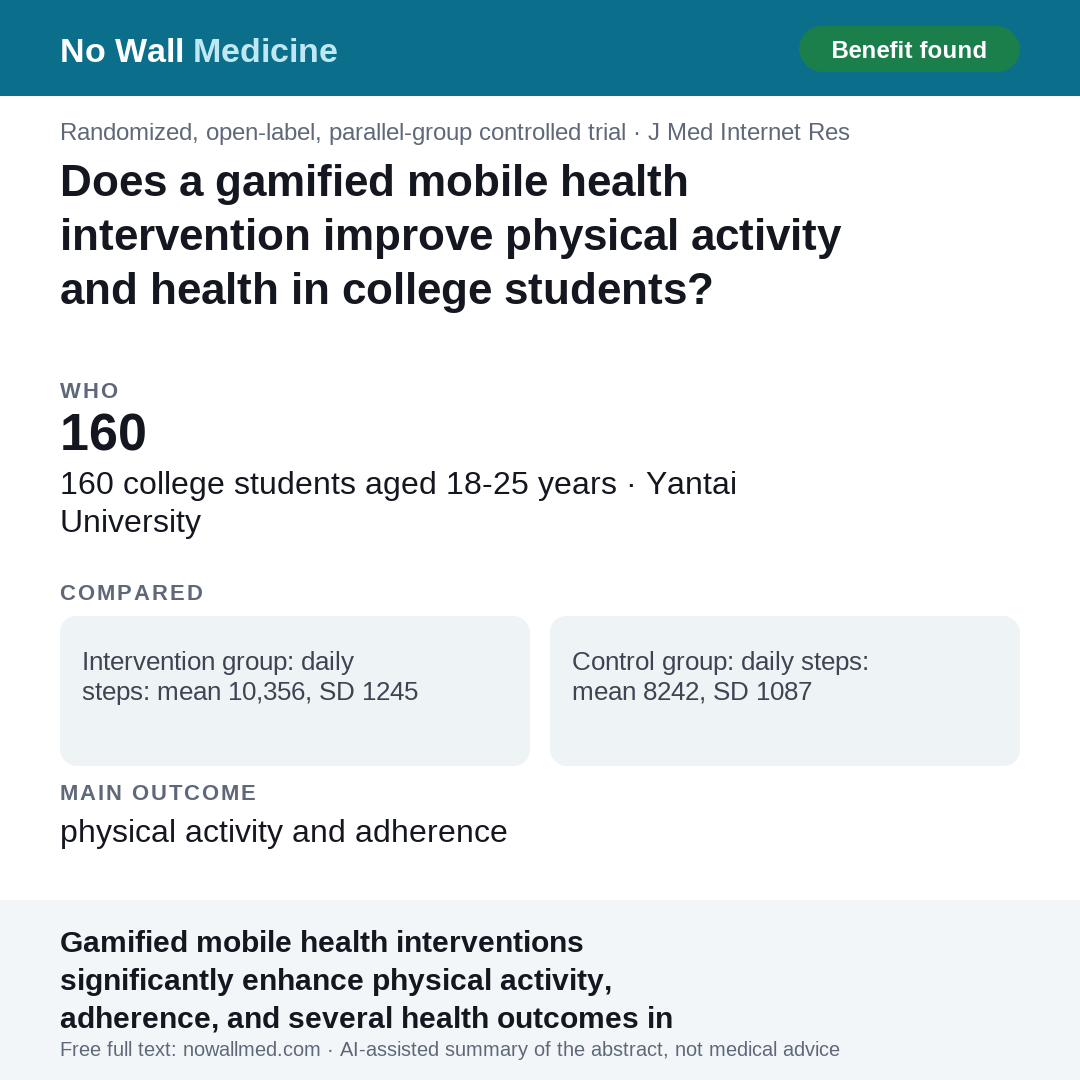
Clinical question: Does a gamified mobile health intervention improve physical activity and health in college students?
Why it matters: Traditional health interventions for college students often face low adherence, and researchers wanted to see if adding competition and rewards to mobile health apps could improve engagement.
Key points
- Researchers studied 160 college students randomized to either a gamified mobile health group or a control group receiving only monitoring for 8 weeks.
- The gamified group showed significantly higher daily steps, mean 10,356, compared to 8,242 in the control group, and higher daily moderate-to-vigorous physical activity.
- Secondary benefits for the gamified group included increased skeletal muscle mass, decreased body fat percentage, faster run times, and fewer depressive symptoms.
Headline and key points written with AI from the paper’s abstract, with every number checked against it. Read the paper before relying on them.
Topics
Cite this article
Yang M, Guo Y, Li Z, Jiang L, Gao Y, Yang S. A Gamified Mobile Health Intervention to Promote Physical Activity, Executive Function, and Mental Health in College Students: Randomized Controlled Trial. J Med Internet Res. 2026. doi:10.2196/82769
Spotted a mistake? Suggest a correction