Local artificial intelligence framework reduces time spent on spine surgery systematic reviews by 91.1 percent
A Locally Executed Agentic Artificial Intelligence Framework for Deduplication, Screening, and Structured Data Extraction in Spine Surgery Systematic Reviews: A PRISMA-Transparent Reporting of Artificial Intelligence in Comprehensive Evidence Synthesis-Compliant Evaluation
Validation study with human-in-the-loop validationBenefit found
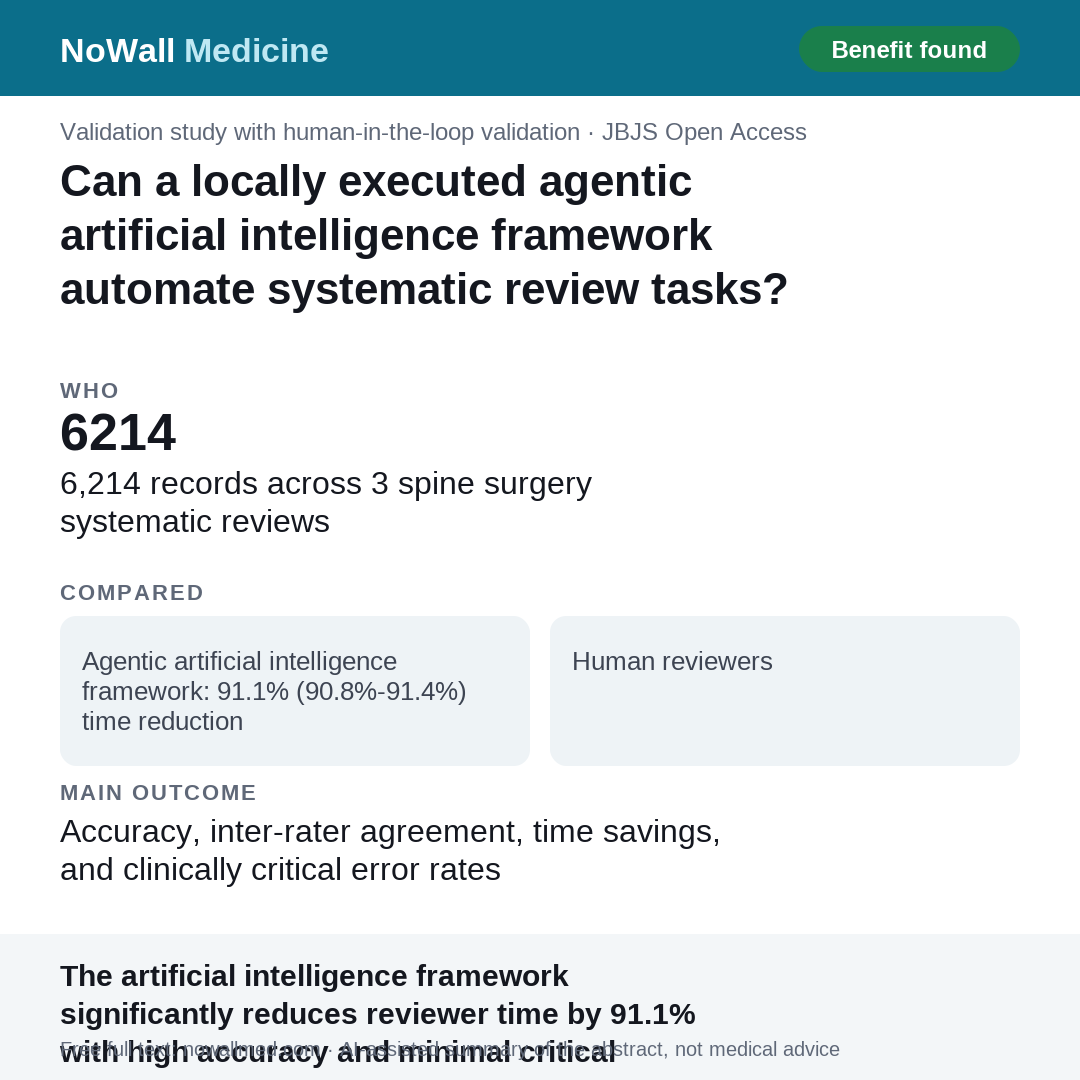
Can a locally executed agentic artificial intelligence framework automate systematic review tasks?
Who
6214
6,214 records across 3 spine surgery systematic reviews
Compared
Agentic artificial intelligence framework: 91.1% (90.8%-91.4%) time reduction
Human reviewers
Main outcome
Accuracy, inter-rater agreement, time savings, and clinically critical error rates
Bottom line: The artificial intelligence framework significantly reduces reviewer time by 91.1% with high accuracy and minimal critical errors.
JBJS Open Access · 2026-08-18Download image
Clinical question: Can a locally executed agentic artificial intelligence framework automate systematic review tasks?
Why it matters: Systematic reviews and meta-analyses are currently time-consuming and labor-intensive processes for researchers.
Key points
- Researchers tested a local artificial intelligence framework against human reviewers across 3 spine surgery systematic reviews involving 6,214 records.
- The system reduced reviewer time by 91.1% (90.8%-91.4%), saving a mean of 19.5 hours per review.
- The framework achieved high agreement with humans in deduplication (κ = 0.98) and screening (κ = 0.91) while reducing full-text review volume by 83%.
Headline and key points written with AI from the paper’s abstract, with every number checked against it. Read the paper before relying on them.
Spotted a mistake? Suggest a correction
More in Orthopedics & Sports Medicine
Higher pre-treatment expectations associated with less pain and better function after physiotherapy
Higher pre-treatment expectations are associated with less pain and better physical function and quality of life after physiotherapy for knee osteoarthritis
Patellofemoral osteochondritis dissecans patients have distinct knee anatomy
Is There an Association Between Abnormal Patellofemoral Morphology and Patellofemoral Osteochondritis Dissecans in Pediatric Patients?
Newly Diagnosed Dyslipidemia Linked to Higher Risk of Osteoarthritis
Association Between Newly Diagnosed Dyslipidemia and Joint-Specific Incident Osteoarthritis: A Nationwide Propensity-Score-Matched Cohort Study