Air pollution and social relationships are linked to cognitive health outcomes in urban environments
A meta-analytical umbrella review assessing urban environment exposures and cognitive health outcomes
Meta-analytic umbrella reviewMixed results
What is the link between urban environmental exposures and cognitive health outcomes?
Who
Systematic reviews examining urban environments and cognitive health
Compared
Air pollution: highly probable detrimental effects
Social relationships: probable beneficial effects
Green and blue spaces: associated with reduced dementia risk
Main outcome
Cognitive health outcomes
Bottom line: Air pollution has highly probable detrimental effects on cognitive health, while social relationships show probable benefits.
Limitation: Research gaps identified for travel behaviour, urban design, noise, light exposure and underexplored pollutants.
Age Ageing · 2026-07-24Download image
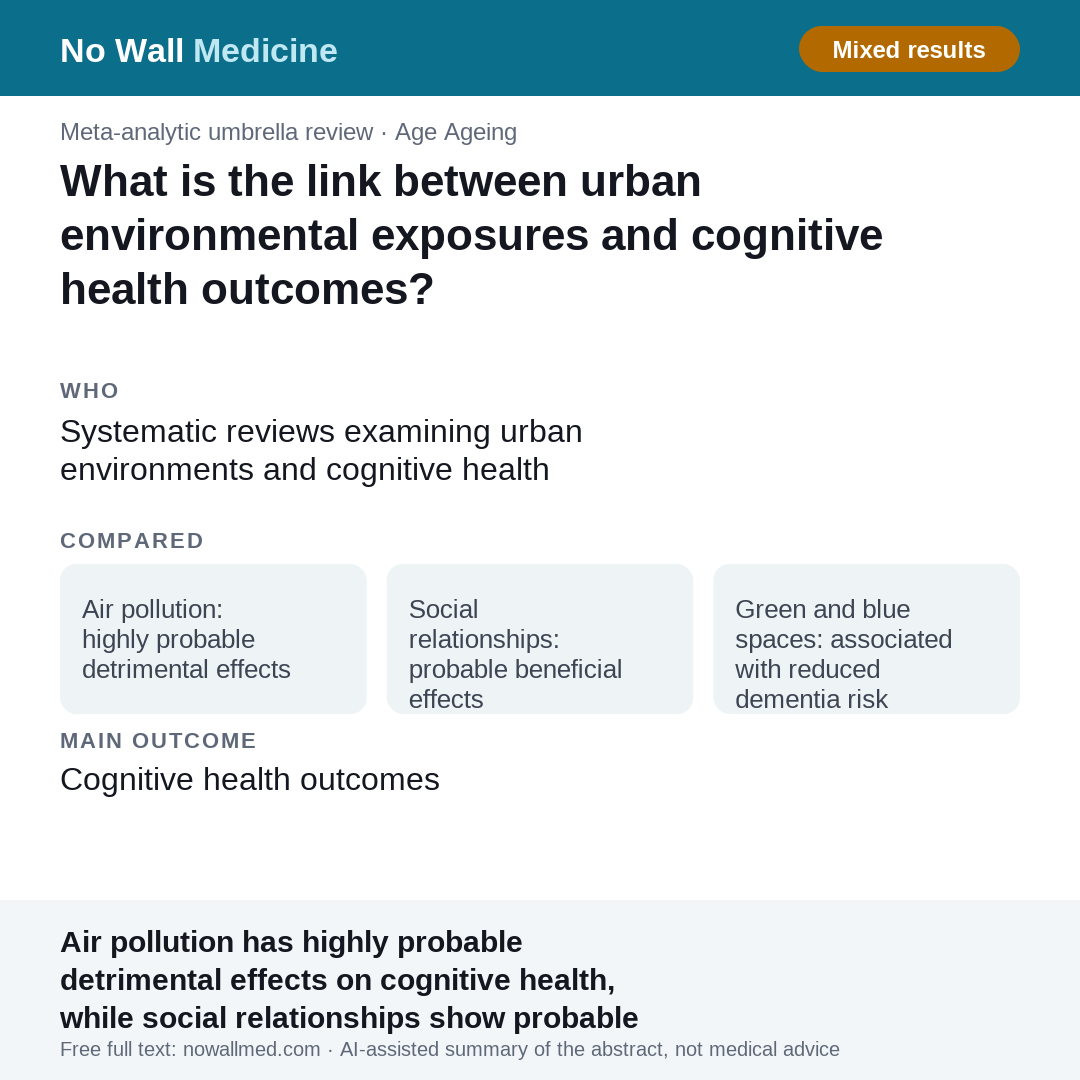
Clinical question: What is the link between urban environmental exposures and cognitive health outcomes?
Why it matters: Evidence regarding how various urban environmental exposures impact cognitive decline and dementia has remained fragmented.
Key points
- Researchers synthesized 54 systematic reviews containing 66 meta-analyzed outcomes and 270 associations between urban exposures and cognitive health.
- Particulate matter 2.5 showed highly probable detrimental effects on cognitive health in 10 out of 11 significant outcomes.
- Social relationships showed probable beneficial effects in 5 out of 8 outcomes, while green and blue spaces were associated with reduced dementia risk in 3 out of 6 outcomes.
Headline and key points written with AI from the paper’s abstract, with every number checked against it. Read the paper before relying on them.
Topics
Cite this article
Glover S, Cleland C, Trott M, Akaraci S, O'Kane N, Valson J. A meta-analytical umbrella review assessing urban environment exposures and cognitive health outcomes. Age Ageing. 2026. doi:10.1093/ageing/afag215
Spotted a mistake? Suggest a correction