Microbiota-directed complementary food was associated with less stunting in malnourished Bangladeshi children
A microbiota-directed complementary food intervention in 12-18-month-old Bangladeshi children improves linear growth
Randomized controlled trial follow-upBenefit found
Does microbiota-directed complementary food improve linear growth in malnourished Bangladeshi children?
Who
124
124 Bangladeshi children with moderate acute malnutrition aged 12-18 months · Bangladesh
Compared
Microbiota-directed complementary food: significantly less stunted during follow-up
Standard ready-to-use supplementary food
Main outcome
linear growth (stunting)
Result: βtreatment group x study week (95% CI) = 0.002 (0.001, 0.003)
Bottom line: Microbiota-directed complementary food reduced stunting in malnourished Bangladeshi children during a two-year follow-up period.
Funded by: BMGF
eBioMedicine · 2024-06-03Download image
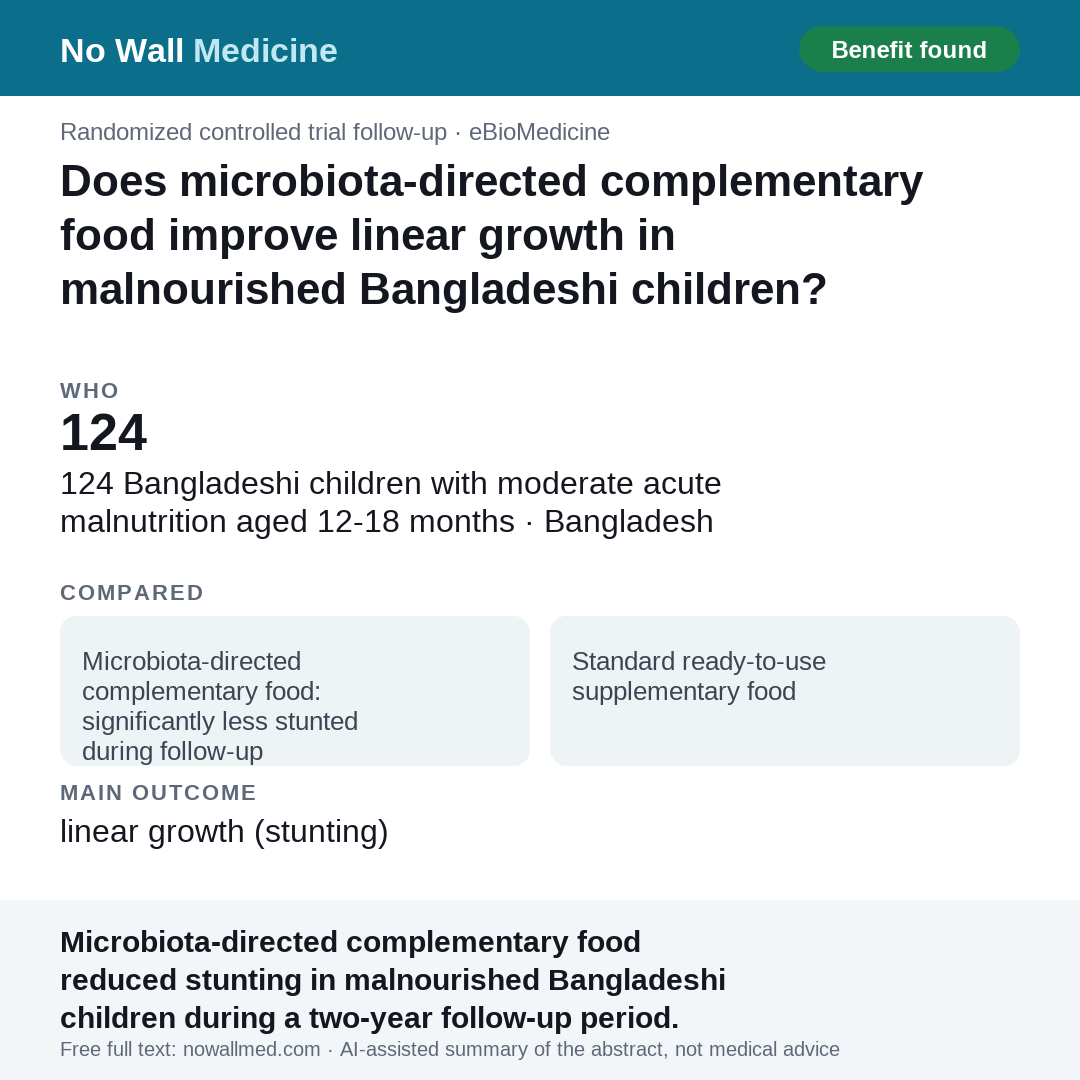
Clinical question: Does microbiota-directed complementary food improve linear growth in malnourished Bangladeshi children?
Why it matters: Current interventions for undernutrition have had limited effectiveness in addressing long-term consequences like stunting, cognitive deficits, and immune dysfunction.
Key points
- Researchers followed 124 Bangladeshi children with moderate acute malnutrition, which is a form of severe undernutrition, for two years after a 3-month intervention.
- Children receiving the microbiota-directed complementary food were significantly less stunted during follow-up compared to those receiving standard ready-to-use supplementary food.
- The intervention was associated with higher levels of 37 plasma proteins, including insulin-like growth factor 1, which persisted for 6-months after the treatment ended.
Headline and key points written with AI from the paper’s abstract, with every number checked against it. Read the paper before relying on them.
Was this summary helpful?
Subject terms
Cite this article
Mostafa I, Hibberd MC, Hartman SJ, Hafizur Rahman MH, Mahfuz M, Hasan SMT. A microbiota-directed complementary food intervention in 12-18-month-old Bangladeshi children improves linear growth. eBioMedicine. 2024. doi:10.1016/j.ebiom.2024.105166
Spotted a mistake? Suggest a correction
Top studies every Monday
The week’s key trials and guidelines in your specialties, plus any topics you follow. By email, free.
Get the weekly digest