Evidence is insufficient to show that air pollution or parasite treatments reduce low birth weight
A modular systematic review of antenatal interventions targeting modifiable environmental exposures in improving low birth weight
Systematic review of clinical trialsNo clear difference
Do antenatal interventions targeting modifiable environmental exposures reduce low birth weight?
Who
Pregnant women
Compared
Indoor air pollution interventions: RR: 0.90 [0.56, 1.44]
Preventative antihelminth treatment: RR: 1.00 [0.79, 1.27]
Main outcome
low birth weight
Result: RR: 0.90 [0.56, 1.44] for indoor air pollution
Bottom line: There is a paucity of evidence that interventions modifying environmental risk factors reduce low birth weight.
Am J Clin Nutr · 2023-06-19Download image
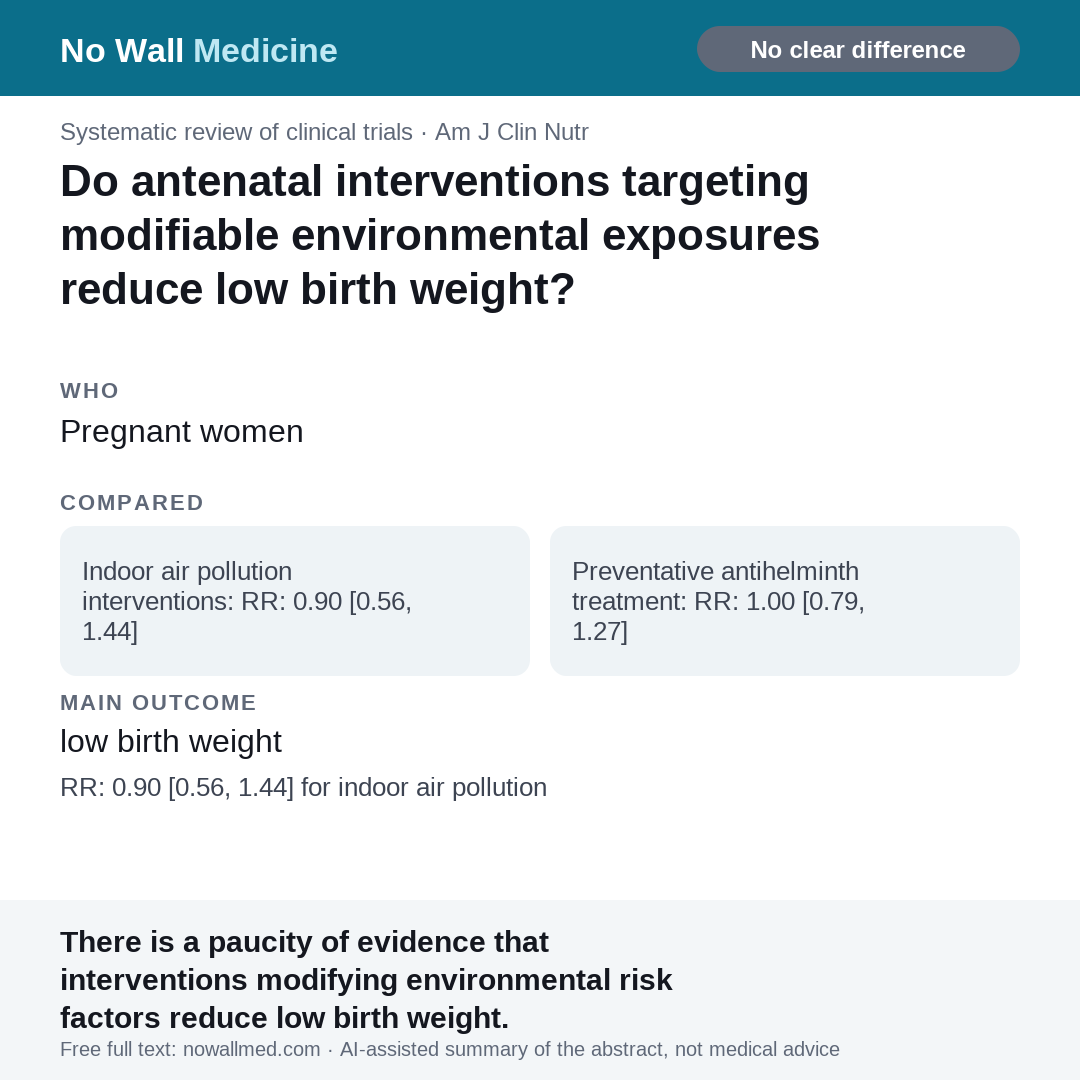
Clinical question: Do antenatal interventions targeting modifiable environmental exposures reduce low birth weight?
Why it matters: It is unknown if specific antenatal interventions targeting modifiable environmental exposures can effectively improve birth outcomes like low birth weight.
Key points
- Researchers reviewed clinical trials looking at interventions to reduce environmental exposures like toxins, sanitation, and hygiene during pregnancy.
- Interventions to reduce indoor air pollution were not likely to reduce low birth weight (RR: 0.90 [0.56, 1.44]) or preterm birth (OR: 2.37 [1.11, 5.07]).
- Preventative antihelminth treatment, which targets parasitic worms, was also not likely to reduce low birth weight (RR: 1.00 [0.79, 1.27]) or preterm birth (RR: 0.88 [0.43, 1.78]).
Limitation the authors note: There is a paucity of evidence from randomized controlled trials regarding interventions that modify environmental risk factors during pregnancy.
Headline and key points written with AI from the paper’s abstract, with every number checked against it. Read the paper before relying on them.
Topics
Cite this article
Näsänen-Gilmore PK, Koivu AM, Hunter PJ, Muthiani Y, Pörtfors P, Heimonen O. A modular systematic review of antenatal interventions targeting modifiable environmental exposures in improving low birth weight. Am J Clin Nutr. 2023. doi:10.1016/j.ajcnut.2022.11.029
Spotted a mistake? Suggest a correction
Top studies every Monday
The week’s key trials and guidelines in your specialties, plus any topics you follow. By email, free.
Get the weekly digest