A multi-dimensional genomic signature beyond homologous recombination deficiency in women receiving first-line niraparib maintenance for ovarian cancer: analytical validation and prospective multicentre evaluation of the MEDx-HRDetectCDx assay
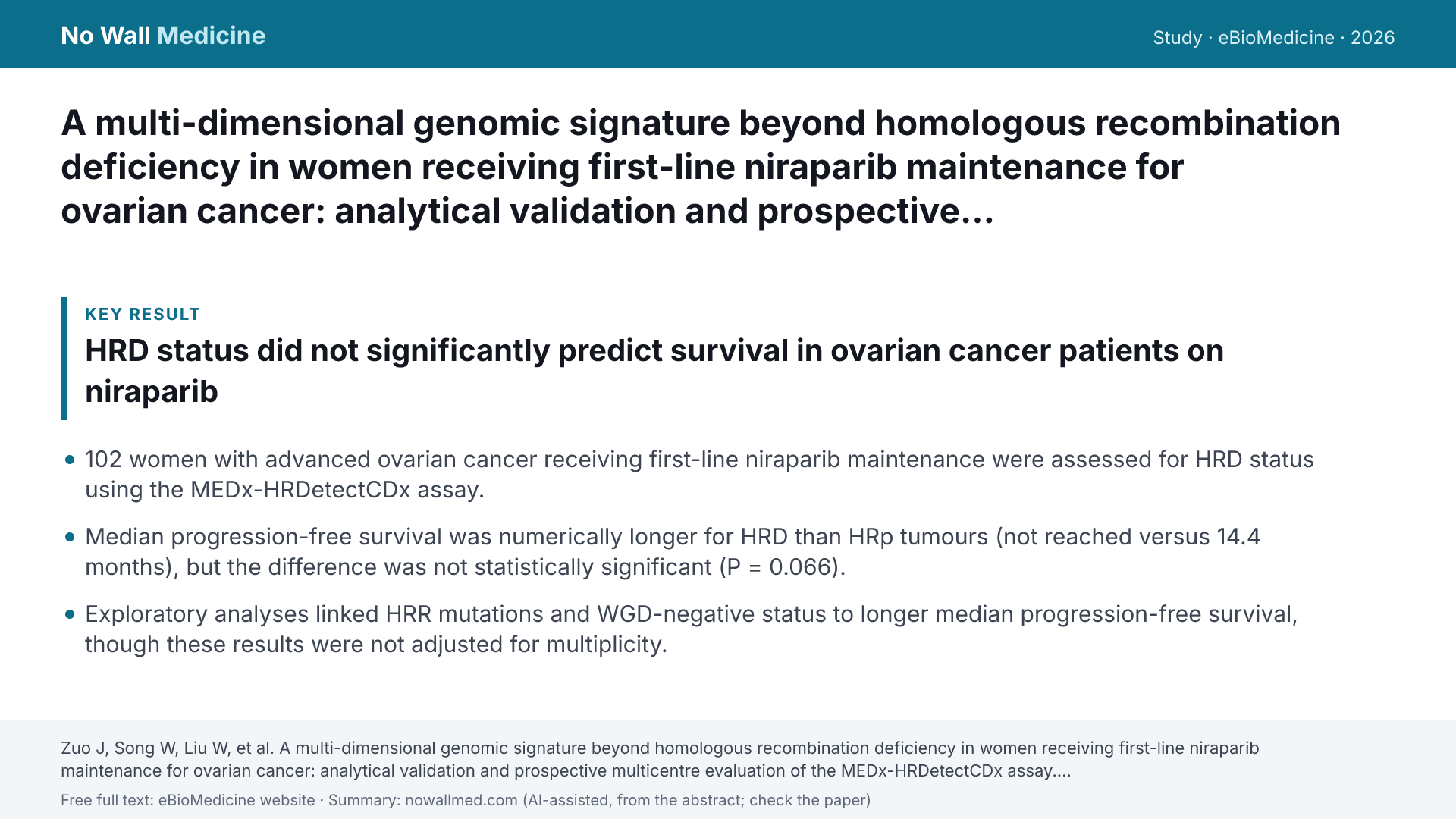
Key result: HRD status did not significantly predict survival in ovarian cancer patients on niraparib
Key points
- 102 women with advanced ovarian cancer receiving first-line niraparib maintenance were assessed for HRD status using the MEDx-HRDetectCDx assay.
- Median progression-free survival was numerically longer for HRD than HRp tumours (not reached versus 14.4 months), but the difference was not statistically significant (P = 0.066).
- Exploratory analyses linked HRR mutations and WGD-negative status to longer median progression-free survival, though these results were not adjusted for multiplicity.
Why it matters: Applies to women with advanced ovarian cancer receiving first-line niraparib; suggests integrating WGD with HRD may identify subgroups with favourable outcomes.
Discussion prompts
- Would these patients look like yours? Who was left out?
- Is the main outcome one that matters to patients?
- Is the difference large enough to change what you do?
Cite: Zuo J, Song W, Liu W, et al. A multi-dimensional genomic signature beyond homologous recombination deficiency in women receiving first-line niraparib maintenance for ovarian cancer: analytical validation and prospective multicentre evaluation of the MEDx-HRDetectCDx assay. EBioMedicine. 2026;134:106573. doi:10.1016/j.ebiom.2026.106573
Free full text: eBioMedicine website · Summary and visual abstract: nowallmed.com/a/a-multi-dimensional-genomic-signature-beyond-homologous-recombination-tn45rt/ (AI-assisted from the abstract; check the paper before relying on it).