Portable brain stimulation improved depression scores in adults with major depressive disorder
A multicenter randomized clinical trial of portable transcranial alternating current stimulation for major depressive disorder
Multicenter randomized clinical trialBenefit found
Is portable high-definition transcranial alternating current stimulation effective for major depressive disorder?
Who
120
Adults with major depressive disorder
Compared
active 10 Hz high-definition transcranial alternating current stimulation: 48% ± 14%
sham stimulation: 24% ± 13%
Main outcome
percentage reduction in 17-item Hamilton Depression Rating Scale scores
Bottom line: Portable 10 Hz high-definition transcranial alternating current stimulation significantly improved depression scores compared to sham stimulation.
NPJ Digit Med · 2026-03-28Download image
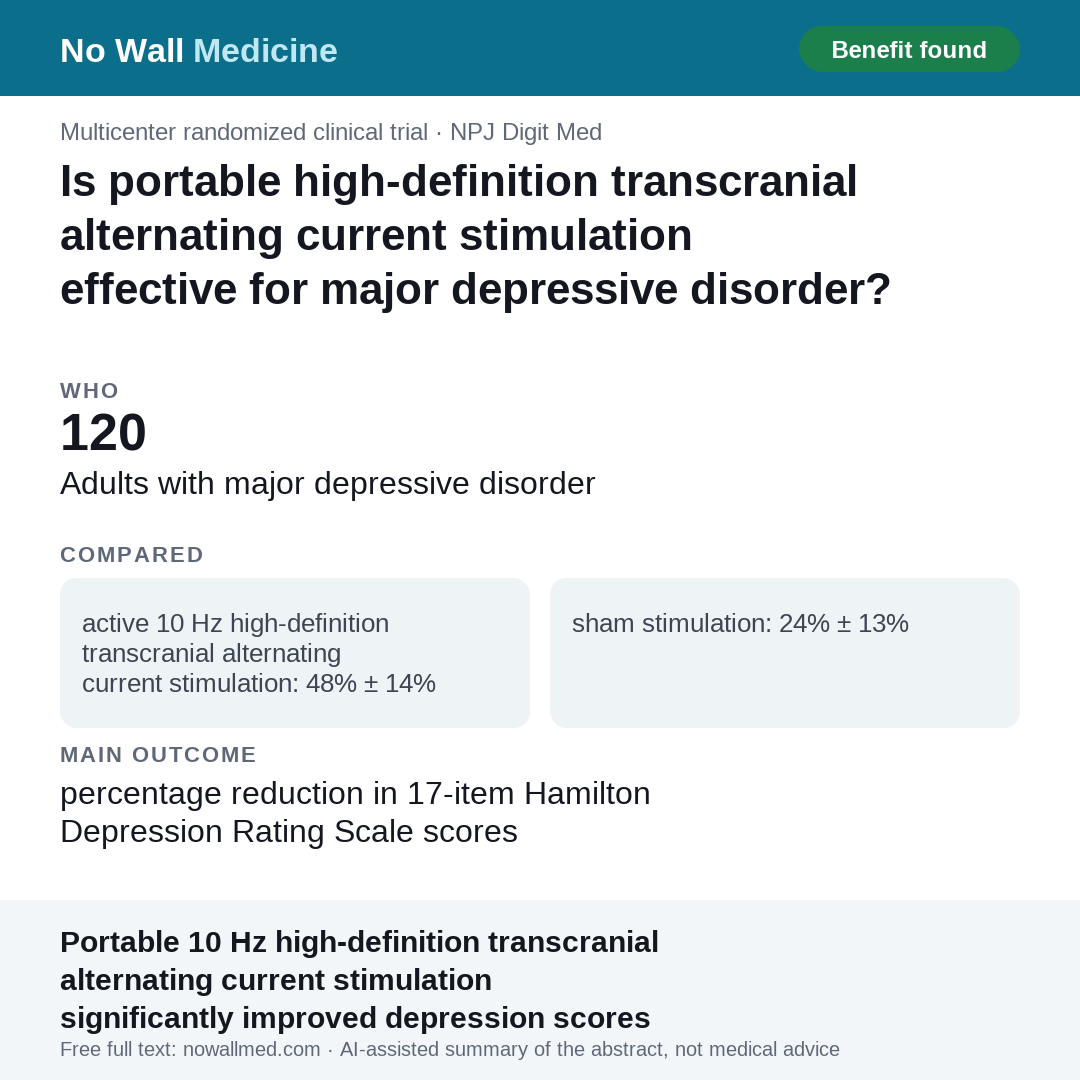
Clinical question: Is portable high-definition transcranial alternating current stimulation effective for major depressive disorder?
Why it matters: High-definition transcranial alternating current stimulation is an emerging method for treating major depressive disorder, but its efficacy needs evaluation.
Key points
- Researchers studied 120 adults with major depressive disorder who received either active 10 Hz high-definition transcranial alternating current stimulation or a sham stimulation over 20 sessions.
- The active group showed a 48% ± 14% reduction in depression scale scores compared to a 24% ± 13% reduction in the sham group.
- Improvements were also seen in anxiety, sleep, and quality of life, though two cases of new-onset hypomania occurred.
Headline and key points written with AI from the paper’s abstract, with every number checked against it. Read the paper before relying on them.
Spotted a mistake? Suggest a correction