Restrictive transfusion strategy worked as well as liberal one for critically ill patients
A multicenter, randomized, controlled clinical trial of transfusion requirements in critical care. Transfusion Requirements in Critical Care Investigators, Canadian Critical Care Trials Group
Why it matters: A restrictive transfusion threshold was at least as safe as a liberal one in critically ill patients.
Context written by the No Wall Medicine team.
Randomized, controlled trialBenefit found
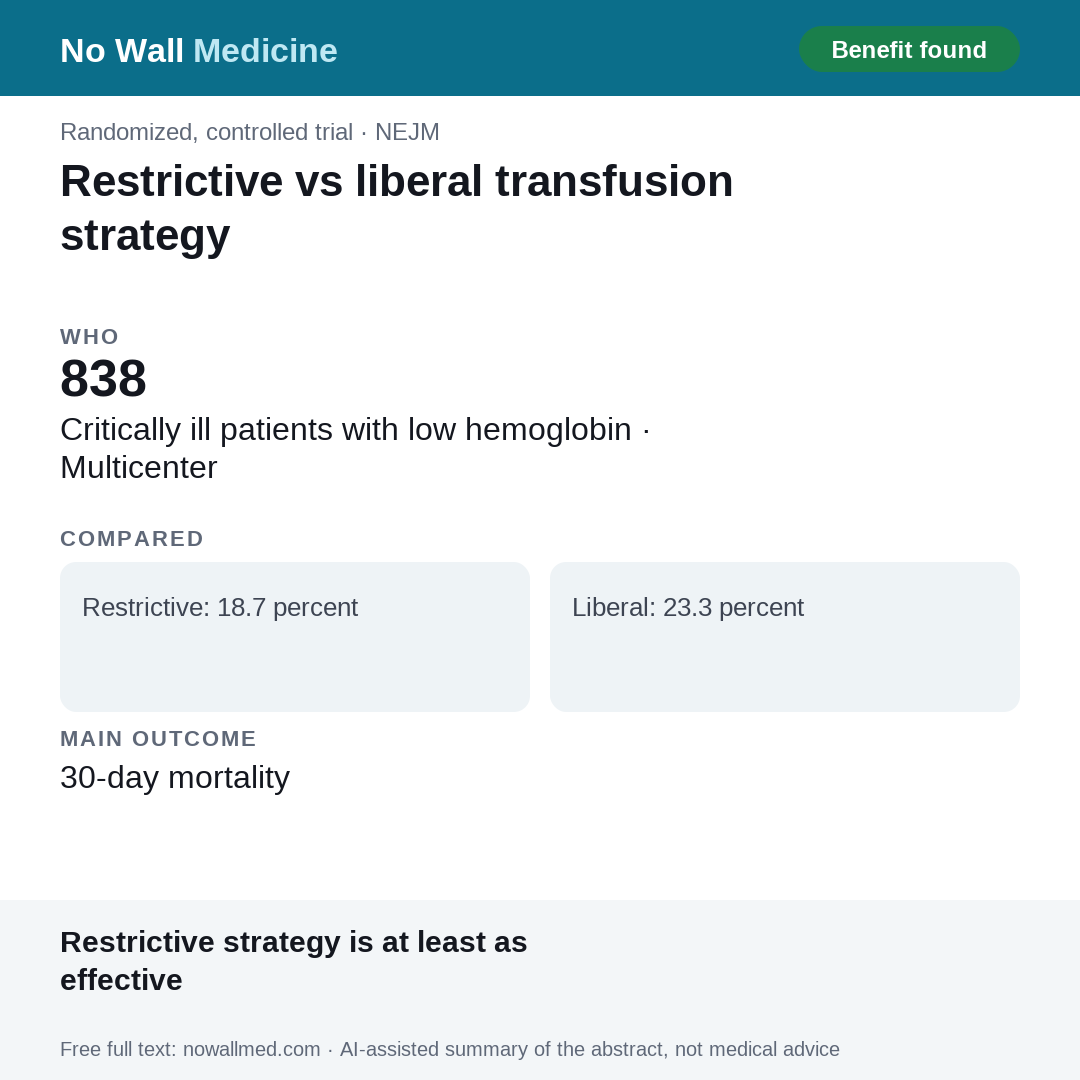
Restrictive vs liberal transfusion strategy
Who
838
Critically ill patients with low hemoglobin · Multicenter
Compared
Restrictive: 18.7 percent
Liberal: 23.3 percent
Main outcome
30-day mortality
Bottom line: Restrictive strategy is at least as effective
NEJM · 1999-02-11Download image
Trial at a glance
Bottom line: Restrictive strategy is at least as effective as liberal strategy
Clinical question
Transfusion strategy in critically ill patients
Design
Multicenter, randomized, controlled clinical trial. Multiple centers, null
Who was studied
838 critically ill patients enrolled
Key inclusion criteria
- critically ill patients
- euvolemia after initial treatment
- hemoglobin concentrations of less than 9.0 g per deciliter
- within 72 hours after admission to the intensive care unit
Interventions
- restrictive strategy: transfuse if hemoglobin below 7.0 g per deciliter
- liberal strategy: transfuse if hemoglobin below 10.0 g per deciliter
Primary outcome
30-day mortality. 18.7 percent vs. 23.3 percent, P= 0.11
Written with AI from the abstract; every number was checked against it. Details such as eligibility criteria may be missing because the abstract does not give them. Read the paper before relying on it.
Key points
- 838 critically ill patients were randomly assigned to two transfusion strategies.
- 30-day mortality was 18.7 percent with restrictive strategy and 23.3 percent with liberal strategy.
- Restrictive strategy had lower mortality rates in less acutely ill patients.
Headline and key points written with AI from the paper’s abstract, with every number checked against it. Read the paper before relying on them.
Topics
Spotted a mistake? Suggest a correction