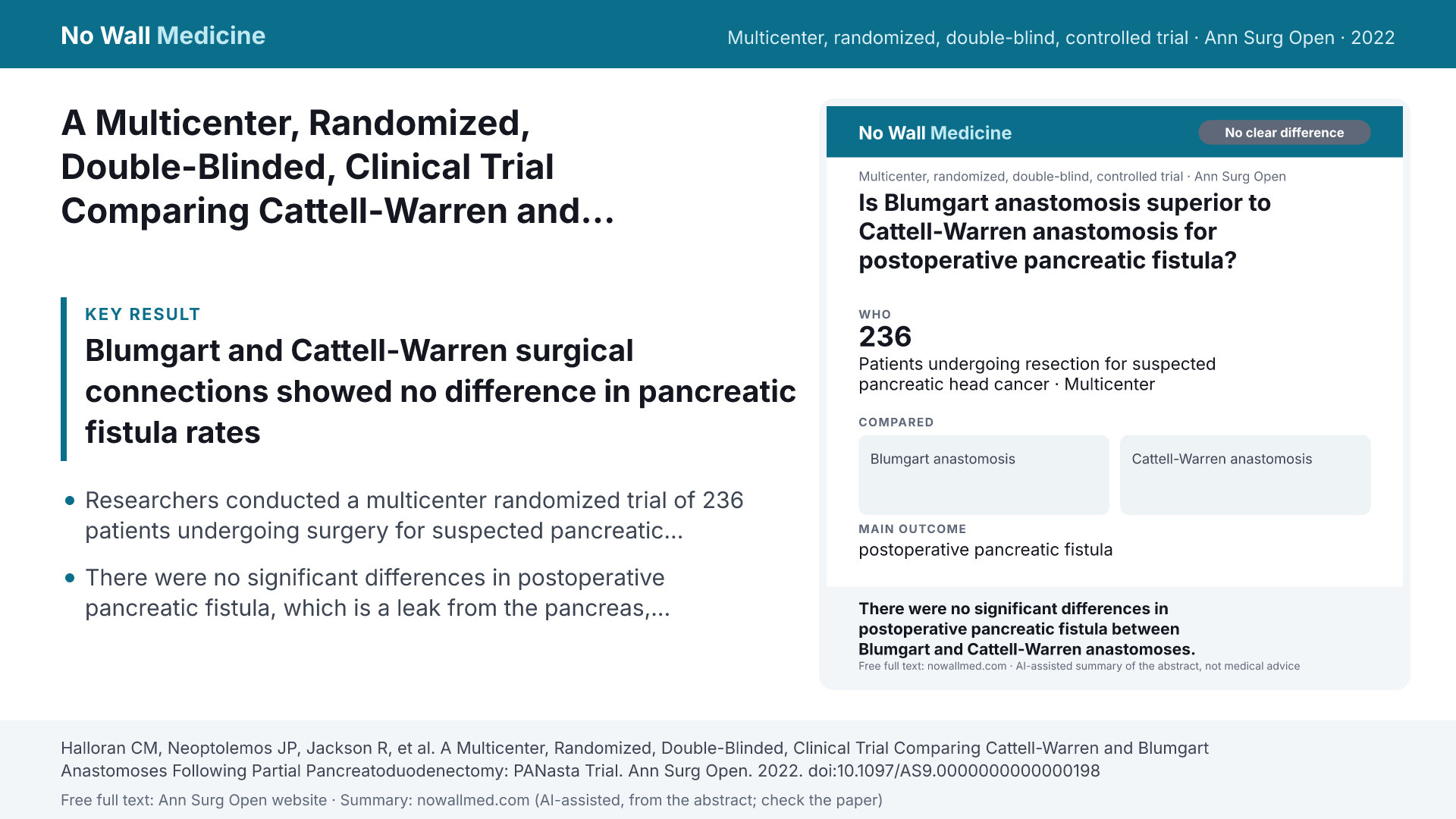
Blumgart and Cattell-Warren surgical connections showed no difference in pancreatic fistula rates
A Multicenter, Randomized, Double-Blinded, Clinical Trial Comparing Cattell-Warren and Blumgart Anastomoses Following Partial Pancreatoduodenectomy: PANasta Trial
Multicenter, randomized, double-blind, controlled trialNo clear difference
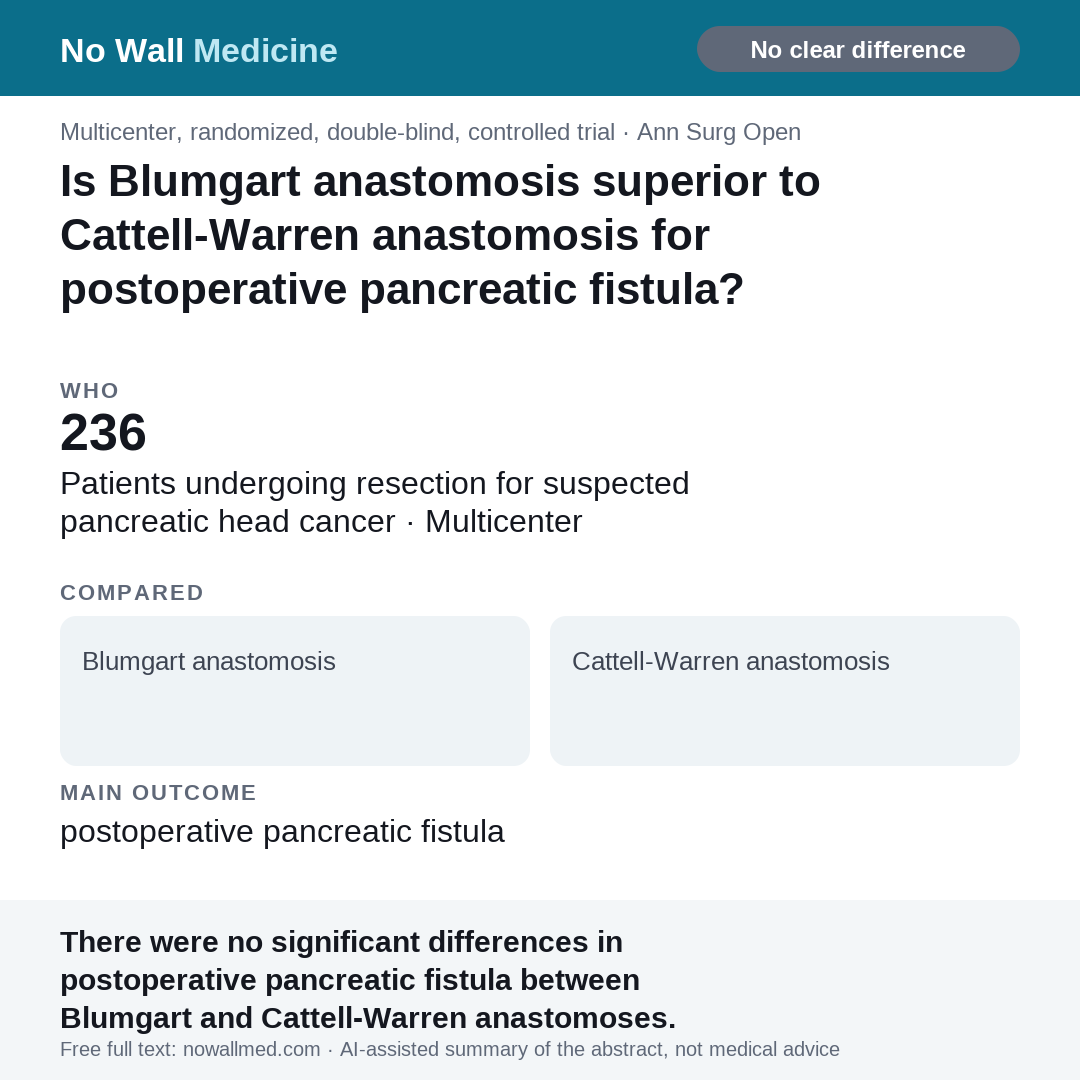
Is Blumgart anastomosis superior to Cattell-Warren anastomosis for postoperative pancreatic fistula?
Who
236
Patients undergoing resection for suspected pancreatic head cancer · Multicenter
Compared
Blumgart anastomosis
Cattell-Warren anastomosis
Main outcome
postoperative pancreatic fistula
Result: odds ratio 1·04 (95% confidence interval 0.58-1.88)
Bottom line: There were no significant differences in postoperative pancreatic fistula between Blumgart and Cattell-Warren anastomoses.
Ann Surg Open · 2022-09-15Download image
Clinical question: Is Blumgart anastomosis superior to Cattell-Warren anastomosis for postoperative pancreatic fistula?
Why it matters: It is unknown whether the Blumgart anastomosis is superior to the Cattell-Warren anastomosis for reducing postoperative pancreatic fistula after pancreatic cancer resection.
Key points
- Researchers conducted a multicenter randomized trial of 236 patients undergoing surgery for suspected pancreatic head cancer to compare two types of surgical connections.
- There were no significant differences in postoperative pancreatic fistula, which is a leak from the pancreas, between the Blumgart anastomosis and the Cattell-Warren anastomosis.
- Twelve-month overall survival rates did not differ between the two surgical methods, with a P value of 0.266.
Headline and key points written with AI from the paper’s abstract, with every number checked against it. Read the paper before relying on them.
Was this summary helpful?
Abstract
Whether a Blumgart anastomosis (BA) is superior to Cattell-Warren anastomosis (CWA) in terms of postoperative pancreatic fistula (POPF) following pancreatoduodenectomy.Importance
Complications driven by POPF following pancreatic cancer resection may hinder adjuvant therapy, shortening survival. BA may reduce complications compared to CWA, improving the use of adjuvant therapy and prolonging survival.Methods
A multicenter double-blind, controlled trial of patients undergoing resection for suspected pancreatic head cancer, randomized during surgery to a BA or CWA, stratified by pancreatic consistency and duct diameter. The primary end point was POPF, and secondary outcome measures were adjuvant therapy use, specified surgical complications, quality of life, and survival from the date of randomization. For a 10% POPF reduction, 416 patients were required, 208 per arm (two-sided α = 0·05; power = 80%).Results
Z-score at planned interim analysis was 0.474 so recruitment was held to 238 patients; 236 patients were analyzed (112 BA and 124 CWA). No significant differences in POPF were observed between BA and CWA, odds ratio (95% confidence interval [CI]) 1·04 (0.58-1.88), P = 0.887, nor in serious adverse events. Adjuvant therapy was delivered to 98 (62%) of 159 eligible patients with any malignancy; statistically unrelated to arm or postoperative complications. Twelve-month overall survival, hazard ratio (95% CI), did not differ between anastomoses; BA 0.787 (0.713-0.868) and CWA 0.854 (0.792-0.921), P = 0.266, nor for the 58 patients with complications, median (IQR), 0.83 (0.74-0.91) compared to 101 patients without complications 0.82 (0.76-0.89) (P = 0.977).Conclusions
PANasta represents the most robust analysis of BA versus CWA to date.
Abstract reproduced under the article’s CC BY licence.
Cite this article
Halloran CM, Neoptolemos JP, Jackson R, et al. A Multicenter, Randomized, Double-Blinded, Clinical Trial Comparing Cattell-Warren and Blumgart Anastomoses Following Partial Pancreatoduodenectomy: PANasta Trial. Ann Surg Open. 2022. doi:10.1097/AS9.0000000000000198
Spotted a mistake? Suggest a correction