Nivolumab with or without ipilimumab shows different response rates in specific sarcoma types
A multicenter, randomized, non-comparative, phase II study of nivolumab ± ipilimumab for patients with metastatic sarcoma (Alliance A091401): expansion cohorts and correlative analyses
Randomized, non-comparative, multicenter phase II studyMixed results
What are the response rates of nivolumab with or without ipilimumab in metastatic sarcoma?
Who
66
Patients with gastrointestinal stromal tumor, undifferentiated pleomorphic sarcoma, and dedifferentiated liposarcoma · Multicenter
Compared
Nivolumab plus ipilimumab: 16.6% (2/12) in DDLPS and UPS
Nivolumab alone: 8.3% (1/12) in DDLPS and UPS
Main outcome
6-month confirmed response rate
Bottom line: Nivolumab plus ipilimumab showed higher response rates in DDLPS and UPS compared to nivolumab alone.
J Immunother Cancer · 2024-09-28Download image
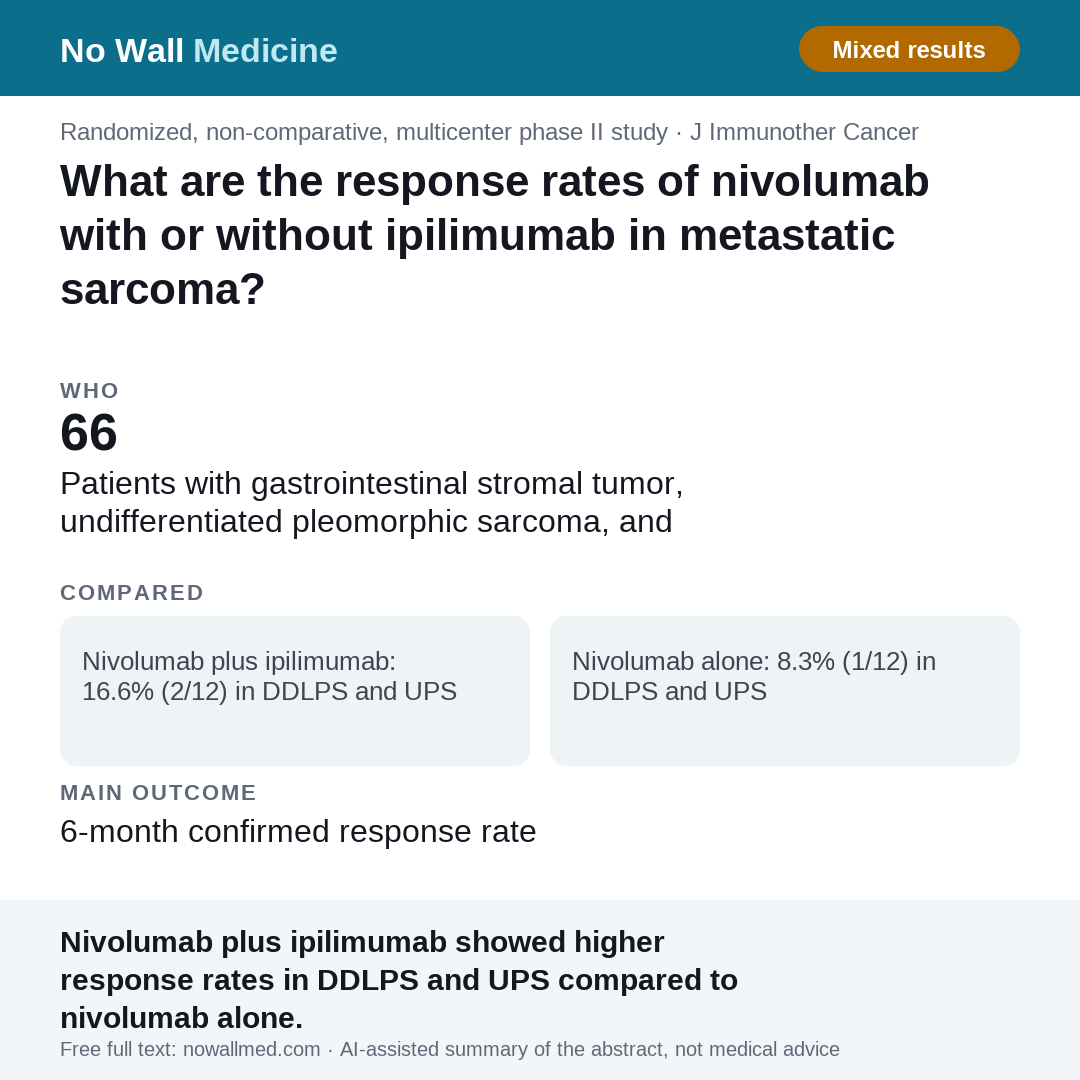
Clinical question: What are the response rates of nivolumab with or without ipilimumab in metastatic sarcoma?
Why it matters: The specific role of immunotherapy and the predictive biomarkers for response in sarcoma patients remain unknown.
Key points
- Researchers studied 66 patients with gastrointestinal stromal tumor, undifferentiated pleomorphic sarcoma, and dedifferentiated liposarcoma to compare nivolumab alone versus nivolumab plus ipilimumab.
- In dedifferentiated liposarcoma and undifferentiated pleomorphic sarcoma, the 6-month confirmed response rate was 16.6% with both drugs combined compared to 8.3% with nivolumab alone.
- In the gastrointestinal stromal tumor group, treatment-related adverse events were higher with the combination therapy, which halted enrollment according to the protocol.
Headline and key points written with AI from the paper’s abstract, with every number checked against it. Read the paper before relying on them.
Abstract
Background
In this open-label, randomized, non-comparative, multicenter phase II study (Alliance A091401) we report on three expansion cohorts treated with nivolumab (N) with and without ipilimumab (N+I) and provide a multi-omic correlative analysis of actionable biomarkers. Methods
Patients were randomized (non-comparative) to receive either N or N+I. The primary endpoint was a 6-month confirmed response rate (CRR) defined by Response Evaluation Criteria in Solid Tumors version 1.1. Secondary endpoints included treatment-related adverse events (TRAEs), progression-free survival, and overall survival. Multi-omic correlative analyses were conducted using samples from both the primary and expansion cohorts. Results
A total of 66 patients were evaluated for the primary endpoint with disease including gastrointestinal stromal tumor (GIST, n=18), undifferentiated pleomorphic sarcoma (UPS, n=24), and dedifferentiated liposarcoma (DDLPS, n=24). Neither N nor N+I achieved a complete or partial response in the GIST expansion cohort. In DDLPS and UPS, the primary response endpoint of CRR was met with N+I (both 16.6%, 2/12) but not with N alone (both 8.3%, 1/12). In the GIST cohort, TRAE was higher with N+I treatment, halting enrollment as required per protocol. In a correlative analysis of patients for the expansion cohort and the original cohort (n=86), traditional biomarkers of immunotherapy response were not correlated with response in any histological subtype. Markers of genomic instability including the presence of gene fusions and increased subclonal mutations correlated with improved clinical outcomes. Conclusions
This expansion cohort reaffirms the outcomes of A091401. There remains a pressing need to determine the role of and predictive biomarkers for immunotherapy in sarcoma. Trial registration number
NCT02500797.
Abstract reproduced under the article’s CC BY NC licence.
Topics
Cite this article
Seligson ND, Chen JL, Goodrich AC, Van Tine BA, Campbell JD, Richards AL. A multicenter, randomized, non-comparative, phase II study of nivolumab ± ipilimumab for patients with metastatic sarcoma (Alliance A091401): expansion cohorts and correlative analyses. J Immunother Cancer. 2024. doi:10.1136/jitc-2024-009472
Spotted a mistake? Suggest a correction
Top studies every Monday
The week’s key trials and guidelines in your specialties, plus any topics you follow. By email, free.
Get the weekly digest