Pecavaptan showed no weight reduction as add-on therapy and was non-inferior to furosemide alone
A multicentre, randomized, double-blind, active and placebo-controlled study of pecavaptan, a dual V1a/V2 vasopressin receptor antagonist, in patients with acute heart failure: The AVANTI trial
Multicentre, randomized, double-blind trialMixed results
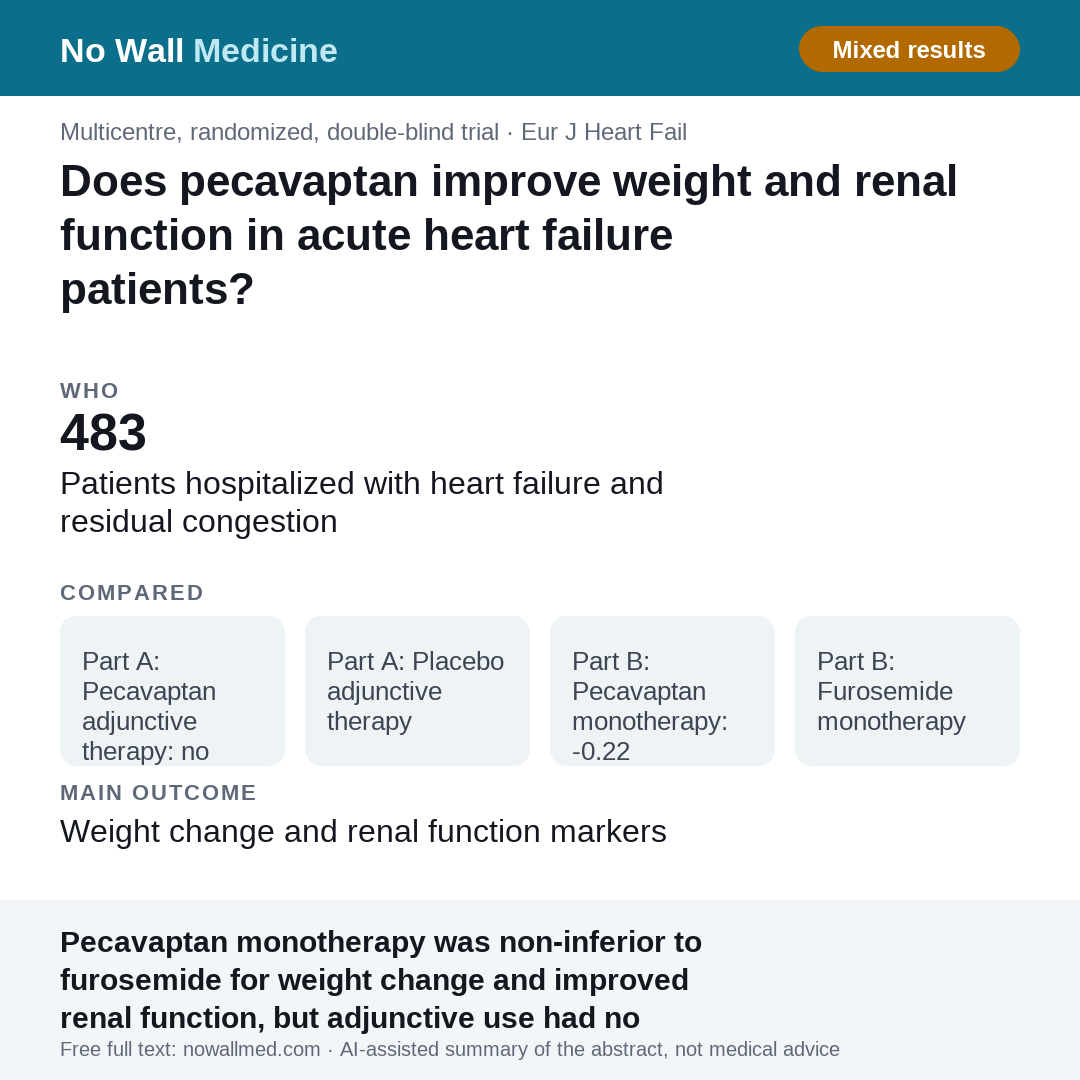
Does pecavaptan improve weight and renal function in acute heart failure patients?
Who
483
Patients hospitalized with heart failure and residual congestion
Compared
Part A: Pecavaptan adjunctive therapy: no difference in weight reduction
Part A: Placebo adjunctive therapy
Part B: Pecavaptan monotherapy: -0.22 log-transformed change in blood urea nitrogen/creatinine ratio
Part B: Furosemide monotherapy
Main outcome
Weight change and renal function markers
Result: between-group difference in log-transformed change in blood urea nitrogen/creatinine ratio was -0.22 (upper one-sided 80% CI -0.19, p < 0.0001)
Bottom line: Pecavaptan monotherapy was non-inferior to furosemide for weight change and improved renal function, but adjunctive use had no impact.
Eur J Heart Fail · 2025-08-11Download image
Clinical question: Does pecavaptan improve weight and renal function in acute heart failure patients?
Why it matters: It is unclear if dual vasopressin receptor antagonism can serve as an effective addition or replacement to standard loop diuretic therapy for heart failure congestion.
Key points
- In Part A, 483 patients received pecavaptan or placebo as an add-on to standard care, showing no difference in weight reduction or serum creatinine levels.
- In Part B, 286 patients were randomized to either furosemide or pecavaptan monotherapy, where pecavaptan was non-inferior to furosemide for weight change over 30 days.
- Pecavaptan monotherapy was associated with a better blood urea nitrogen to creatinine ratio, though congestion-related adverse events were numerically higher in pecavaptan groups.
Limitation the authors note: The authors suggest that future trials will need optimized background diuretic dosing due to the increase in congestion events.
Headline and key points written with AI from the paper’s abstract, with every number checked against it. Read the paper before relying on them.
Topics
Cite this article
Udelson JE, Goldsmith SR, Burkhoff D, Colorado P, Dinh W, Gustafsson F. A multicentre, randomized, double-blind, active and placebo-controlled study of pecavaptan, a dual V1a/V2 vasopressin receptor antagonist, in patients with acute heart failure: The AVANTI trial. Eur J Heart Fail. 2025. doi:10.1002/ejhf.3801
Spotted a mistake? Suggest a correction
Top studies every Monday
The week’s key trials and guidelines in your specialties, by email. Free.
Get the weekly digest