Digital intervention increased help-seeking intentions for suicidal ideation in sexual and gender diverse young adults
A multicomponent digital intervention to promote help-seeking for mental health problems and suicide in sexual and gender diverse young adults: A randomized controlled trial
Randomized controlled trialBenefit found
Does a digital multicomponent intervention promote help-seeking for mental health and suicide in LGBTQ+ young adults?
Who
144
LGBTQ+ young adults aged 18 to 29 with moderate or above mental health distress
Compared
Intervention: significant improvement in help-seeking intentions for suicidal ideation
Active control
Main outcome
help-seeking intentions for emotional problems, suicidal ideation, and attitudes toward seeking help
Result: mean difference = 0.25 (95% CI [0.11, 0.38])
Bottom line: A digital multicomponent intervention significantly improved help-seeking intentions for suicidal ideation and emotional problems in LGBTQ+ young adults.
Limitation: follow-up time point was limited to 3 months
PLOS Med · 2023-03-06Download image
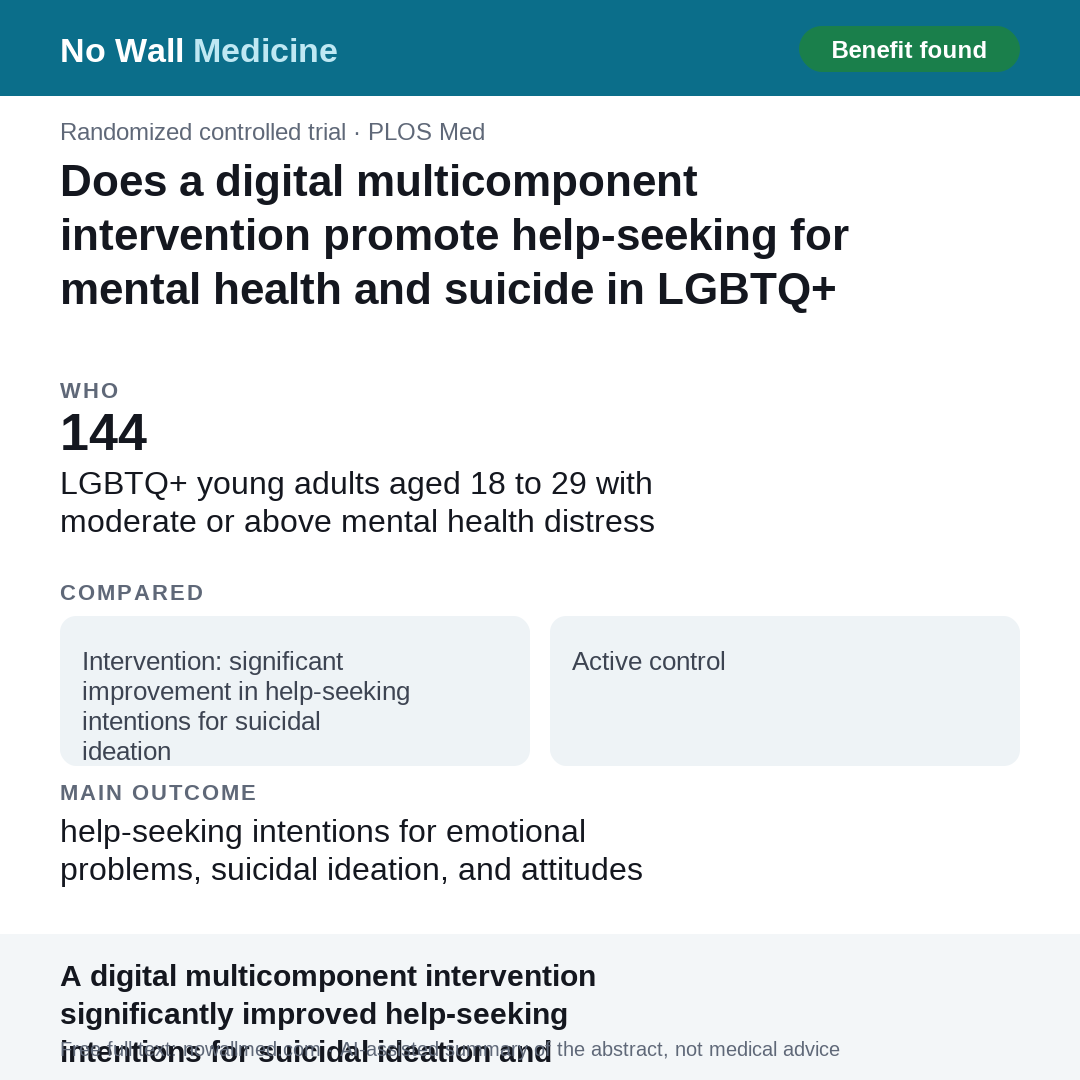
Clinical question: Does a digital multicomponent intervention promote help-seeking for mental health and suicide in LGBTQ+ young adults?
Why it matters: There is a lack of research on tailored interventions designed to address the specific mental health help-seeking barriers faced by the LGBTQ+ population.
Key points
- Researchers studied 144 sexual and gender diverse young adults aged 18 to 29 who experienced moderate or higher depression, anxiety, or stress.
- The digital intervention group showed significant improvements in help-seeking intentions for suicidal ideation at post-discussion (mean difference = 0.22), 1-month (mean difference = 0.19), and 3-month follow-ups.
- The intervention also increased help-seeking intentions for emotional problems at 1-month (mean difference = 0.17) and 3-month (mean difference = 0.16) follow-ups, but did not change actual help-seeking behaviors.
Limitation the authors note: The follow-up time point was limited to 3 months, which might not be long enough for drastic mindset and behavioral changes in help-seeking to occur.
Headline and key points written with AI from the paper’s abstract, with every number checked against it. Read the paper before relying on them.
Topics
Cite this article
Han M, Wang Y, Zhang Y, Wang Y, Ou J, Ren D. A multicomponent digital intervention to promote help-seeking for mental health problems and suicide in sexual and gender diverse young adults: A randomized controlled trial. PLOS Med. 2023. doi:10.1371/journal.pmed.1004197
Spotted a mistake? Suggest a correction
Top studies every Monday
The week’s key trials and guidelines in your specialties, plus any topics you follow. By email, free.
Get the weekly digest