Multifaceted intervention increased bystander CPR rates after cardiac arrest
A multifaceted intervention to increase bystander CPR rates after out-of-hospital cardiac arrest in France: a stepped-wedge, cluster-randomised, controlled trial
Stepped-wedge, cluster-randomised trialBenefit found
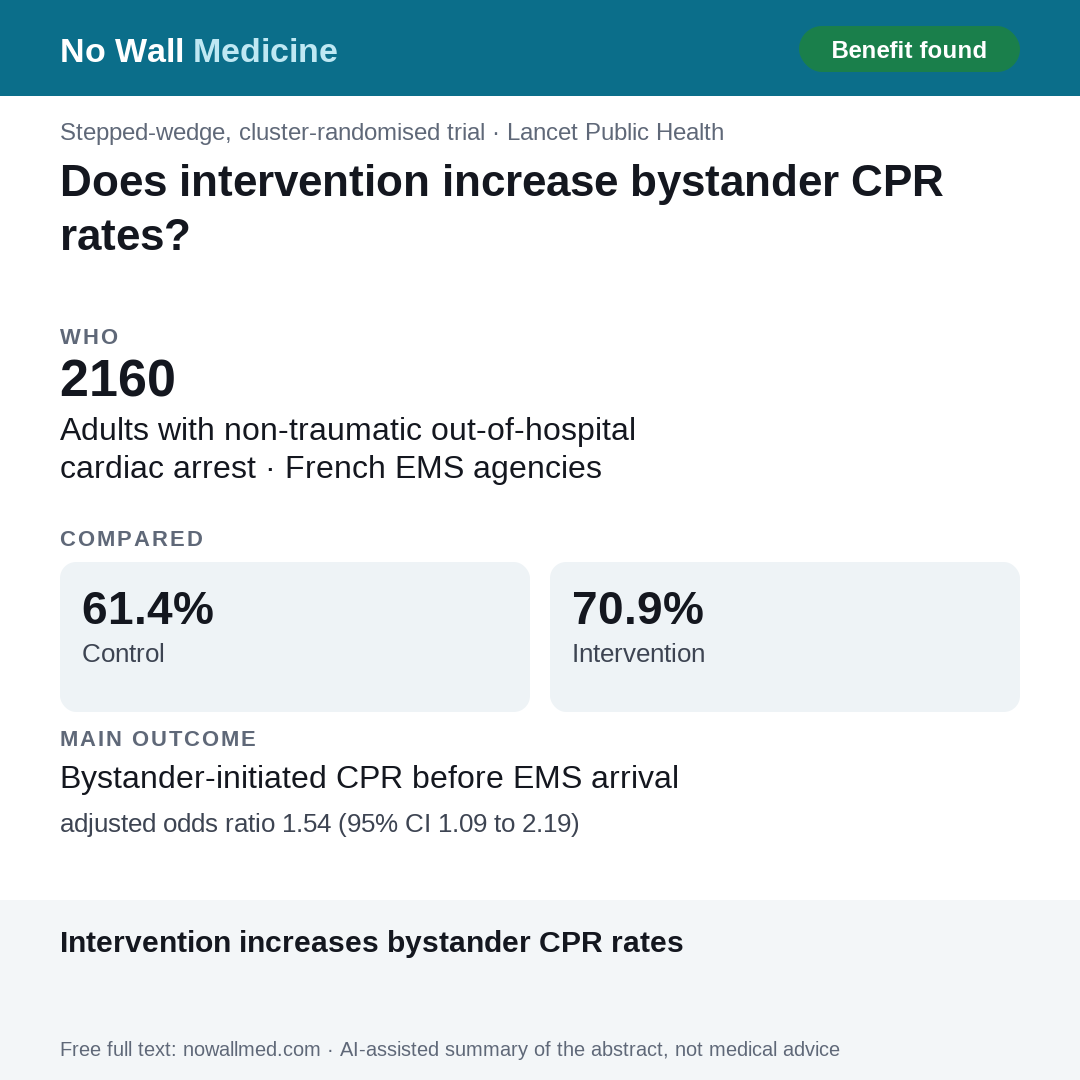
Does intervention increase bystander CPR rates?
Who
2160
Adults with non-traumatic out-of-hospital cardiac arrest · French EMS agencies
Compared
61.4%Control (421/686)
70.9%Intervention (708/998)
Main outcome
Bystander-initiated CPR before EMS arrival
Result: adjusted odds ratio 1.54 (95% CI 1.09 to 2.19)
Bottom line: Intervention increases bystander CPR rates
Funded by: Direction Générale de l'Offre de Soins
Lancet Public Health · 2026-10-20Download image
Clinical question: Does intervention increase bystander CPR rates?
In absolute numbers
Control: 61.4% · Intervention: 70.9% → a difference of 9.5 percentage points, so about 11 people would need the treatment for 1 more to benefit (number needed to treat) over the trial’s follow-up.
Worked out by us from the two group results above, not reported by the authors. Check the paper for the exact outcome and timing.
Key points
- Researchers studied 1684 patients with out-of-hospital cardiac arrest across 12 emergency medical service agencies.
- Bystander-initiated CPR occurred in 70.9% of patients in the intervention group and 61.4% in the control group.
- Adjusted odds ratio was 1.54, but estimates were sensitive to modelling of secular trends and baseline characteristics.
Headline and key points written with AI from the paper’s abstract, with every number checked against it. Read the paper before relying on them.
Abstract
Background
Bystander cardiopulmonary resuscitation (CPR) is a key determinant of survival after out-of-hospital cardiac arrest (OHCA), but rates remain suboptimal worldwide. We evaluated whether a multifaceted intervention targeting emergency dispatch systems and community response could increase bystander-initiated CPR before emergency medical service (EMS) arrival. Methods
We conducted a stepped-wedge, cluster-randomised trial in 15 French EMS agencies. The intervention combined dispatcher training for early recognition of cardiac arrest and telephone-assisted CPR, activation of trained volunteers through a geolocation smartphone application, and structured audit and feedback provided to EMS agencies. Consecutive adults (≥18 years) with non-traumatic OHCA were included. Randomisation was stratified by tercile of OHCA volume managed by each EMS in 2015. The intervention was implemented during a 1-month transition period before the intervention period at each EMS centre. A dedicated protocol guided dispatchers to identify cardiac arrest from unresponsiveness and abnormal breathing, then gave scripted compression-only instructions and activated volunteers, targeting recognition within 60 s of call pick-up and first compression within a further 60 s. The primary outcome was bystander-initiated CPR before EMS arrival. The trial was prospectively registered on ClinicalTrials.gov (NCT03633370) and is completed. Findings
Of the 15 EMS agencies initially randomised, two withdrew before recruitment began and were replaced, and one enrolled no patients. Therefore, between Aug 27, 2018, and Feb 20, 2022, 14 EMS agencies recruited a total of 2160 patients. The intention-to-treat analysis included 1684 patients (686 control, 998 intervention) enrolled across the 12 originally randomised EMS agencies. The mean age for all patients included in the intention-to-treat analysis was 67 years (SD 15), and 1205 (71·6%) were male. Bystander-initiated CPR before EMS arrival occurred in 421 (61·4%) patients in the control group and 708 (70·9%) patients in the intervention group (adjusted odds ratio [OR] 1·54 [95% CI 1·09-2·19]; p=0·017). Estimates were consistent across six prespecified sensitivity analyses (OR range, 1·38-1·55), remaining significant in four, but not after adjustment for cluster-specific secular trends (1·38 [0·98-1·94]) or baseline characteristics (1·39 [0·97-1·98]). No intervention-related adverse events were reported. Interpretation
A multifaceted intervention was associated with increased bystander-initiated CPR after OHCA, although the estimate was sensitive to the modelling of secular trends, and it did not translate into improved clinical outcomes. These findings support further investigation of coordinated community-based strategies to strengthen the early links in the chain of survival at a population level. Funding
Direction Générale de l'Offre de Soins.
Abstract reproduced under the article’s CC BY licence.
Topics
Spotted a mistake? Suggest a correction