Multilevel health system intervention increased HIV viral suppression among adolescents and young adults in Kenya and Uganda
A multilevel health system intervention for virological suppression in adolescents and young adults living with HIV in rural Kenya and Uganda (SEARCH-Youth): a cluster randomised trial
Cluster randomised, open-label trialBenefit found
Does a multilevel health system intervention increase virological suppression in adolescents and young adults living with HIV?
Who
1549
Adolescents and young adults aged 15-24 years living with HIV · Rural Kenya and Uganda
Compared
88%Intervention clinics (95% CI 85-92)
80%Control clinics (77-84)
Main outcome
Virological suppression (HIV RNA <400 copies per mL) at 2 years
Result: risk ratio 1·10, 95% CI 1·03-1·16
Bottom line: A multilevel health system intervention increased virological suppression among adolescents and young adults living with HIV in rural Kenya and Uganda.
Lancet HIV · 2023-08-05Download image
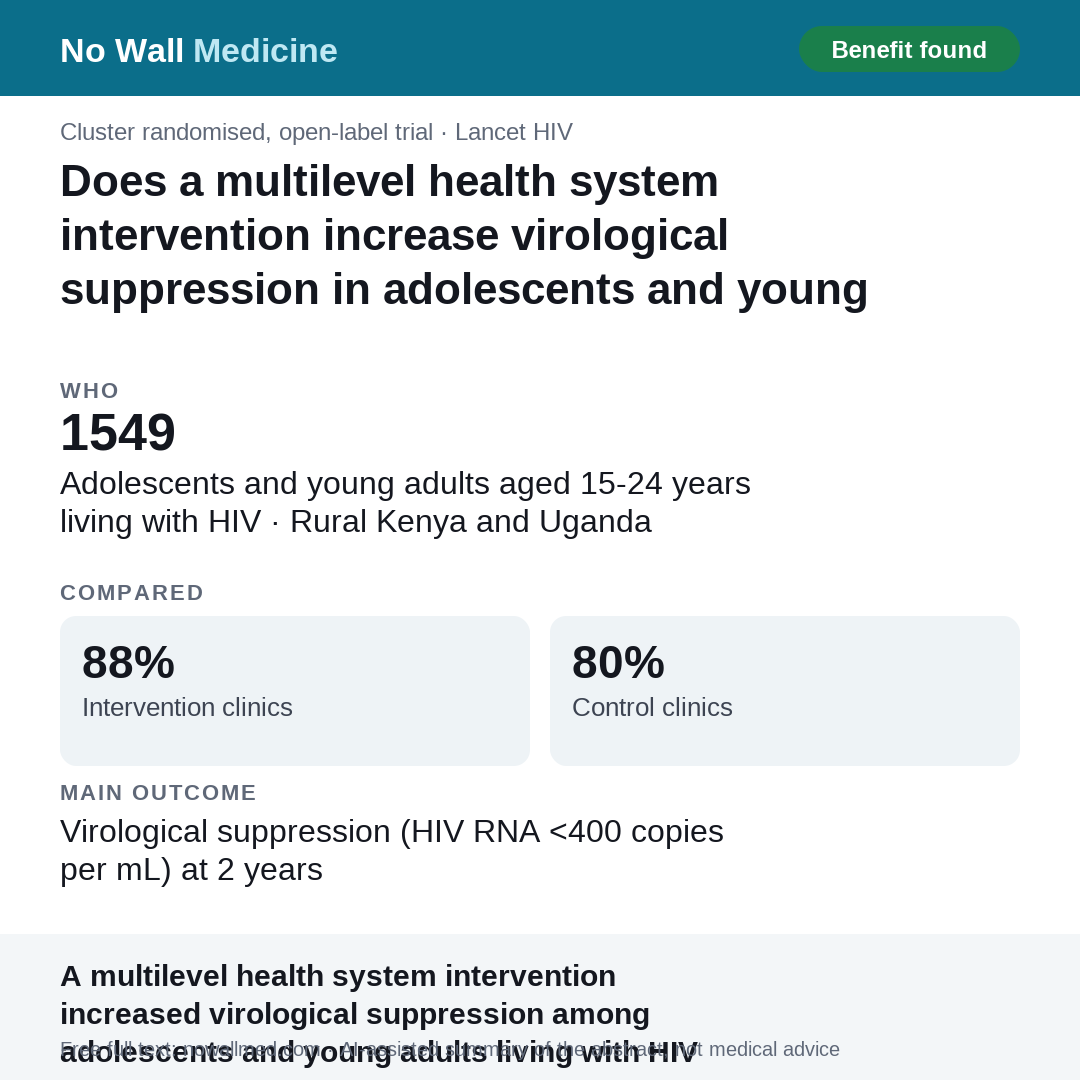
Clinical question: Does a multilevel health system intervention increase virological suppression in adolescents and young adults living with HIV?
Why it matters: Social and cognitive developmental events can disrupt medication adherence and care for adolescents and young adults living with HIV in sub-Saharan Africa.
Key points
- The study randomized 28 clinics and 1549 participants aged 15-24 years to receive either a multilevel health system intervention or standard care.
- At 2 years, the mean proportion of participants with virological suppression, meaning HIV RNA <400 copies per mL, was 88% in intervention clinics and 80% in control clinics.
- The intervention was associated with increased virological suppression across all subgroups of sex, age, and baseline care status.
Headline and key points written with AI from the paper’s abstract, with every number checked against it. Read the paper before relying on them.
Was this summary helpful?
Abstract
Background
Social and cognitive developmental events can disrupt care and medication adherence among adolescents and young adults living with HIV in sub-Saharan Africa. We hypothesised that a dynamic multilevel health system intervention helping adolescents and young adults and their providers navigate life-stage related events would increase virological suppression compared with standard care. Methods
We did a cluster randomised, open-label trial of young individuals aged 15-24 years with HIV and receiving care in eligible clinics (operated by the government and with ≥25 young people receiving care) in rural Kenya and Uganda. After clinic randomisation stratified by region, patient population, and previous participation in the SEARCH trial, participants in intervention clinics received life-stage-based assessment at routine visits, flexible clinic access, and rapid viral load feedback. Providers had a secure mobile platform for interprovider consultation. The control clinics followed standard practice. The primary, prespecified endpoint was virological suppression (HIV RNA <400 copies per mL) at 2 years of follow-up among participants who enrolled before Dec 1, 2019, and received care at the study clinics. This trial is registered with ClinicalTrials.gov, NCT03848728, and is closed to recruitment. Findings
28 clinics were enrolled and randomly assigned (14 control, 14 intervention) in January, 2019. Between March 14, 2019, and Nov 26, 2020, we recruited 1988 participants at the clinics, of whom 1549 were included in the analysis (785 at intervention clinics and 764 at control clinics). The median participant age was 21 years (IQR 19-23) and 1248 (80·6%) of 1549 participants were female. The mean proportion of participants with virological suppression at 2 years was 88% (95% CI 85-92) for participants in intervention clinics and 80% (77-84) for participants in control clinics, equivalent to a 10% beneficial effect of the intervention (risk ratio [RR] 1·10, 95% CI 1·03-1·16; p=0·0019). The intervention resulted in increased virological suppression within all subgroups of sex, age, and care status at baseline, with greatest improvement among those re-engaging in care (RR 1·60, 95% CI 1·00-2·55; p=0·025). Interpretation
Routine and systematic life-stage-based assessment, prompt adherence support with rapid viral load testing, and patient-centred, flexible clinic access could help bring adolescents and young adults living with HIV closer towards a goal of universal virological suppression. Funding
Eunice Kennedy Shriver National Institute of Child Health and Human Development, US National Institutes of Health.
Abstract reproduced under the article’s CC BY licence.
Subject terms
Cite this article
Ruel T, Mwangwa F, Balzer LB, Ayieko J, Nyabuti M, Mugoma WE. A multilevel health system intervention for virological suppression in adolescents and young adults living with HIV in rural Kenya and Uganda (SEARCH-Youth): a cluster randomised trial. Lancet HIV. 2023. doi:10.1016/S2352-3018(23)00118-2
Spotted a mistake? Suggest a correction
Top studies every Monday
The week’s key trials and guidelines in your specialties, plus any topics you follow. By email, free.
Get the weekly digest