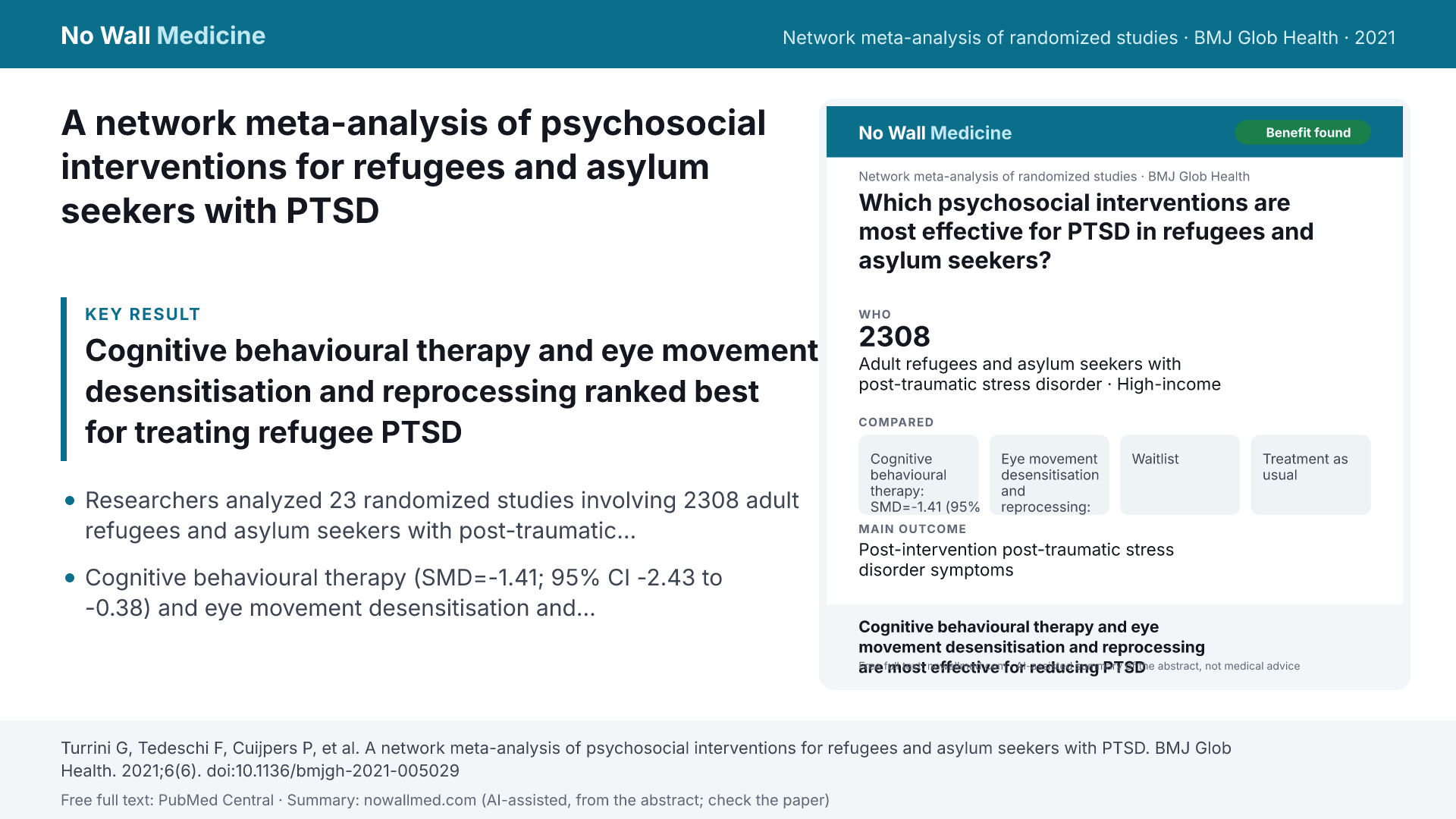
Cognitive behavioural therapy and eye movement desensitisation and reprocessing ranked best for treating refugee PTSD
A network meta-analysis of psychosocial interventions for refugees and asylum seekers with PTSD
Network meta-analysis of randomized studiesBenefit found
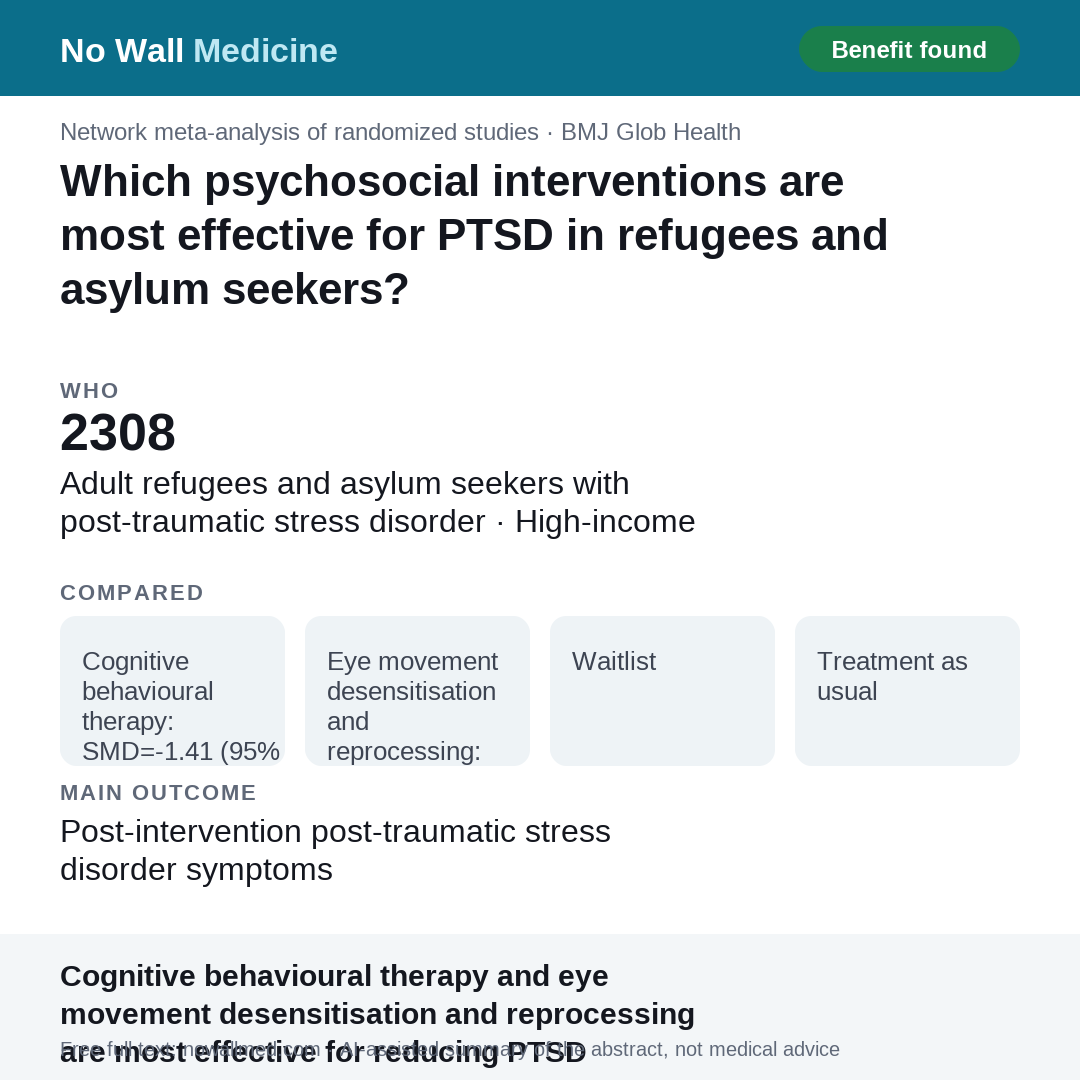
Which psychosocial interventions are most effective for PTSD in refugees and asylum seekers?
Who
2308
Adult refugees and asylum seekers with post-traumatic stress disorder · High-income and low-income or middle-income countries
Compared
Cognitive behavioural therapy: SMD=-1.41 (95% CI -2.43 to -0.38) vs waitlist
Eye movement desensitisation and reprocessing: SMD=-1.30 (95% CI -2.40 to -0.20) vs waitlist
Waitlist
Treatment as usual
Main outcome
Post-intervention post-traumatic stress disorder symptoms
Result: SMD=-1.41 (95% CI -2.43 to -0.38) for CBT vs waitlist
Bottom line: Cognitive behavioural therapy and eye movement desensitisation and reprocessing are most effective for reducing PTSD symptoms.
BMJ Glob Health · 2021-06-05Download image
Clinical question: Which psychosocial interventions are most effective for PTSD in refugees and asylum seekers?
Why it matters: It is unknown which psychosocial interventions are most effective for treating post-traumatic stress disorder in adult refugees and asylum seekers.
Key points
- Researchers analyzed 23 randomized studies involving 2308 adult refugees and asylum seekers with post-traumatic stress disorder.
- Cognitive behavioural therapy (SMD=-1.41; 95% CI -2.43 to -0.38) and eye movement desensitisation and reprocessing (SMD=-1.30; 95% CI -2.40 to -0.20) were more effective than a waitlist.
- Cognitive behavioural therapy was also associated with a higher decrease in symptoms than treatment as usual (SMD -1.51; 95% CI -2.67 to -0.36).
Headline and key points written with AI from the paper’s abstract, with every number checked against it. Read the paper before relying on them.
Was this summary helpful?
Abstract
Introduction
Refugees and asylum seekers are vulnerable to common mental disorders, including post-traumatic stress disorder (PTSD). Using a network meta-analysis (NMA) approach, the present systematic review compared and ranked psychosocial interventions for the treatment of PTSD in adult refugees and asylum seekers. Methods
Randomised studies of psychosocial interventions for adult refugees and asylum seekers with PTSD were systematically identified. PTSD symptoms at postintervention was the primary outcome. Standardised mean differences (SMDs) and ORs were pooled using pairwise and NMA. Study quality was assessed with the Cochrane Risk of Bias (RoB) tool, and certainty of evidence was assessed through the Confidence in Network Meta-Analysis application. Results
A total of 23 studies with 2308 participants were included. Sixteen studies were conducted in high-income countries, and seven in low-income or middle-income countries. Most studies were at low risk of bias according to the Cochrane RoB tool. NMA on PTSD symptoms showed that cognitive behavioural therapy (CBT) (SMD=-1.41; 95% CI -2.43 to -0.38) and eye movement desensitisation and reprocessing (EMDR) (SMD=-1.30; 95% CI -2.40 to -0.20) were significantly more effective than waitlist (WL). CBT was also associated with a higher decrease in PTSD symptoms than treatment as usual (TAU) (SMD -1.51; 95% CI -2.67 to -0.36). For all other interventions, the difference with WL and TAU was not significant. CBT and EMDR ranked best according to the mean surface under the cumulative ranking. Regarding acceptability, no intervention had less dropouts than inactive interventions. Conclusion
CBT and EMDR appeared to have the greatest effects in reducing PTSD symptoms in asylum seekers and refugees. This evidence should be considered in guidelines and implementation packages to facilitate dissemination and uptake in refugee settings.
Abstract reproduced under the article’s CC BY NC licence.
Subject terms
Cite this article
Turrini G, Tedeschi F, Cuijpers P, Del Giovane C, Kip A, Morina N. A network meta-analysis of psychosocial interventions for refugees and asylum seekers with PTSD. BMJ Glob Health. 2021. doi:10.1136/bmjgh-2021-005029
Spotted a mistake? Suggest a correction
Top studies every Monday
The week’s key trials and guidelines in your specialties, plus any topics you follow. By email, free.
Get the weekly digest