Quadruple therapy for heart failure with reduced ejection fraction was found to be most cost-effective
A NETwork meta-analysis with COST-effectiveness evaluation of pharmacological treatments for heart failure with reduced ejection fraction: NET-COST-HFrEF
Network meta-analysis of randomized controlled trialsBenefit found
What is the cost-effectiveness of pharmacological treatments for heart failure with reduced ejection fraction?
Who
75 978
Patients with heart failure with reduced ejection fraction · United Kingdom, Sweden, and United States
Compared
Increasing number of pharmacological treatments
Quadruple therapy (ARNI, BB, MRA, SGLT2i): 12.31 quality-adjusted life-years
Main outcome
All-cause mortality and total heart failure hospitalizations
Result: net monetary benefit of £338 460
Bottom line: Quadruple therapy including ARNI, beta-blocker, MRA, and SGLT2i is the most cost-effective strategy.
Eur J Heart Fail · 2026-07-16Download image
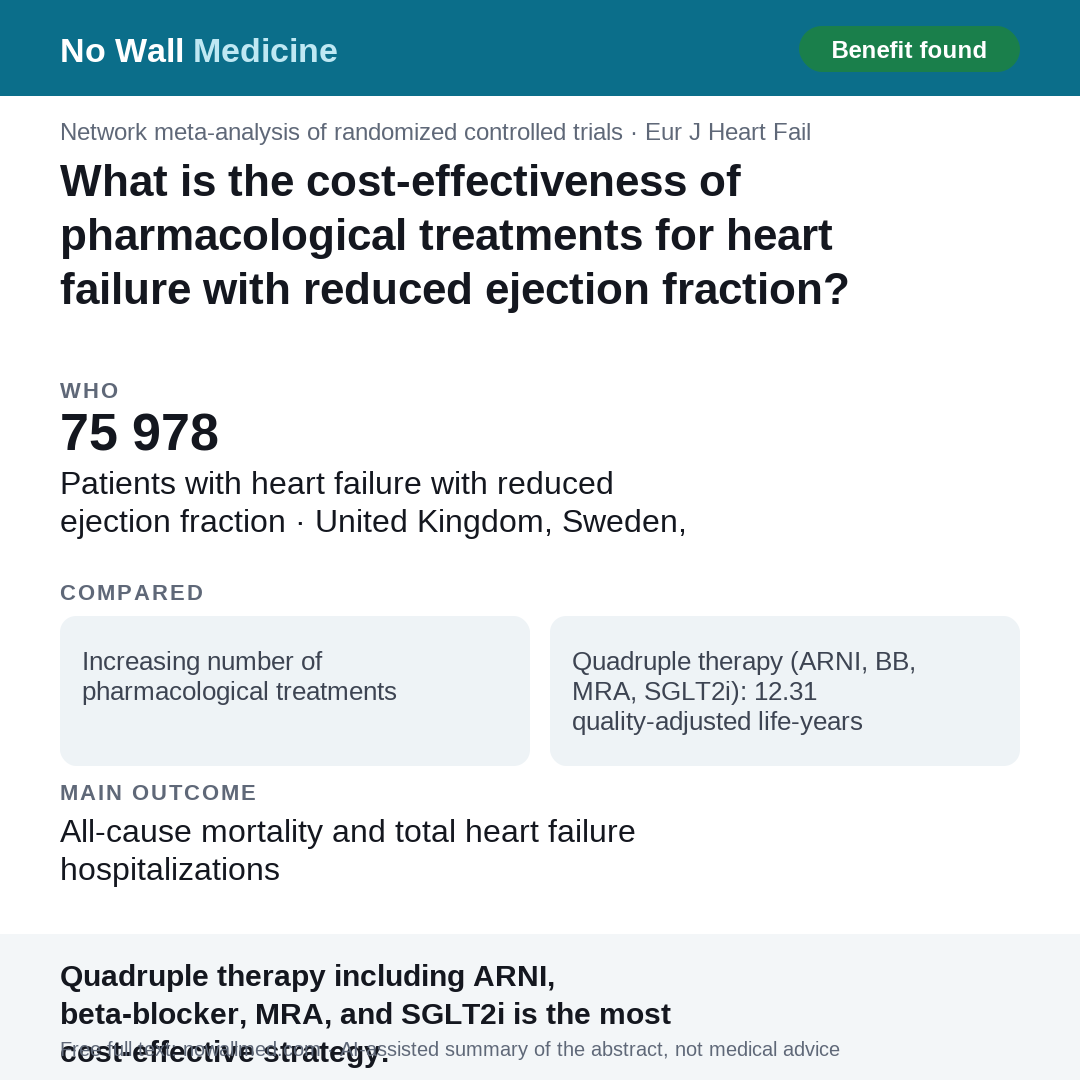
Clinical question: What is the cost-effectiveness of pharmacological treatments for heart failure with reduced ejection fraction?
Why it matters: There is a need to assess the cost-effectiveness of guideline-directed medical treatments for patients with heart failure with reduced ejection fraction.
Key points
- Researchers analyzed 47 randomized controlled trials involving 75,978 patients to compare different drug treatments for heart failure with reduced ejection fraction.
- The combination of an angiotensin receptor-neprilysin inhibitor, beta-blocker, mineralocorticoid receptor antagonist, and sodium-glucose cotransporter 2 inhibitor provided the greatest benefit.
- In the United Kingdom analysis, this quadruple therapy resulted in 12.31 quality-adjusted life-years and a net monetary benefit of £338,460.
Headline and key points written with AI from the paper’s abstract, with every number checked against it. Read the paper before relying on them.
Topics
Spotted a mistake? Suggest a correction
More in Cardiology
Clonal hematopoiesis mutations linked to higher atrial fibrillation risk in cancer populations
Association of Clonal Hematopoiesis Mutations With Incident Atrial Fibrillation: A Systematic Review and Meta-Analysis
Deep learning model detects aortic stenosis from finger-cuff pressure waveforms accurately
Aortic Valve Stenosis Screening Using Deep Learning on Noninvasive Arterial Pressure Waveforms
Spontaneous coronary artery dissection affects younger women more often than expected
Spontaneous coronary artery dissection: implications for women's health, clinical care, and future research
Early lipid-lowering strategies may reduce atherosclerotic cardiovascular disease risk
Lipid-Lowering Strategies in the Era of Early Atherosclerosis Detection: 2026 ACC Scientific Statement: A Report of the American College of Cardiology