A network model of depressive and anxiety symptoms: a statistical evaluation
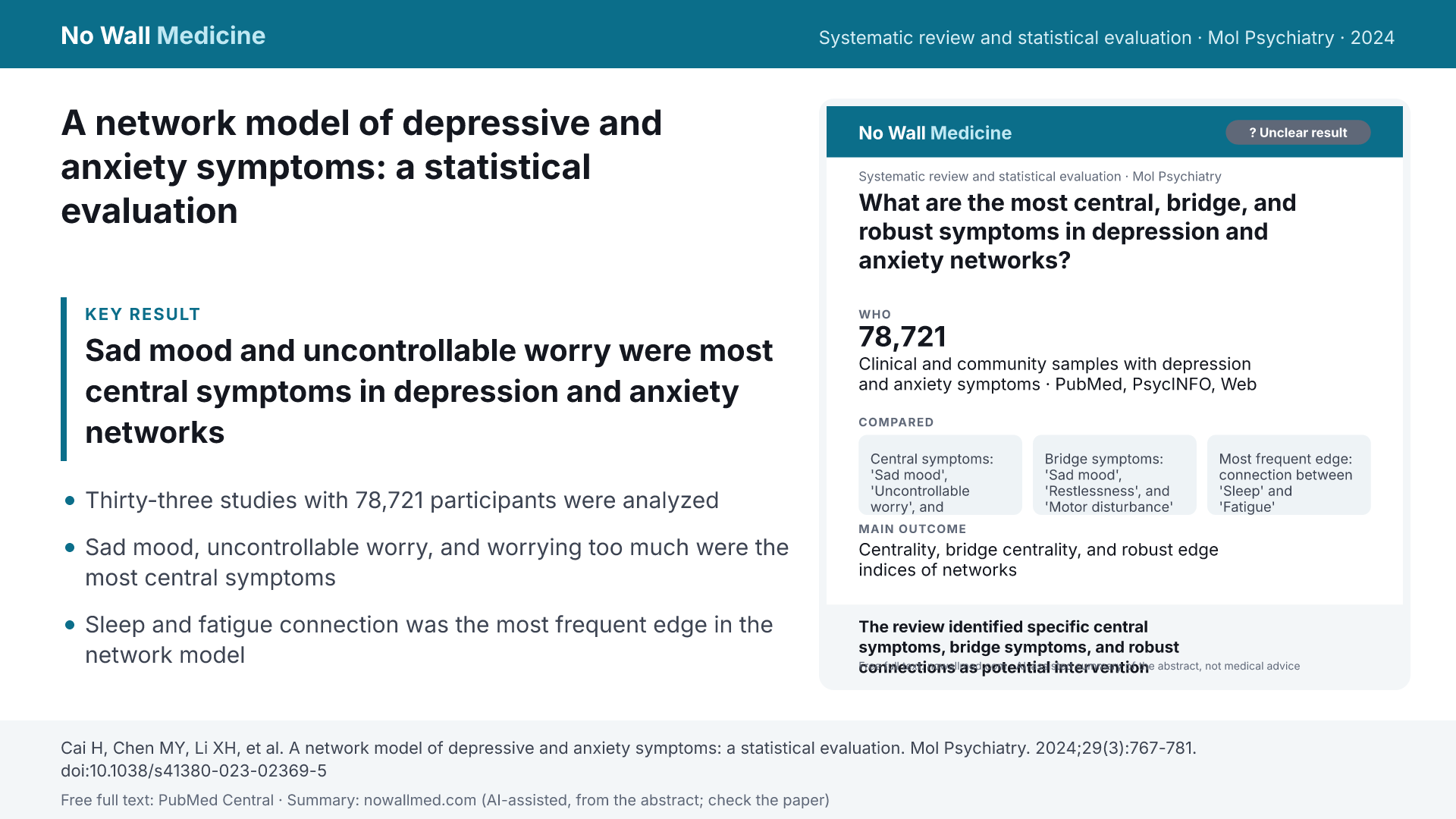
Key result: Sad mood and uncontrollable worry were most central symptoms in depression and anxiety networks
Systematic review and statistical evaluationUnclear result
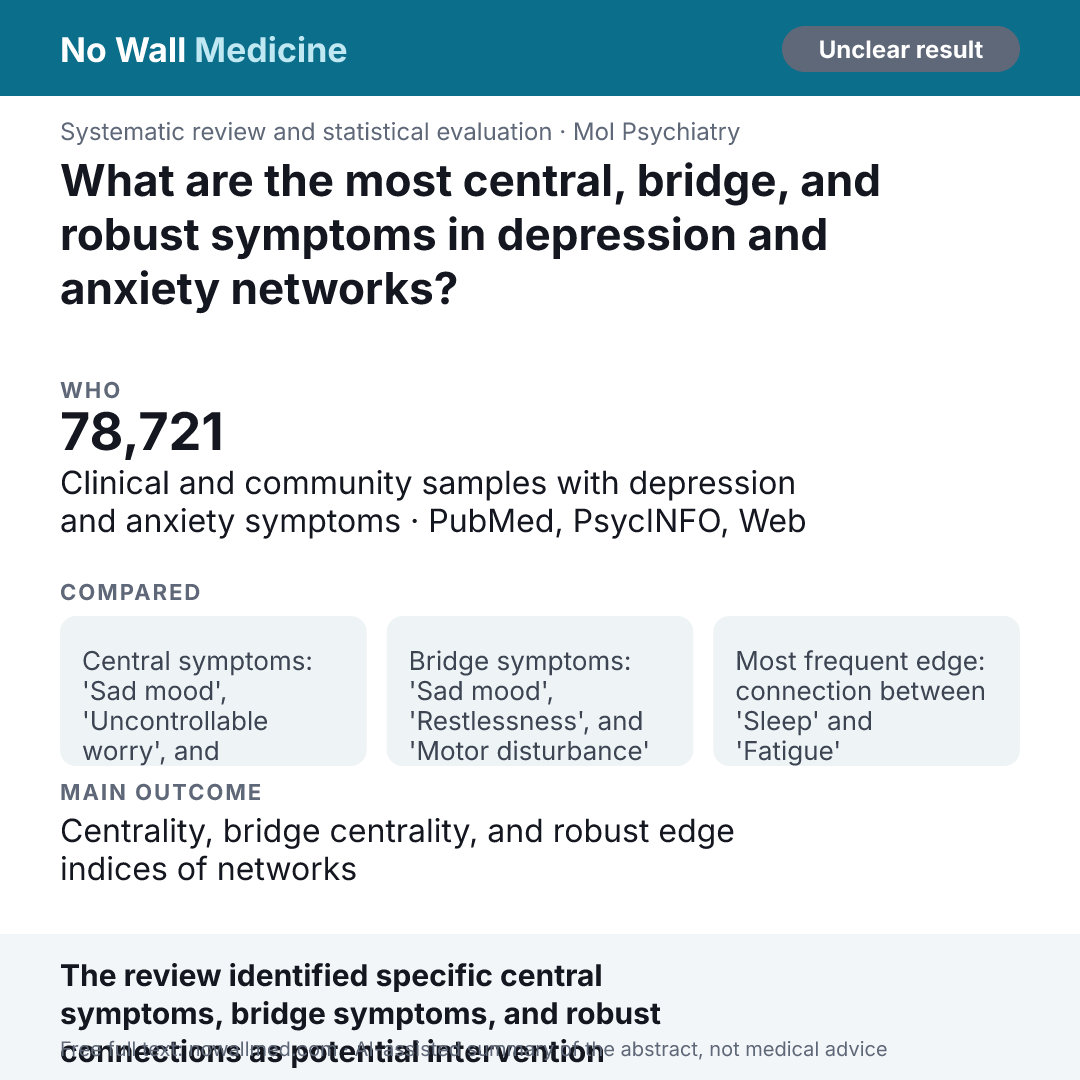
What are the most central, bridge, and robust symptoms in depression and anxiety networks?
Who
78,721
Clinical and community samples with depression and anxiety symptoms · PubMed, PsycINFO, Web of Science, and EMBASE databases
Compared
Central symptoms: 'Sad mood', 'Uncontrollable worry', and 'Worrying too much'
Bridge symptoms: 'Sad mood', 'Restlessness', and 'Motor disturbance'
Most frequent edge: connection between 'Sleep' and 'Fatigue'
Main outcome
Centrality, bridge centrality, and robust edge indices of networks
Bottom line: The review identified specific central symptoms, bridge symptoms, and robust connections as potential intervention targets.
Limitation: Substantial variability between study samples and network features was found.
Mol Psychiatry · 2024-01-18 · Save PNG
Key points
- Thirty-three studies with 78,721 participants were analyzed.
- Sad mood, uncontrollable worry, and worrying too much were the most central symptoms.
- Sleep and fatigue connection was the most frequent edge in the network model.
Limitation the authors note: Substantial variability between study samples and network features was found
Discussion prompts
- Would these patients look like yours? Who was left out?
- Is the main outcome one that matters to patients?
- Is the difference large enough to change what you do?
Cite: Cai H, Chen MY, Li XH, et al. A network model of depressive and anxiety symptoms: a statistical evaluation. Mol Psychiatry. 2024;29(3):767-781. doi:10.1038/s41380-023-02369-5
Free full text: PubMed Central · Summary and visual abstract: nowallmed.com/a/a-network-model-of-depressive-and-anxiety-symptoms-a-statistical-bealn1/ (AI-assisted from the abstract; check the paper before relying on it).