Simplified three-factor model increased medication rates for preventing blood clots after inguinal hernia surgery
A new simplified risk assessment model enhances postoperative prophylaxis of venous thromboembolism in Chinese adult patients with inguinal hernia (CHAT-3): a prospective, multicenter, randomized controlled trial
Prospective, multicenter, randomized controlled trialBenefit found
Does a three-factor model improve venous thromboembolism prophylaxis in inguinal hernia surgery?
Who
1109
Chinese adult patients with inguinal hernia · multicenter
Compared
26.2%three-factor model
6.00%routine practices
Main outcome
rate of venous thromboembolism prophylaxis
Bottom line: A simple three-factor model improves venous thromboembolism prophylaxis rates without increasing venous thromboembolism or bleeding risks.
Int J Surg · 2024-09-01Download image
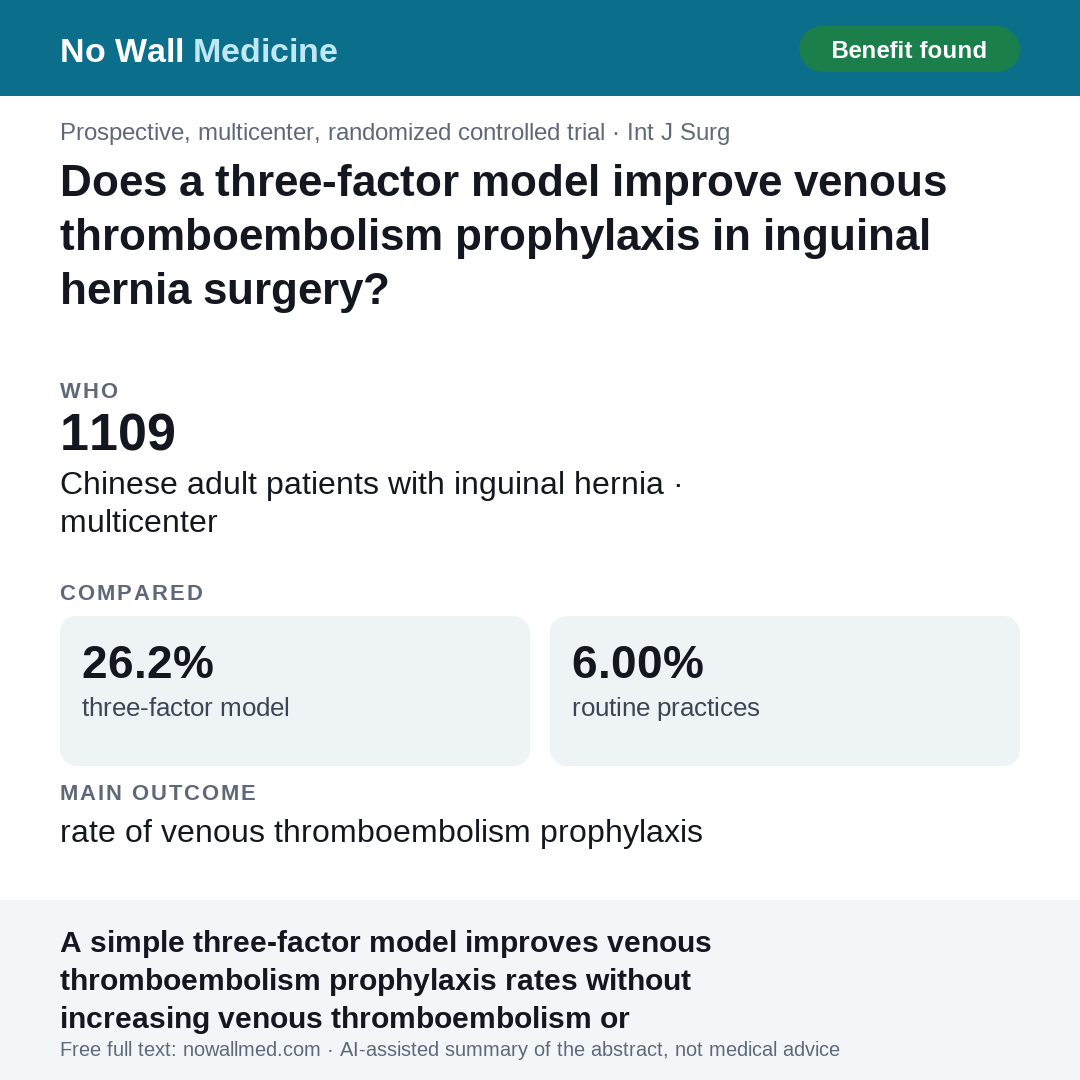
Clinical question: Does a three-factor model improve venous thromboembolism prophylaxis in inguinal hernia surgery?
Why it matters: The complex Caprini score used for assessing venous thromboembolism risk poses practical challenges for surgeons in clinical settings.
Key points
- Researchers conducted a randomized controlled trial with 1109 participants to compare a three-factor risk assessment model against routine practices.
- The three-factor model resulted in higher pharmacologic prophylaxis rates for all patients (26.2% vs. 6.00%) and high-risk patients (57.3% vs. 9.50%).
- The experimental group spent less time on risk assessment (1.39±0.55 min vs. 5.73±1.35 min) and had no increased risk of blood clots or bleeding.
Headline and key points written with AI from the paper’s abstract, with every number checked against it. Read the paper before relying on them.
Topics
Cite this article
Gu ZC, Dai MF, Hu M, Yan YD, Lin HW, Zhang L. A new simplified risk assessment model enhances postoperative prophylaxis of venous thromboembolism in Chinese adult patients with inguinal hernia (CHAT-3): a prospective, multicenter, randomized controlled trial. Int J Surg. 2024. doi:10.1097/JS9.0000000000001758
Spotted a mistake? Suggest a correction
Top studies every Monday
The week’s key trials and guidelines in your specialties, by email. Free.
Get the weekly digest