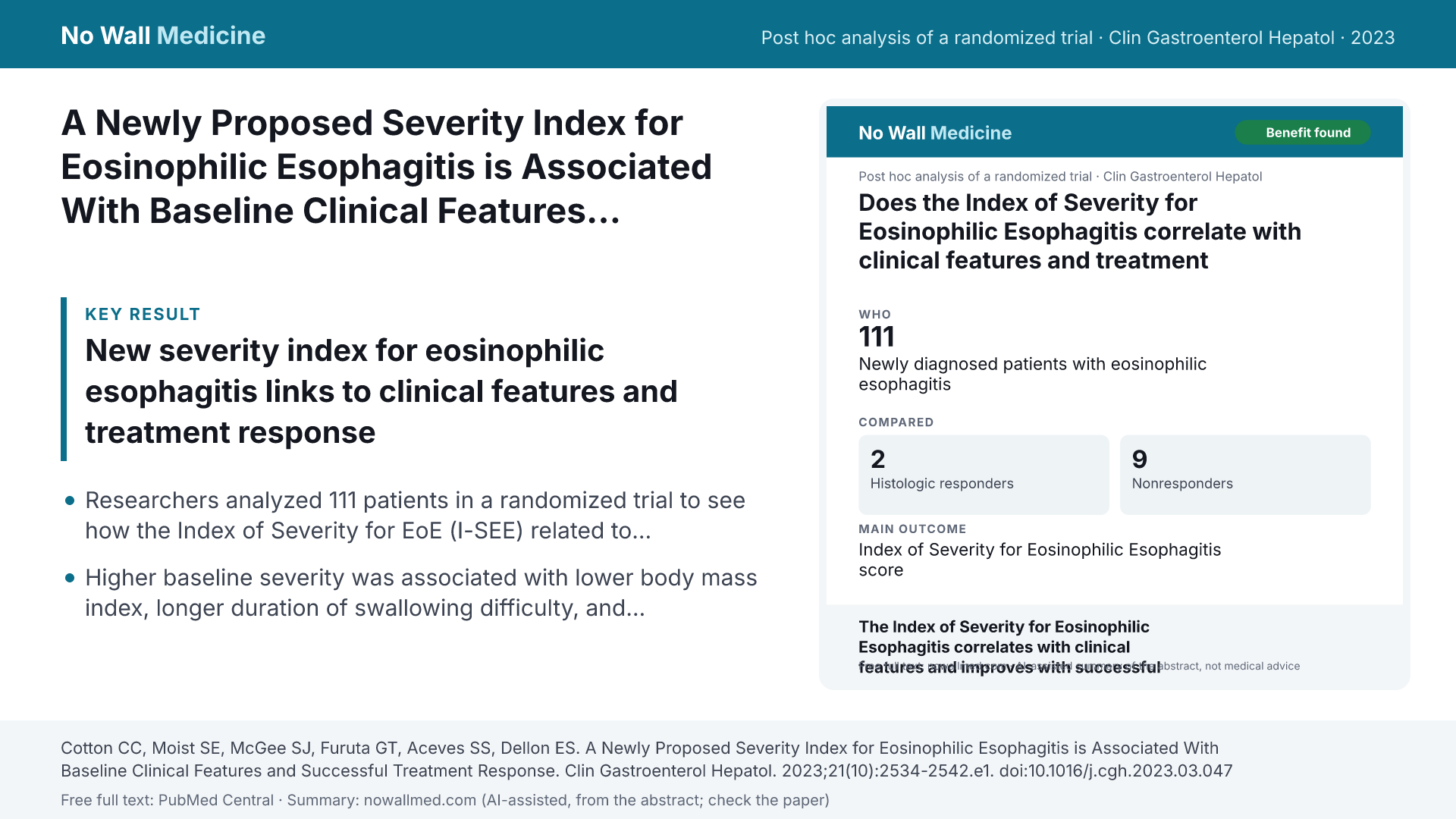
A Newly Proposed Severity Index for Eosinophilic Esophagitis is Associated With Baseline Clinical Features and Successful Treatment Response
Key result: New severity index for eosinophilic esophagitis links to clinical features and treatment response
Post hoc analysis of a randomized trialBenefit found
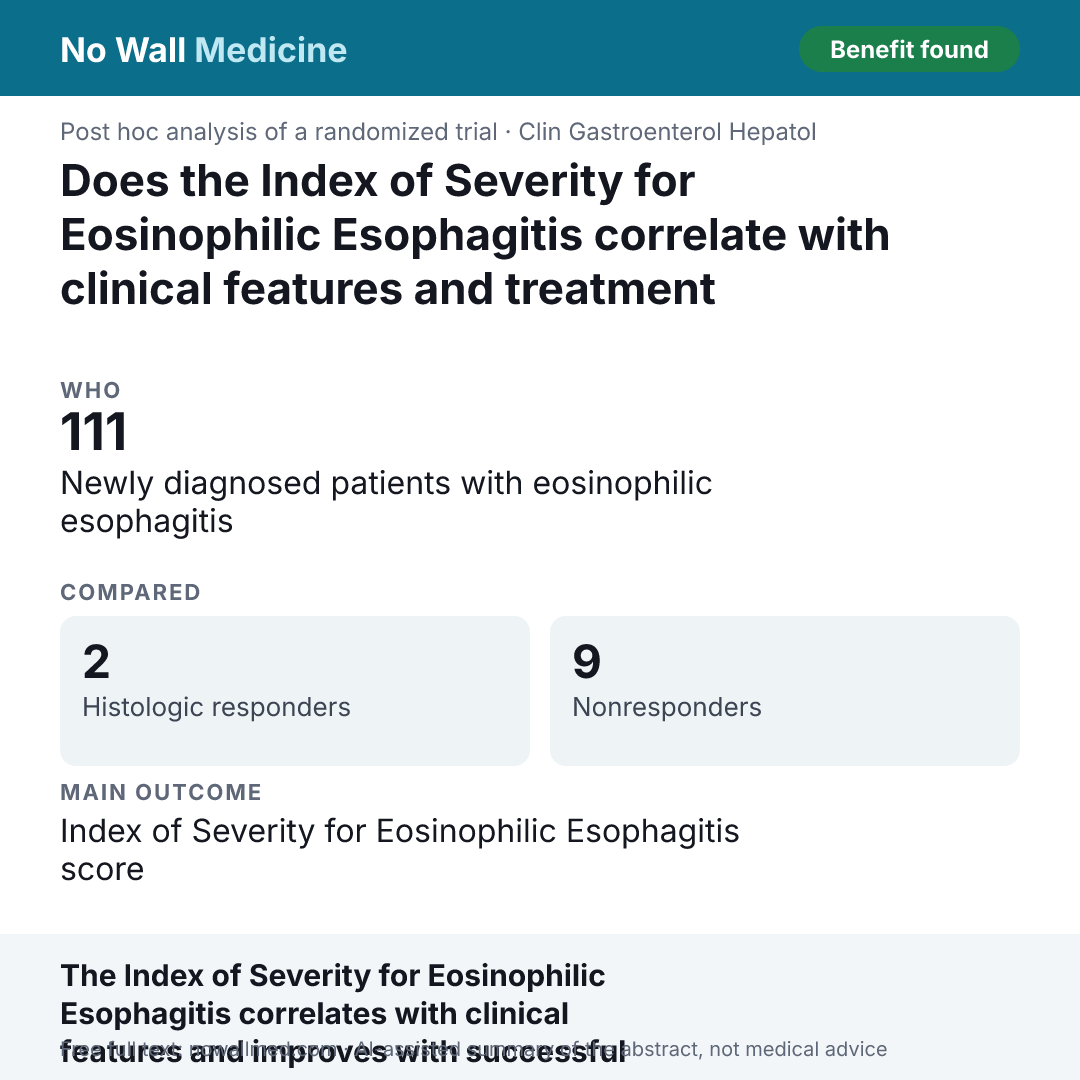
Does the Index of Severity for Eosinophilic Esophagitis correlate with clinical features and treatment response?
Who
111
Newly diagnosed patients with eosinophilic esophagitis
Compared
2Histologic responders
9Nonresponders
Main outcome
Index of Severity for Eosinophilic Esophagitis score
Bottom line: The Index of Severity for Eosinophilic Esophagitis correlates with clinical features and improves with successful topical corticosteroid treatment.
Clin Gastroenterol Hepatol · 2023-04-14 · Save PNG
Key points
- Researchers analyzed 111 patients in a randomized trial to see how the Index of Severity for EoE (I-SEE) related to clinical, endoscopic, and histologic features.
- Higher baseline severity was associated with lower body mass index, longer duration of swallowing difficulty, and smaller esophageal diameter.
- Mean severity scores decreased from 11 to 4 after treatment, and lower scores were seen in patients with a histologic response of <15 eosinophils per high-power field.
Discussion prompts
- Would these patients look like yours? Who was left out?
- Is the main outcome one that matters to patients?
- Is the difference large enough to change what you do?
Cite: Cotton CC, Moist SE, McGee SJ, Furuta GT, Aceves SS, Dellon ES. A Newly Proposed Severity Index for Eosinophilic Esophagitis is Associated With Baseline Clinical Features and Successful Treatment Response. Clin Gastroenterol Hepatol. 2023;21(10):2534-2542.e1. doi:10.1016/j.cgh.2023.03.047
Free full text: PubMed Central · Summary and visual abstract: nowallmed.com/a/a-newly-proposed-severity-index-for-eosinophilic-esophagitis-is-1sf2980/ (AI-assisted from the abstract; check the paper before relying on it).