Imagery-based retrieval-extinction training decreased smoking cravings and cigarette consumption in nicotine-dependent individuals
A novel imagery-based retrieval-extinction training for intervention in nicotine addiction
Randomized trialBenefit found
Does imagery-based retrieval-extinction training affect nicotine addiction?
Who
57
Nicotine-dependent individuals
Compared
Experimental group
Control group
Main outcome
Smoking imagery vividness, smoking craving, and daily cigarette consumption
Bottom line: Imagery-based retrieval-extinction training significantly decreased smoking craving and cigarette consumption for one month after a single session.
BMC Med · 2025-10-17Download image
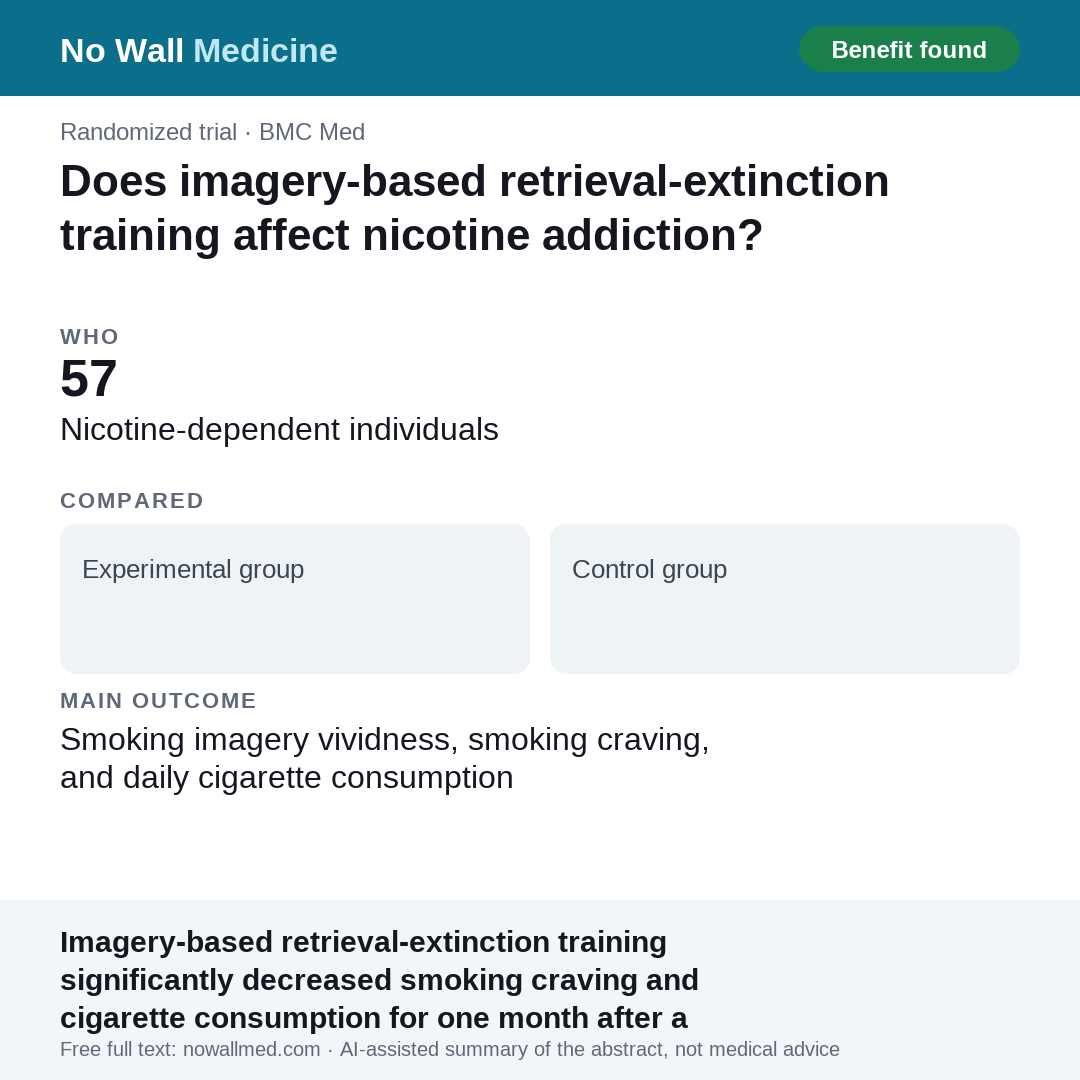
Clinical question: Does imagery-based retrieval-extinction training affect nicotine addiction?
Why it matters: Conventional methods for retrieval-extinction training lack the contextual and selective activation of memories needed for effective clinical translation in addiction treatment.
Key points
- The study randomized 57 nicotine-dependent individuals into an experimental group of 29 or a control group of 28 to test imagery-based retrieval-extinction training.
- After a single session, smoking imagery vividness, cravings, and daily cigarette consumption significantly decreased at 1-week and 1-month follow-ups.
- A significant decrease in microstate C duration, measured via electroencephalogram (brain wave monitoring), was associated with decreased smoking cravings.
Headline and key points written with AI from the paper’s abstract, with every number checked against it. Read the paper before relying on them.
Topics
Cite this article
Chen B, Gan H, Yang L, Yan X, Lv X, Zhang X. A novel imagery-based retrieval-extinction training for intervention in nicotine addiction. BMC Med. 2025. doi:10.1186/s12916-025-04386-3
Spotted a mistake? Suggest a correction