Stabilized rapamycin cream showed varying levels of improvement for facial angiofibromas in a randomized trial
A novel rapamycin cream formulation improves facial angiofibromas associated with tuberous sclerosis complex: a double-blind randomized placebo-controlled trial
Multicentre double-blind randomized placebo-controlled trialBenefit found
Does a novel stabilized rapamycin cream improve facial angiofibromas in tuberous sclerosis complex?
Who
107
Participants aged 6-65 years with mild or moderate facial angiofibromas · Multicentre
Compared
Topical rapamycin 0.5%: 56% achieved at least one-grade Investigator's Global Assessment improvement
Topical rapamycin 1%: 61% achieved at least one-grade Investigator's Global Assessment improvement
Placebo: 24% achieved at least one-grade Investigator's Global Assessment improvement
Main outcome
Percentage of participants achieving Investigator's Global Assessment scores of clear or almost clear
Result: OR 4.73, 95% CI 1.59-14.10 for 0.5% and OR 5.14, 95% CI 1.70-15.57 for 1%
Bottom line: Both 0.5% and 1% rapamycin cream formulations significantly improved facial angiofibroma severity compared to placebo.
Br J Dermatol · 2023-07-18Download image
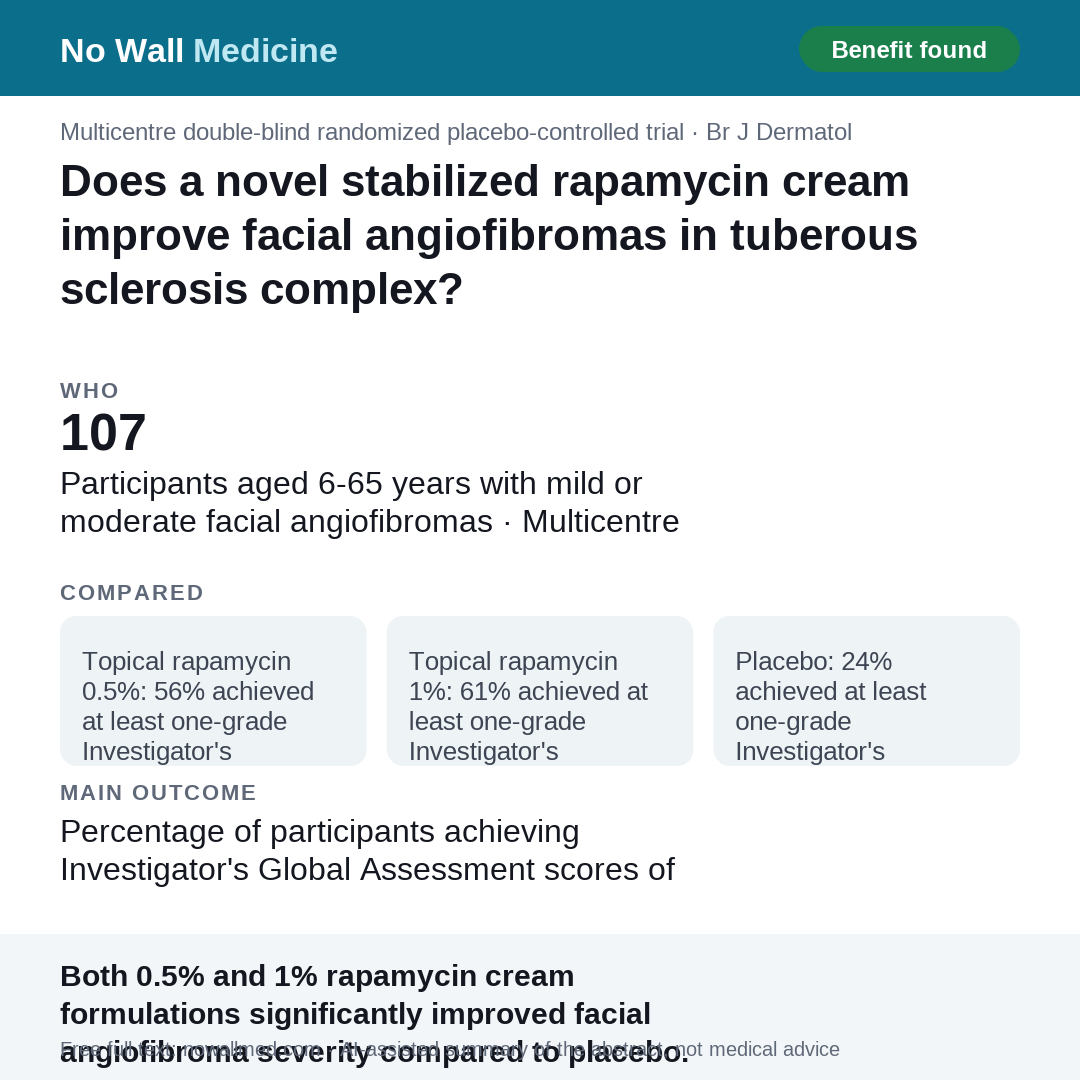
Clinical question: Does a novel stabilized rapamycin cream improve facial angiofibromas in tuberous sclerosis complex?
Why it matters: It was unknown if a new stabilized cream formulation of rapamycin is effective and safe for treating facial angiofibromas in people with tuberous sclerosis complex.
Key points
- The study included 107 participants aged 6-65 years with mild or moderate facial angiofibromas, comparing 0.5% rapamycin cream, 1% rapamycin cream, and a placebo.
- While 56% of the 0.5% group and 61% of the 1% group achieved at least a one-grade improvement on the Investigator's Global Assessment scale, the two-grade improvement results were not statistically significant.
- Skin adverse reactions were more common in patients using rapamycin cream at 64% compared to 29% for the placebo group.
Headline and key points written with AI from the paper’s abstract, with every number checked against it. Read the paper before relying on them.
Topics
Cite this article
Aitken P, Stanescu I, Boddington L, Mahon C, Fogarasi A, Liao YH. A novel rapamycin cream formulation improves facial angiofibromas associated with tuberous sclerosis complex: a double-blind randomized placebo-controlled trial. Br J Dermatol. 2023. doi:10.1093/bjd/ljad243
Spotted a mistake? Suggest a correction
Top studies every Monday
The week’s key trials and guidelines in your specialties, plus any topics you follow. By email, free.
Get the weekly digest