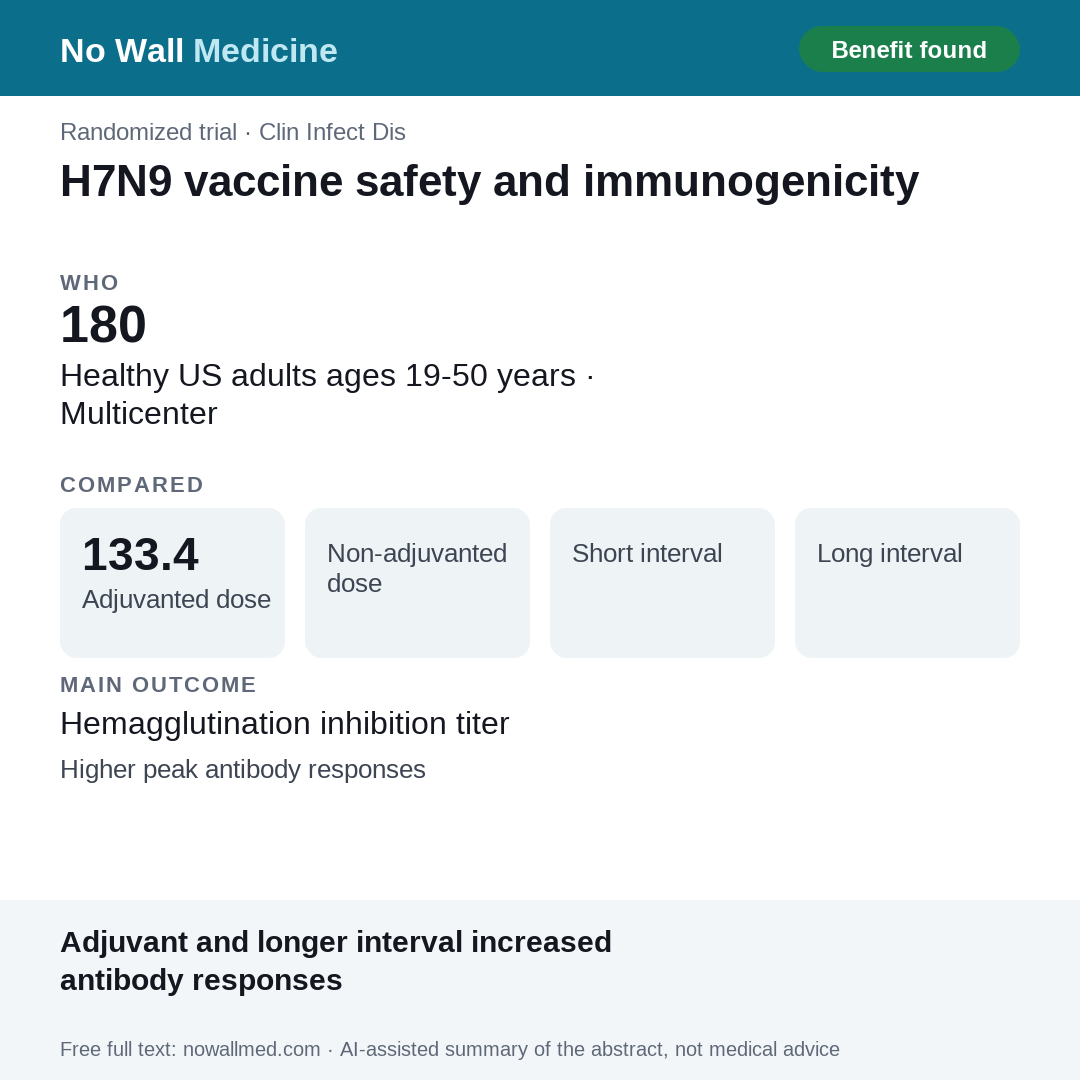
Adjuvant and longer intervals between doses increased antibody responses to H7N9 influenza vaccines
A Phase 2 Clinical Trial to Evaluate the Safety, Reactogenicity, and Immunogenicity of Different Prime-Boost Vaccination Schedules of 2013 and 2017 A(H7N9) Inactivated Influenza Virus Vaccines Administered With and Without AS03 Adjuvant in Healthy US Adults
Randomized trialBenefit found
H7N9 vaccine safety and immunogenicity
Who
180
Healthy US adults ages 19-50 years · Multicenter
Compared
133.4Adjuvanted dose (83.6-212.6)
Non-adjuvanted dose
Short interval
Long interval
Main outcome
Hemagglutination inhibition titer
Result: Higher peak antibody responses
Bottom line: Adjuvant and longer interval increased antibody responses
Clin Infect Dis · 2024-03-28Download image
Why it matters: Data were needed regarding the safety and immune response of different vaccination schedules and the use of the AS03 adjuvant for H7N9 influenza vaccines.
Key points
- Researchers studied 180 healthy adults aged 19 to 50 years to compare different vaccination schedules and dosages of inactivated influenza vaccines.
- The highest antibody response against the 2017 strain was a geometric mean titer of 133.4 (95% confidence interval 83.6-212.6) with a delayed boost interval and adjuvant.
- Injection site reactions were more common in groups receiving the AS03 adjuvant, though most symptoms were mild to moderate.
Headline and key points written with AI from the paper’s abstract, with every number checked against it. Read the paper before relying on them.
Topics
Cite this article
Rostad CA, Atmar RL, Walter EB, Frey S, Meier JL, Sherman AC. A Phase 2 Clinical Trial to Evaluate the Safety, Reactogenicity, and Immunogenicity of Different Prime-Boost Vaccination Schedules of 2013 and 2017 A(H7N9) Inactivated Influenza Virus Vaccines Administered With and Without AS03 Adjuvant in Healthy US Adults. Clin Infect Dis. 2024. doi:10.1093/cid/ciae173
Spotted a mistake? Suggest a correction
Top studies every Monday
The week’s key trials and guidelines in your specialties, plus any topics you follow. By email, free.
Get the weekly digest