Intranasal insulin and empagliflozin showed effects on cognition and biomarkers in early Alzheimer's disease
A phase 2A/B randomized trial of metabolic modulators intranasal insulin and empagliflozin for MCI and early AD
2x2 factorial double-blinded randomized trialBenefit found
Are intranasal insulin and empagliflozin safe and effective for mild cognitive impairment and early Alzheimer's disease?
Who
participants with mild cognitive impairment, early Alzheimer's disease, or amyloid positive
Compared
intranasal insulin
empagliflozin
both agents
placebo
Main outcome
treatment-related adverse events
Bottom line: Intranasal insulin and empagliflozin were safe with promising effects on cognition and biomarkers.
Alzheimers Dement · 2025-10-08Download image
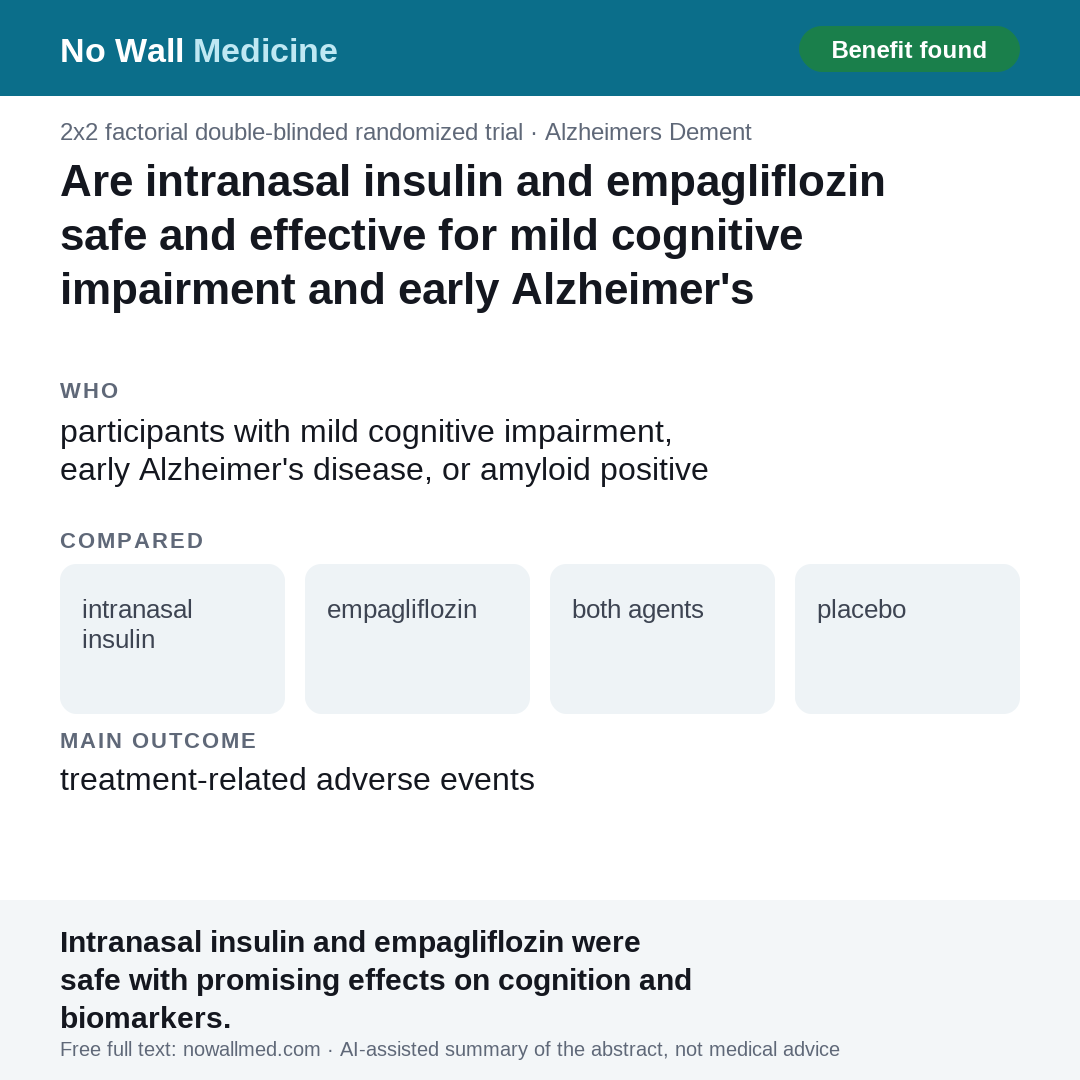
Clinical question: Are intranasal insulin and empagliflozin safe and effective for mild cognitive impairment and early Alzheimer's disease?
Key points
- Participants with mild cognitive impairment, early Alzheimer's disease, or amyloid positivity were randomized to receive intranasal insulin, empagliflozin, both, or a placebo for 4 weeks.
- Intranasal insulin increased the modified Preclinical Alzheimer's Cognitive Composite-5 score and reduced plasma glial fibrillary acidic protein, a marker of brain cell damage.
- Empagliflozin lowered cerebrospinal fluid tau, a protein associated with neurodegeneration, and both agents modulated cerebral blood flow and neurovascular markers.
Headline and key points written with AI from the paper’s abstract, with every number checked against it. Read the paper before relying on them.
Was this summary helpful?
Subject terms
Cite this article
Erichsen JM, Register TC, Sutphen C, Ma D, Gaussoin SA, Rudolph M. A phase 2A/B randomized trial of metabolic modulators intranasal insulin and empagliflozin for MCI and early AD. Alzheimers Dement. 2025. doi:10.1002/alz.70704
Spotted a mistake? Suggest a correction
Top studies every Monday
The week’s key trials and guidelines in your specialties, plus any topics you follow. By email, free.
Get the weekly digest