Monthly oral ibrexafungerp was associated with fewer recurrent vaginal yeast infections than placebo
A phase 3, multicenter, randomized, placebo-controlled trial of monthly oral ibrexafungerp to reduce the incidence of recurrent vulvovaginal candidiasis
Randomized trialBenefit found
Does ibrexafungerp reduce recurrent vulvovaginal candidiasis?
Who
130
People with recurrent vulvovaginal candidiasis
Compared
70.8%ibrexafungerp (92/130)
58.5%placebo (76/130)
Main outcome
no mycologically proven recurrence
Result: relative risk 1.22 (95% CI 1.032 to 1.430)
Bottom line: Ibrexafungerp reduces recurrent vulvovaginal candidiasis
AJOG · 2025-08-05Download image
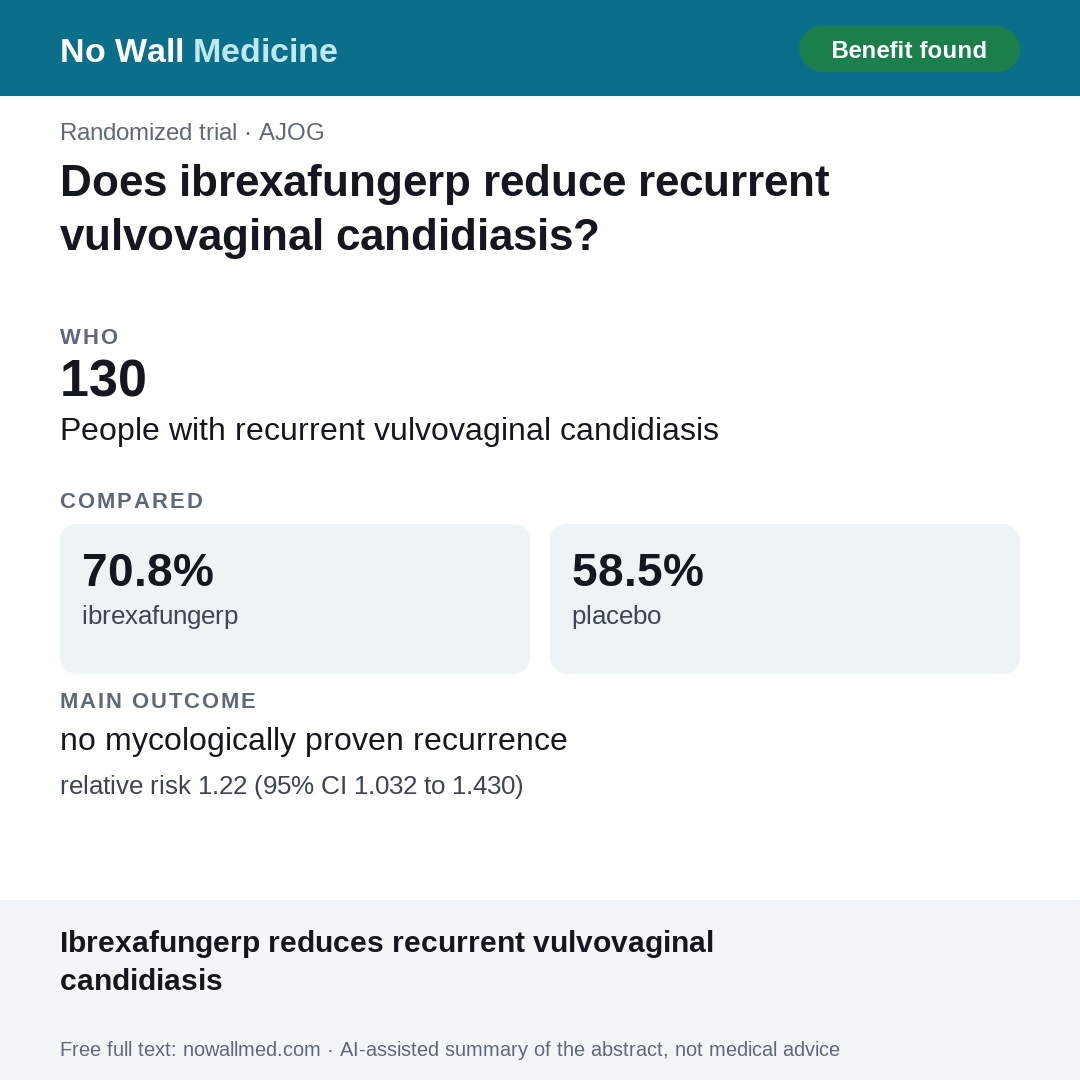
Clinical question: Does ibrexafungerp reduce recurrent vulvovaginal candidiasis?
Why it matters: Recurrent vulvovaginal candidiasis affects 5% to 9% of people assigned female at birth and significantly impacts quality of life.
In absolute numbers
ibrexafungerp: 70.8% · placebo: 58.5% → a difference of 12.3 percentage points, so about 9 people would need the treatment for 1 more to benefit (number needed to treat) over the trial’s follow-up.
Worked out by us from the two group results above, not reported by the authors. Check the paper for the exact outcome and timing.
Key points
- In this phase 3 trial, 130 participants with recurrent vulvovaginal candidiasis, a recurring yeast infection, were randomized to receive either monthly ibrexafungerp or a placebo.
- By the Test-of-Cure, 70.8% (n=92/130) of the ibrexafungerp group had no mycologically proven recurrence compared to 58.5% (n=76/130) in the placebo group.
- Clinical success was achieved by 65.4% (n=85/130) of those taking ibrexafungerp and 53.1% (n=69/130) of those taking placebo.
Headline and key points written with AI from the paper’s abstract, with every number checked against it. Read the paper before relying on them.
Topics
Cite this article
Goje O, Azie NE, Angulo DA, Sobel R, Nyirjesy P, Sobel JD. A phase 3, multicenter, randomized, placebo-controlled trial of monthly oral ibrexafungerp to reduce the incidence of recurrent vulvovaginal candidiasis. AJOG. 2025. doi:10.1016/j.ajog.2025.07.040
Spotted a mistake? Suggest a correction
Top studies every Monday
The week’s key trials and guidelines in your specialties, plus any topics you follow. By email, free.
Get the weekly digest